Plaza Mayor Madrid Travel Guide
Plan plaza mayor madrid with top picks, neighborhood context, timing tips, and practical booking advice for a smoother trip.
On this page
Plaza Mayor Madrid: Your Essential Travel Guide
Plaza Mayor sits at the heart of Hapsburg Madrid, the oldest part of the city. The rectangular square — 129 metres long and 94 metres wide — is surrounded by three-story red-brick buildings with 237 balconies facing inward, and nine arched entrances opening onto the surrounding streets. It has hosted bullfights, royal coronations, executions during the Spanish Inquisition, and today functions as a lively meeting point for locals and visitors alike.
This guide covers the square's key landmarks, the history behind them, where to eat and drink without overpaying, how to fit it into a wider Madrid day, and a Sunday morning route that most first-timers miss completely.
Plan with trusted sources: cross-check opening hours and seasonal details with the official Madrid tourism site, and read more about the city on its Wikipedia entry before you go.
Plaza Mayor: Grand Architecture and the Bocadillo de Calamares
Plaza Mayor is a 400-year-old square at the center of Madrid, famous for its grand architecture and for one specific sandwich. The bocadillo de calamares — fried calamari rings in a crusty baguette — has become the square's unofficial emblem. You'll find it at almost every bar inside the arcades and on the surrounding streets. La Campana, just outside the Arco de los Cuchilleros, is consistently cited by locals as one of the best. Expect to pay around €3–4 for a good one. Avoid the cafes directly on the square's perimeter for sit-down meals: a café con leche there costs double what you'll pay one street over.
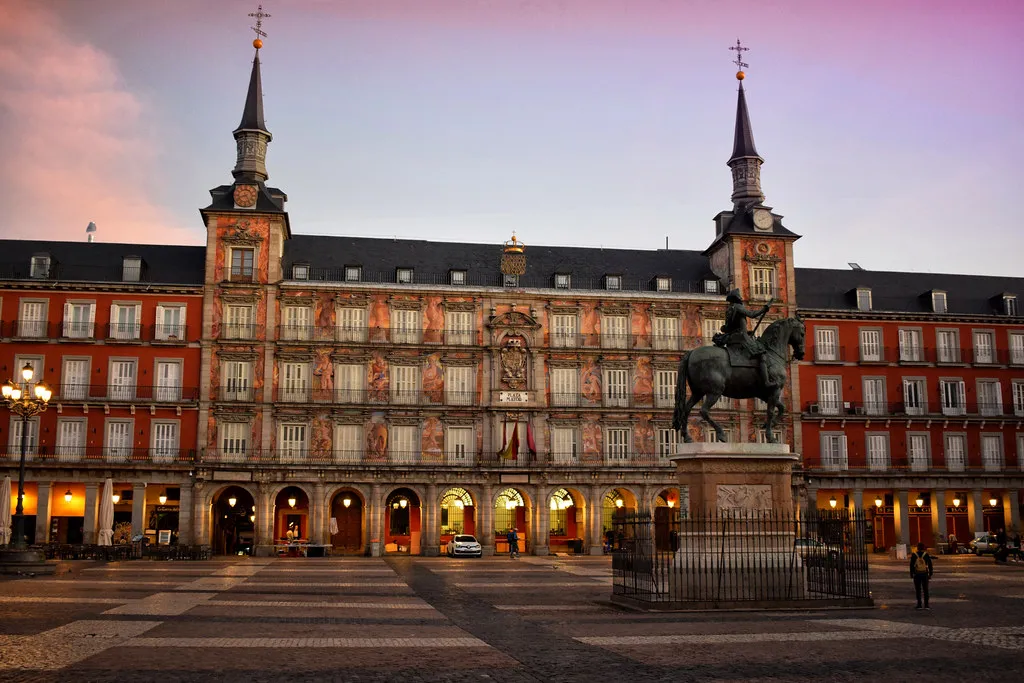
The architecture itself is the main visual draw. The buildings are uniform in height — Juan de Villanueva standardized them after the devastating 1790 fire — giving the square a closed, almost theatrical quality. The Casa de la Panadería on the northern side is the most recognizable: its twin towers and vivid frescoes, painted in 1992 by artist Carlos Franco, depict mythological figures tied to Madrid's history including the Goddess Cybele. At the center stands the bronze equestrian statue of King Philip III, cast by Flemish sculptor Giambologna and finished by Pietro Tacca in 1616. It stood at the entrance to Casa de Campo Park for more than two centuries before Queen Isabella II had it moved here in 1848.
The arcades running along the ground floor of all four sides deserve more time than most visitors give them. Small shops have operated here continuously for centuries — watch-makers, souvenir sellers, stamp dealers — and the covered walkway is one of the few places in central Madrid where you can browse without the sun or rain interfering. Check the current schedule at Madrid Destino for seasonal events held in the square, including the Easter drum parade and the December Christmas market.
History of Plaza Mayor
The square was built on the site of the Plaza del Arrabal, a busy outdoor market that served Madrid when it was still a small town outside the city walls. When Philip II moved the Spanish court from Toledo to Madrid in 1561, he began planning to reshape the city into a proper capital. He never saw the project completed. His son Philip III commissioned architect Juan Gómez de Mora to design the square, which was inaugurated in 1619.
From the beginning, Plaza Mayor served as the city's main stage for public life. Bullfights were held here until Madrid's dedicated bullring opened in 1830. The Spanish Inquisition used the square for autos-da-fé — formal religious trials that frequently ended in public executions. Coronations and royal canonizations also took place here, with the tiered balconies rented to aristocrats for premium views. Historian accounts suggest the square could hold up to 50,000 spectators during major events.
Three major fires swept through the square in its history. The worst, in 1790, burned for five days and nearly destroyed the entire structure. Juan de Villanueva — the same architect behind the Prado Museum — rebuilt it, reducing the buildings from three stories to two and designing the nine arched entrances that frame the square today. The square was renamed Plaza de la Constitución between 1812 and 1935; its original name was restored at the end of the Spanish Civil War. Today, the three-story apartments facing inward are still privately owned, making this one of the most exclusive residential addresses in Madrid.
Must-See Landmarks Inside the Square
The Casa de la Panadería on the north side is the square's anchor landmark. Originally built around 1590 to regulate bread prices for the city's poor residents, it has since served as royal chambers, the San Fernando Royal Academy of Fine Arts, and the Academy of History. Today it houses the Plaza Mayor Tourist Information Centre and the Tienda Casa de la Panadería, which sells souvenirs made by local artisans. The facade frescoes are worth examining closely — the mythological imagery was painted in 1992 and is far more recent than most visitors assume.
Directly opposite on the south side is the Casa de la Carnicería, the former butchers' guild. Its architectural design mirrors the Casa de la Panadería almost exactly. The building now houses the Hotel Pestana Plaza Mayor; even if you're not staying there, the lobby gives a good sense of how the interior of these historic buildings was adapted for modern use.
The Arco de los Cuchilleros in the southwest corner is the most dramatic of the nine entrances. Its steep staircase drops down to Calle de los Cuchilleros, named for the knife-makers who once supplied butchers working on the square. The street's buildings are taller than their neighbors because they were constructed as buttresses to support the elevated Plaza. This area, also called the Barrio de los Austrias, has some of Madrid's oldest taverns. Check our top things to do in Madrid guide for the best bars in the immediate neighborhood.
What's in the Area Around Plaza Mayor
Mercado de San Miguel sits immediately to the northwest, a two-minute walk through the Arco de San Miguel. It is Madrid's most photographed covered market, housed in a 1916 iron-and-glass structure. The stalls inside sell premium tapas, charcuterie, oysters, and wine by the glass. Prices are higher than typical Madrid tapas bars, but the quality is reliable and the setting is genuinely impressive. It opens at 10:00 and stays open until 00:00 on weekdays, until 01:00 on weekends.
The Barrio de los Austrias — Habsburg Madrid — wraps around the square on all sides. Calle Mayor leads east toward Puerta del Sol in about 10 minutes on foot. To the west, Calle de Bailén runs up to the Royal Palace and the Almudena Cathedral. The La Latina neighborhood starts at the southern edge of the square and is the best area for traditional tapas in the evening, particularly along Calle de la Cava Baja. This is also one of the most walkable parts of central Madrid — flats, hills are gentle here, and the streets are narrow enough that you won't need a map.
If you have more time, the Plaza de la Villa is a five-minute walk north. It is smaller and much quieter than Plaza Mayor, surrounded by 15th- and 16th-century buildings including the Casa de Cisneros and the Torre de los Lujanes, the oldest secular building in Madrid. Most visitors skip it entirely, which makes it worth stopping at. Check the Madrid's hidden gems guide for other under-visited spots in the same neighborhood.
The Sunday Morning Rastro-to-Plaza-Mayor Route
One practical angle that most general Plaza Mayor guides skip: the square works particularly well as the end point of a Sunday morning in Madrid, not just a standalone stop. El Rastro, Madrid's famous open-air flea market, takes place every Sunday from 09:00 to 15:00 along Calle de la Ribera de Curtidores in the Lavapiés neighborhood, about a 15-minute walk south of Plaza Mayor. The market draws hundreds of stalls selling antiques, vintage clothing, tools, art, and general bric-a-brac.
The route back north from El Rastro passes through the heart of La Latina — up Calle de la Cava Baja, which by 11:00 on a Sunday has several traditional bars already open and serving vermut (vermouth with olives or pickles), a classic Madrid Sunday ritual. This stretch of La Latina is busiest between 12:00 and 14:00, when locals from the Rastro crowd the outdoor terraces. The walk ends at Plaza Mayor via the Arco de los Cuchilleros.
Arriving at Plaza Mayor around 13:00 on a Sunday puts you there as the market crowd winds down and before the main tourist rush of the afternoon. The light at this time from the south side of the square is also the best for photos of the Casa de la Panadería facade. If you're staying for a bocadillo de calamares, the bars on Calle de los Cuchilleros will be serving without the long weekend queues you'd encounter in the square's arcades.
Family-Friendly and Budget-Friendly Options
Entering Plaza Mayor is free. The square itself is open around the clock, and the arcaded walkways provide shade in summer and shelter in light rain. For families, the open paving gives children room to move while adults sit at the perimeter. Street performers and artists are usually present during the day, most active in the afternoon. The Christmas market in December adds stalls selling ornaments and figurines — it typically runs from late November through 5 January and is one of the few major Madrid Christmas events held outdoors.
Budget travelers should note that the square's perimeter cafes charge significantly more than the streets immediately outside. A coffee on the terrace inside the arcades can cost €4–5; the same coffee on Calle Mayor or Calle de la Sal costs €1.50–2. The bocadillo de calamares is the one exception: it is genuinely cheap everywhere you find it and is as much a local staple as a tourist trap. For a full cheap lunch, head to La Latina, where several restaurants offer a menú del día (two courses, bread, and a drink) for €11–14 at lunch.
| Item | On the Square | One Street Away |
|---|---|---|
| Café con leche | €4–5 | €1.50–2 |
| Bocadillo de calamares | €3–4 | €3–4 |
| Menú del día (lunch) | €18–22 | €11–14 (La Latina) |
| Entry to the square | Free | — |
| Metro single fare | €1.50–2.00 (€1.15 with 10-trip card) | |
| Prado Museum | €22 standard; free Tue–Sat 18:00–20:00 (EU citizens) | |
| Madrid City Pass (1 day) | €75–85 (Royal Palace + 3 museums + metro) | |
Free walking tours start from Plaza Mayor daily, most at 10:00 and 16:00. These tip-based tours are a reliable way to get the historical context for the Barrio de los Austrias in 90 minutes. Look for the guides in colored shirts in the center of the square near the Philip III statue. It is one of the best free things to do. For families with younger children, see visiting Madrid with kids for nearby options that work for all ages.
How to Plan Your Plaza Mayor Day
The square is liveliest between 11:00 and 20:00. Before 09:00 it is nearly empty — good for unobstructed photos, though many cafes are not yet open. Midday in summer (13:00–16:00) is when heat and foot traffic peak simultaneously; bring water and arrive with a plan rather than wandering. Evenings from 19:00 onward have a relaxed atmosphere as locals come for a drink and the tourist density drops slightly.
A focused visit to Plaza Mayor — walking all four sides under the arcades, photographing the Casa de la Panadería, and grabbing a bocadillo — takes 30–45 minutes. If you pair it with Mercado de San Miguel and a walk down to La Latina for tapas, budget 2.5–3 hours. Adding the Royal Palace and Almudena Cathedral (about 1.2 km west on foot) turns it into a half-day in the Habsburg Madrid quarter. See the Madrid 1-day itinerary for a full sequence that covers all these stops without backtracking.
Wear flat shoes — the cobblestones inside the square and on the streets descending from it are uneven. The Arco de los Cuchilleros stairs in particular are steep and have no handrail on one side. The square is wheelchair-accessible from at least four of the nine arches, but the interior paving has a slight gradient toward the center.
Book tickets for the Prado Museum or the Royal Palace in advance if you're visiting on a weekend or a public holiday. Both sell out same-day in peak season (April–October). The Prado offers free entry Tuesday–Saturday from 18:00–20:00 and Sunday from 17:00–19:00 for EU citizens; non-EU visitors pay the standard €22 admission. See our guide to practical travel tips for more on when to pre-book.
Skip the Line at Madrid's Famous Museums
The Prado, Thyssen-Bornemisza, and Reina Sofía — the so-called Golden Triangle of Art — are all within a 20-minute walk of Plaza Mayor. All three have significant queues on weekends and during the Easter and summer high seasons. Buying timed-entry tickets online at least 48 hours in advance is the most reliable way to avoid the queues. The Prado's official website (museodelprado.es) releases time slots 30 days out; they do sell out for peak weekend mornings.
Consider the Madrid City Pass if you're visiting more than three paid attractions in a day. The pass typically includes fast-track entry to the Royal Palace, the Prado, the Thyssen, and the Reina Sofía, plus unlimited metro and bus travel. At around €75–85 for a one-day version in 2026, it pays for itself if you're planning a concentrated museum day rather than spreading visits across several days.
Early arrival — being at the museum door at opening time (usually 10:00) — works well for the Thyssen, which is less crowded than the Prado in the first hour. The Reina Sofía can be entered free for EU citizens on Mondays (closed Tuesdays), and on certain evenings. Always check the museum's official website for current free-entry windows before your visit.
Getting Around Madrid
Plaza Mayor is served by three metro stations within walking distance: Sol (Lines 1, 2, 3) is the closest, about 500 metres east via Calle Mayor. La Latina (Line 5) is 600 metres south and useful if you're arriving from or heading to the Lavapiés or Carabanchel areas. Opera (Lines 2, 5, R) is 700 metres northwest and drops you near the Royal Palace. A standard metro journey costs €1.50–2.00 per trip in 2026; a 10-trip card (metrobús) brings it down to €1.15 per journey. Check our getting around the city guide for full metro and bus options.
The city center around Plaza Mayor is best covered on foot. Key clusters of attractions — the Royal Palace, Puerta del Sol, La Latina, and the Golden Triangle of Art — are all within 20–25 minutes of each other by walking. The terrain is mostly flat between the square and Puerta del Sol or La Latina; the Royal Palace direction involves a mild uphill on Calle Mayor toward Calle de Bailén.
Taxis are metered and reliable. A ride from Madrid Barajas Airport to the city center costs a flat €32 (all zones) under the fixed-rate agreement. For shorter trips within the center, the minimum taxi fare is around €4. Ride-hailing apps (Cabify, FreeNow) are widely available and often slightly cheaper than street taxis. For arrival logistics from the airport, see getting from the airport.
Discover Everything Madrid Has to Offer
Plaza Mayor is the best starting point in Madrid because it puts you within walking distance of the city's three most distinct quarters. Head northeast for the Habsburg district and Puerta del Sol. Walk west for the Royal Palace and the Almudena Cathedral. Go south into La Latina for the city's most intact traditional tapas culture. Each direction gives a meaningfully different experience within 15 minutes on foot.
For neighborhoods beyond the historic center: Salamanca (northeast of the Retiro) is Madrid's upscale shopping district. Malasaña and Chueca (north of Gran Vía) have independent restaurants, vintage shops, and a younger crowd. Lavapiés (southeast) is the most multicultural neighborhood in the city — good for affordable food from Morocco, India, and sub-Saharan Africa. A flamenco show in the Barrio de los Austrias, close to Plaza Mayor, provides an evening option that doesn't require crossing the city. Check our a guide to Madrid's neighborhoods for a fuller breakdown.
For sports, Santiago Bernabéu stadium (Real Madrid) hosts matches from August through May. The temple of Debod — a genuine 2nd-century BC Egyptian temple gifted to Spain in 1968 — is a 20-minute walk northwest of Plaza Mayor and is free to visit, with better sunset views than anywhere else in central Madrid. Find more ideas in our guide to the the best places to eat and beyond. Madrid.es publishes the official events calendar in English.
Frequently Asked Questions
Which Plaza Mayor Madrid options fit first-time visitors?
First-time visitors to Plaza Mayor should prioritize admiring the architecture and soaking in the atmosphere. Enjoy a coffee or a bocadillo de calamares at one of the square's many cafes. Take photos of the King Philip III statue and Casa de la Panadería. Consider a short, free walking tour starting from the square to learn about its history.
How much time should you plan for Plaza Mayor Madrid?
Plan at least 30 minutes to an hour to fully experience Plaza Mayor Madrid. This allows time for a leisurely stroll, photos, and perhaps a quick snack. If you plan to dine at a restaurant or explore nearby shops, allocate more time. The square serves as a great starting point for wider exploration.
What should travelers avoid when planning Plaza Mayor Madrid?
Travelers should avoid visiting Plaza Mayor during peak midday hours if they prefer fewer crowds. Also, be aware that prices at cafes directly on the square can be higher than those on surrounding streets. Avoid relying solely on cash; many establishments accept cards. Always be mindful of your belongings in crowded areas.
Is Plaza Mayor Madrid worth including on a short itinerary?
Yes, Plaza Mayor Madrid is definitely worth including on a short itinerary, even if you only have a day or two. It is centrally located and easily accessible from other major attractions. Its historical significance and vibrant atmosphere make it an essential Madrid experience. It offers a quick yet impactful cultural immersion. You can fit it into a Madrid 3-day itinerary easily.
Which Must-See Plaza Mayor Attractions options fit first-time visitors?
First-time visitors to Plaza Mayor should focus on the central King Philip III statue and the ornate Casa de la Panadería. These iconic landmarks provide excellent photo opportunities and historical context. Take time to walk under the arcades surrounding the square. This offers a full appreciation of its unique architecture.
Plaza Mayor Madrid is a square that repays attention. The architecture, the history, the street food, and the network of old streets branching out from its nine arches are all richer than a quick stop suggests. Come early for photos, return in the evening for drinks in La Latina, and save Sunday morning for the Rastro-to-Plaza-Mayor walk that ties together three of Madrid's oldest neighborhoods in one route.
Use the practical details in this guide — entry costs, metro stops, best timing, museum booking tips — to plan around the crowds rather than just accepting them. Plaza Mayor is worth seeing, and it's worth seeing well.
You might also like

Continue reading
More guides you'll find useful