Madrid 3 Day Itinerary: A Local's Guide to the Perfect Trip
Plan your Madrid 3 day itinerary with expert local tips, day-by-day activities, neighborhood guides, and practical advice for first-timers.
On this page
Madrid 3 Day Itinerary: Your Local's Guide to an Unforgettable Trip
Three days in Madrid is the sweet spot for a first visit. It's enough time to hit the royal landmarks, lose yourself in world-class art museums, eat your way through authentic tapas bars, and wander the distinct neighborhoods that give this city its character. It's not enough to do everything — but with the right structure, you leave feeling like you actually know the city rather than having rushed past it.
This itinerary is built around how Madrid actually flows. Day 1 anchors you in the historic core. Day 2 takes you through Lavapiés and the art triangle. Day 3 is for neighborhoods. I've written it for 2026 travel, with current prices, booking advice, and a few details that most guides skip entirely.
Plan with trusted sources: cross-check opening hours and seasonal details with the official Madrid tourism site, and read more about the city on its Wikipedia entry before you go.
Madrid Planning Cheatsheet
Before you dive into the day-by-day plan, here are the practical facts that shape every decision you'll make in Madrid.
- Currency: Euro (EUR). Most places accept cards, but carry €20–30 cash for markets and older tapas bars.
- Language: Spanish. In tourist areas, English is widely spoken. A few words of Spanish go a long way.
- Tipping: Not mandatory but appreciated. Round up at bars; 5–10% at sit-down restaurants is generous.
- Meal times: Lunch runs 14:00–16:00, dinner from 21:00. Eating at 19:00 marks you immediately as a tourist — and many kitchens aren't even open yet.
- Free museum hours: Prado Museum is free Mon–Sat 18:00–20:00, Sundays 17:00–19:00. Reina Sofía is free Mon and Wed–Sat 19:00–21:00, Sundays 13:30–19:00. If your schedule is flexible, these slots save €15–20 per museum.
- Booking priority: Royal Palace and flamenco shows — book 1–2 weeks ahead. Prado and Reina Sofía — 3–5 days ahead, especially in summer. Temple of Debod requires a free timed-entry reservation online.
- Transport: The metro is fast and cheap (€1.50–2.00 per journey). A 10-trip Metrobus card (€12.20) is worth it if you plan to use public transport daily.
When to Visit Madrid
Spring (late March to May) and autumn (September to October) are the best windows for a 3-day trip. Temperatures sit between 15–25°C, the light is excellent for photography, and outdoor dining is comfortable well into the evening. Crowds exist but are manageable compared to the peak summer surge.

Summer (June–August) is hot — routinely above 35°C in July and August. Many Madrileños leave in August, so some smaller restaurants and local shops close. That said, the museums are air-conditioned, the evenings are electric, and prices on flights sometimes drop in late August. If you visit in summer, front-load your outdoor sightseeing before 12:00 and save the afternoon for museums.
Winter (November–February) brings thin crowds and significantly lower hotel rates. Temperatures hover around 5–12°C — cold but rarely miserable. Christmas in Madrid is genuinely special: Plaza Mayor hosts a traditional market, and the city is lit beautifully from late November through early January. The Prado and Reina Sofía are at their most relaxed in January and February.
Semana Santa (Holy Week, the week before Easter) is worth planning around — either to be there for the processions or to avoid the surge. Major museums and the Royal Palace tend to be packed; hotels book up months in advance. If you're visiting then, book everything the moment dates are confirmed.
Where to Stay in Madrid for 3 Days
For a 3-day itinerary built around the city center, three neighborhoods stand out. The best area to stay in Madrid depends on what you want from your base.

La Latina is the best all-around choice for first-timers who want an authentic Madrid feel. The streets are narrow and medieval, the tapas bars are genuinely excellent, and the location puts you within a 15-minute walk of the Royal Palace, Plaza Mayor, and Puerta del Sol. It's less touristy than Sol, yet still completely central. Hotel Gavinet (from around €125/night) and the One Shot La Latina boutique hotel (€150–200/night) are both solid picks here.
Barrio de Las Letras (the Literary Quarter) sits one block from the Prado and Reina Sofía. It has a more stately, Old World atmosphere — cobbled lanes, literary café culture, and some of the best mid-range hotels in the city. Catalonia Las Cortes (€175–225/night) is a beautifully restored 18th-century building with modern rooms; Gran Hotel Inglés is the boutique luxury option and consistently rates among the top hotels in Madrid on TripAdvisor.
Sol / Gran Vía is the most convenient for pure sightseeing access — everything is walkable. The trade-off is noise, crowds, and higher prices. NH Collection Madrid Gran Vía (from €250–350/night) is the standout here. Budget travelers should look at SLEEP'N Atocha, near the art museums, or Petit Palace Arenal on a pedestrian street steps from Puerta del Sol.
How to Get Around Madrid
Madrid is compact enough that you'll walk most of this itinerary. The historic center — from the Royal Palace to the Prado to Puerta del Sol — fits within a roughly 2km radius. On most days you won't need anything beyond your feet and the occasional metro line.
The metro is fast, clean, and runs until 01:30 (02:30 on weekends). A single journey costs €1.50–2.00 depending on the number of zones. Line 1 (blue) runs through the center and connects most of the key tourist areas. Line 2 (red) gets you between Sol and Retiro quickly. Buy a 10-trip Metrobus card (€12.20) at any metro machine — it works on both metro and bus, and the per-journey rate drops compared to single tickets.
From Adolfo Suárez Madrid–Barajas Airport, the metro (Line 8) takes about 30–40 minutes to reach Sol or Nuevos Ministerios, costing around €5 including the airport supplement. A taxi costs roughly €30–35 flat-rate to the city center. Uber is available but often not significantly cheaper than taxi once surge pricing applies.
If you plan to do a day trip to Toledo or Segovia, both are served by high-speed RENFE trains from Atocha (Toledo) and Chamartín/Atocha (Segovia Guiomar). Tickets run €10–15 each way and should be booked in advance at renfe.com. The journey is 25–35 minutes.
Madrid 3 Day Itinerary Overview
Here is the structure at a glance before diving into the details. Each day is built around a distinct zone and mood — historic core, art district, and neighborhood wandering — so the trip builds on itself rather than backtracking.
- Day 1: The City Center and Main Sights. Puerta del Sol, Plaza Mayor, Mercado de San Miguel, Royal Palace, Almudena Cathedral, evening in Barrio de Las Letras.
- Day 2: Lavapiés, Reina Sofía, Retiro Park. Morning in multicultural Lavapiés, Reina Sofía Museum for Guernica and the modern art collection, Retiro Park and Crystal Palace in the afternoon, live jazz or tapas in Barrio de Las Letras in the evening.
- Day 3: Neighborhood Hopping. La Latina for Sunday El Rastro market (or morning tapas), Gran Vía and Malasaña for independent shops and churros, Arguelles for dinner and the Temple of Debod at sunset.
| Day | Zone | Morning | Afternoon | Evening |
|---|---|---|---|---|
| Day 1 | Historic Core | Puerta del Sol, La Mallorquina, Plaza Mayor, Mercado de San Miguel | Royal Palace (1.5–2 hrs), Almudena Cathedral | Barrio de Las Letras — Calle Huertas tapas, Cervecería Alemana |
| Day 2 | Art District | Lavapiés wander, Pum Pum Cafe breakfast | Reina Sofía (Guernica), Cuesta de Moyano, Retiro Park & Crystal Palace | Café Central jazz, Taberna La Daniela or Estado Puro |
| Day 3 | Neighborhoods | La Latina — El Rastro market (Sun) or Plaza de la Paja wander | Gran Vía, Malasaña, Chocolatería San Ginés churros | Arguelles — Temple of Debod at sunset, neighborhood dinner |
Day 1: Madrid's City Center and Main Sights
Start at Puerta del Sol, the absolute center of Madrid and the Kilometer Zero marker of Spain's entire road network. The square is ringed with 19th-century buildings, and the famous bear-and-strawberry-tree statue on the eastern end makes for an obligatory first photo. Before leaving, stop at La Mallorquina — a pastry shop operating since the 1800s, right on the square. Their chocolate napolitana is the best way to start your first Madrid morning.
From Sol, walk five minutes down Calle Mayor to Plaza Mayor. The 17th-century arcaded square is one of the most photographed places in Spain for good reason. It's touristy, yes, but the architecture is genuinely spectacular. Grab a bocadillo de calamares (fried squid sandwich — Madrid's unofficial civic food) at a bar on the square, or walk two minutes to Mercado de San Miguel, a covered market with fresh seafood, pintxos, jamón, and excellent vermouth. This works as brunch.
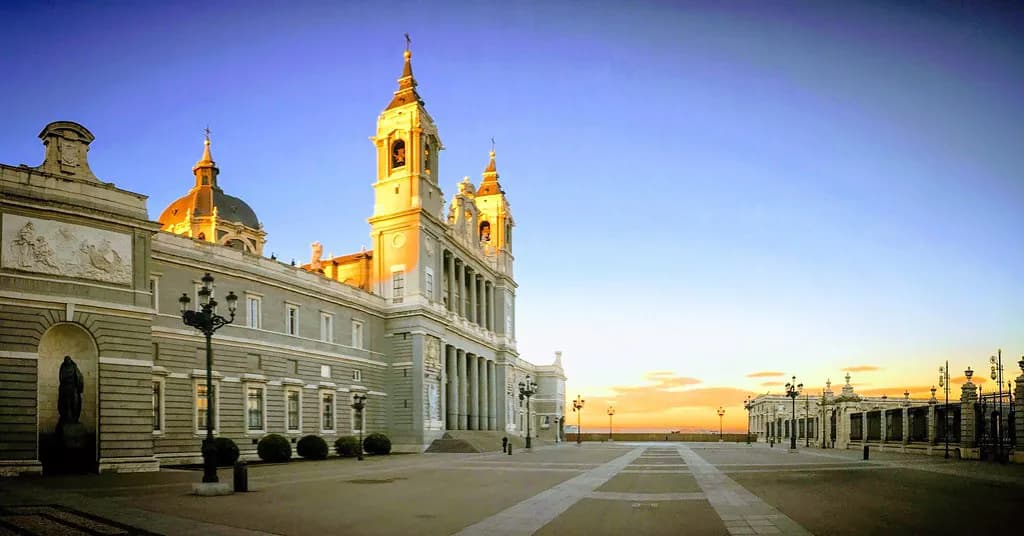
Dedicate the bulk of your afternoon to the Royal Palace (Palacio Real). It's the largest royal palace in Western Europe by floor area — 135,000 square metres across 3,418 rooms, of which visitors see a small but extraordinary portion including the throne room, royal armoury, and frescoed ceiling halls. Allow 1.5–2 hours. Buy timed-entry tickets at the official website (patrimonionacional.es) to avoid queues. Tickets cost around €14 without guide, €24 with one. Adjacent and free to enter: Almudena Cathedral, which took 110 years to build and was consecrated by Pope John Paul II in 1993. The neo-Gothic interior is worth 20 minutes.
In the evening, head to Barrio de Las Letras, Madrid's Literary Quarter, named for the writers — Lope de Vega, Cervantes, Quevedo — who lived here in the 17th century. The pedestrian Calle Huertas is the spine of the neighborhood, lined with tapas bars and cafe terraces. Order beer and patatas bravas at Cervecería Alemana on Plaza de Santa Ana — Hemingway drank here regularly and it still has the same dark-wood interior. End the evening people-watching from the plaza.
Day 2: Lavapiés, Reina Sofía, Retiro Park, and an Evening in Barrio de Las Letras
Start the day in Lavapiés, one of Madrid's most genuinely multicultural and fascinating neighborhoods. It sits just south of the city center and feels completely different from the tourist trail — South Asian spice shops next to old Madrid tabernas, community murals covering entire building facades, and an arts scene centered around La Casa Encendida, a cultural center hosting contemporary art and film. Pum Pum Cafe on Calle de la Fe is a local institution for breakfast: generous portions, good coffee, and a neighborhood crowd. Lavapiés rewards wandering for an hour before the museums open.
From Lavapiés, walk 10 minutes north to the Museo Nacional Centro de Arte Reina Sofía. This is Madrid's museum of 20th-century art and it contains one of the most important works of art in the world: Picasso's Guernica (1937), a vast monochrome canvas painted in direct response to the Nazi bombing of a Basque town during the Spanish Civil War. Standing in front of it is a different experience than seeing it in photographs. The museum also houses important works by Dalí, Miró, and Juan Gris. Admission is €12 (or free during the evening free hours — Mon, Wed–Sat 19:00–21:00, Sundays 13:30–19:00). Allow 2 hours.
After the Reina Sofía, walk along Cuesta de Moyano — a short sloping street lined with antiquarian bookstalls that has operated since the 19th century. It's a pleasant 10-minute detour before heading into Parque del Retiro. The park covers 118 hectares and was originally the private gardens of the Spanish royal family, opened to the public in the 19th century. The rowing lake at its center rents boats for €7–8 per hour — excellent on a sunny afternoon. The real highlight is the Palacio de Cristal (Crystal Palace), a stunning iron-and-glass pavilion from 1887, now used by the Reina Sofía as an exhibition space. Entrance is free; there's sometimes a short wait but it moves fast.
For the evening, return to Barrio de Las Letras for dinner and live music. Café Central on Plaza del Ángel is one of Europe's finest jazz clubs, consistently named among the best in the world. Shows typically start at 21:00 and tickets cost €12–20; book ahead on their website. If jazz isn't your thing, the neighborhood has excellent restaurants at all price points — Taberna La Daniela for traditional cocido madrileño, or Estado Puro for modern tapas.
Day 3: La Latina, Malasaña, and Arguelles
If your Day 3 falls on a Sunday, start in La Latina for El Rastro — Madrid's famous open-air flea market, held every Sunday morning from roughly 09:00 to 15:00 along Calle de la Ribera de Curtidores and the surrounding streets. It's massive, chaotic, and genuinely fun: antiques, vintage clothing, old prints, ceramics, and a lot of tourist merchandise mixed in. Keep your belongings close — pickpockets know exactly when to work a dense Sunday crowd. After browsing, settle into a tapas bar on Calle Cava Baja — the street that runs through the heart of La Latina — for vermouth and late-morning snacks. This is a Madrid ritual.
If it's not a Sunday, La Latina is still excellent for morning coffee and a wander. The neighborhood's narrow medieval streets and the area around Plaza de la Paja — a quiet square that predates Plaza Mayor — give you a sense of how the city looked before the grand Bourbon squares were built. From here, walk north over Gran Vía into Malasaña, Madrid's bohemian quarter. The neighborhood around Plaza Dos de Mayo is full of independent record shops, vintage clothing stores, bookshops, and cafes with retro-tiled interiors. Stop at Chocolatería San Ginés — open 24 hours, tucked down a passageway off Calle Arenal — for churros with thick hot chocolate. It's the most famous churros spot in the city and the queue moves quickly.
In the late afternoon, head west toward Arguelles. The neighborhood is calmer and more residential than Malasaña, popular with students from the nearby Complutense University. The reason you're here: the Temple of Debod, an authentic 2nd-century BC Egyptian temple gifted to Spain by Egypt in the 1970s in thanks for Spanish financial aid during the Aswan Dam construction. It sits in Parque de la Montaña with panoramic views over the Royal Palace and western Madrid. Visiting the interior requires a free timed-entry reservation through the Madrid city website; sunset from the surrounding park is one of the finest views in the city and costs nothing. For your final dinner, Arguelles has excellent, unpretentious neighborhood restaurants — less expensive than the tourist center and with local clientele.
How to Use Madrid's Free Museum Hours
Madrid's three great art museums all have recurring free-entry windows that most visitors never use because guides don't highlight them clearly. If you're flexible about timing, these hours can save €30–40 per person over a 3-day trip.
The Prado Museum is free Monday to Saturday 18:00–20:00 and Sundays 17:00–19:00. Two hours is genuinely enough time to see the highlights — Velázquez's Las Meninas, Goya's Black Paintings, Bosch's Garden of Earthly Delights — if you go in with a focused list. Arrive 20 minutes before free-entry opening and expect a line. The museum stays open (not just the queue) until the posted closing time.
The Reina Sofía is free Monday and Wednesday through Saturday 19:00–21:00, and Sundays 13:30–19:00. The Sunday afternoon slot is the most practical: you can spend lunch in Lavapiés and arrive at the museum in the early afternoon with no queue pressure. Guernica is on the second floor (Colección 1, Room 206) — head there first.
The Thyssen-Bornemisza Museum, the third leg of Madrid's "Golden Triangle of Art," is free on Mondays 12:00–16:00. It covers the gap between the Prado's Old Masters and the Reina Sofía's 20th-century works — Impressionists, Expressionists, early American modernism. If you have the energy for a third museum, a Monday visit here fits naturally into Day 1 or Day 2.
One caveat: free-entry hours are always busier than paid sessions, and the Prado's free evening windows in June–September can be genuinely crowded. If you want a quieter, more contemplative experience — especially for Guernica — a paid midweek morning visit is worth the €12–15.
Optional 4th Day: Day Trips from Madrid
Madrid's position at the geographic center of Spain makes it one of Europe's best bases for day trips. Two cities in particular are worth the detour — and both are faster and cheaper to reach than most visitors expect.
Toledo is the most atmospheric day trip from Madrid. A UNESCO World Heritage city, it sits on a rocky outcrop ringed by the Tagus River and contains an extraordinary density of medieval Christian, Jewish, and Islamic heritage — hence its traditional name, "City of Three Cultures." The cathedral (€10 entry) is one of the finest examples of Gothic architecture in Spain; the tiny the best day trips synagogues and the El Greco Museum are equally worth your time. RENFE high-speed trains from Atocha to Toledo take 33 minutes; tickets cost €13–15 each way and should be booked in advance. Allow a full day — Toledo is easily walkable and rewards slow exploration.
Segovia is the alternative for those more interested in Roman heritage and fairy-tale architecture. The 1st-century Roman aqueduct, built without mortar, still bisects the modern city center. The Alcázar — a turreted castle that partially inspired the Disney castle — sits at the city's western tip above a river gorge. A high-speed train from Chamartín (not Atocha) reaches Segovia Guiomar in about 28 minutes; tickets run €12–14 each way. The city center is a 15-minute bus ride from the station. Segovia is slightly smaller than Toledo and easier to see in half a day, leaving time for an afternoon back in Madrid.
If you want to do both cities in one day, guided combo tours operate from Madrid — but the pace is rushed. Better to choose one and experience it properly. Toledo is the stronger choice for first-timers; Segovia works better for those who have already seen Toledo on a previous trip.
Book in Advance: Essential Madrid Reservations
Madrid rewards preparation. A handful of bookings made before you arrive will save hours of queuing and prevent the frustration of sold-out time slots.
The Royal Palace is the single most important advance booking. In spring and summer, timed-entry slots sell out days ahead. Book at patrimonionacional.es (€14 general admission). If you want a guided tour, book that separately — small-group guided options sell out even faster. Aim for a 10:00 or 10:30 slot to get ahead of tour groups.
The Prado Museum online tickets (€15 general admission) guarantee entry at your chosen time. During peak season (June–September) even free-entry evening slots have queues. If you're planning to visit during paid hours, book 3–5 days ahead.
For flamenco shows, popular tablao venues like Corral de la Morería, Tablao las Carboneras, and Teatro Flamenco Madrid regularly sell out a week or more in advance. Shows typically start at 20:00 or 22:00 and cost €30–60 per person including one drink. Tablao 1911 and Cardamomo are slightly less expensive alternatives with equally strong reputations. If you want the best seats — typically directly facing the stage rather than at an angle — booking 7–10 days ahead is the minimum. Check the the city's best tapas bars guide for neighborhoods near flamenco venues where you can eat beforehand.
The Temple of Debod requires a free timed-entry reservation through the Madrid city tourism portal (esmadrid.com). Slots for weekend evenings (the most popular time, around sunset) fill up several days ahead. Book as soon as you know your travel dates.
Frequently Asked Questions
Which Madrid 3 day itinerary options fit first-time visitors?
This itinerary is specifically designed for first-timers, balancing iconic sights with authentic local experiences. It covers major landmarks like the Royal Palace and Prado Museum, alongside vibrant neighborhoods for dining and culture.
How much time should you plan for Madrid 3 day itinerary?
A 3-day itinerary allows for a comprehensive introduction to Madrid's main attractions and neighborhoods. It provides enough time to see the highlights without feeling rushed, offering a good balance of sightseeing and relaxation.
What are the best neighborhoods to stay in Madrid for 3 days?
For a 3-day trip, staying in the Centro district is ideal for convenience. Neighborhoods like Sol, Gran Vía, and La Latina offer central locations, excellent transport links, and easy access to most attractions.
Is a Madrid tourist travel pass worth it for 3 days?
A Madrid tourist travel pass can be worthwhile if you plan extensive use of public transport and multiple museum entries. Calculate your expected costs against the pass price to determine if it offers savings for your specific itinerary.
Three days in Madrid gives you a genuine introduction to one of Europe's most underrated capital cities. The key is structure: anchor your first day in the historic core, dedicate your second to Lavapiés and the art museums, and spend your third wandering neighborhoods at a slower pace. Adjust the timing, use the free museum windows if you're budget-conscious, and book the Royal Palace and any flamenco shows before you land.
Madrid rewards people who engage with it rather than just check it off. Eat late, walk far, and stay for one more drink than you planned. That's when the city starts to feel like your own.
You might also like


Continue reading
More guides you'll find useful