

Madrid Neighborhood Guide: Best Areas to Stay & Explore (2026)
Discover Madrid's best neighborhoods for your trip. Our guide covers top areas, local insights, hotel recommendations, and practical tips for every traveler.
On this page
7 Recommended Madrid Neighborhoods for Every Traveler (2026)
Madrid is a city where your neighborhood choice shapes everything — your mornings, your evenings, the food you eat, and the people you meet. I've spent time across a dozen of its barrios, and the differences are real. A quiet street in Chamberí feels nothing like the Saturday chaos of La Latina's Cava Baja. This guide cuts to what actually matters: which areas suit which traveler, what you pay, and what trade-offs you're making.
The short answer is that most first-timers should pick between La Latina, Sol, or Barrio de las Letras. Each sits within a 20-minute walk of Puerta del Sol, is well connected by metro, and gives you easy access to Madrid's main sights. Scroll down for a full breakdown of seven recommended neighborhoods plus a few alternates worth knowing.
Plan with trusted sources: cross-check opening hours and seasonal details with the official Madrid tourism site, and read more about the city on its Wikipedia entry before you go.
Madrid Planning Cheatsheet: Essential Tips for Your Trip
Before diving into specific barrios, a few practical fundamentals. Madrid's best weather falls in April–May and September–October — mild, comfortable, and without the summer exodus that empties the center in August (when locals flee to the coast and many smaller restaurants close). If you visit in July or August, the center is quieter and hotels are cheaper, but temperatures regularly hit 36–40°C. Winter is mild (rarely below 5°C) and the Christmas markets in Plaza Mayor are genuinely worth a visit.
Budget planning: a mid-range hotel in a central barrio costs €90–€200 per night in 2026. A daily menú del día (two courses plus wine) at a neighborhood restaurant runs €12–€18. The metro is the cheapest way to travel — a 10-trip Metrobus card costs €6.10, and a single journey is €1.50–€2.00 depending on zones. Many of Madrid's top museums offer free entry on certain evenings: the Prado is free 18:00–20:00 Monday to Saturday and 17:00–19:00 Sundays; the Reina Sofía is free 19:00–21:00 Monday and Wednesday to Friday, plus Sunday afternoons after 13:30.
Cash is useful for El Rastro market and smaller tapas bars, though cards are accepted almost everywhere. Tipping is optional; rounding up or leaving €1–€2 on the table is considered polite. Most restaurants don't open for dinner until 21:00 — eating at 19:00 marks you as a tourist. For more detail on getting around the city once you arrive, see our guide on getting around the city.
Overview of Madrid's Layout and Getting Around
Madrid radiates outward from Puerta del Sol, the literal kilometre zero of Spain's road network. The historic core — roughly bounded by the Royal Palace to the west, Gran Vía to the north, Retiro Park to the east, and Ronda de Toledo to the south — is compact and highly walkable. You can cross it end to end in about 30 minutes on foot. All seven neighborhoods in this guide sit within or immediately adjacent to this zone.
The metro is your best friend for anything further afield. It's clean, air-conditioned, and runs until 01:30 (02:30 on Fridays and Saturdays). Line 1 (light blue) and Line 2 (red) intersect at Sol and cover most central neighborhoods. From Barajas Airport (MAD), Line 8 connects directly to the city in about 25 minutes for €4.50–€5.00. The Exprés Aeropuerto bus (yellow coach) runs 24/7 between all terminals and Atocha/Cibeles for €5, payable by card on board — good if you have luggage and want a more direct route. For a complete breakdown of options, see our getting from the airport guide.
A note on Madrid de los Austrias: this is the old Habsburg quarter immediately west of Sol, containing Plaza Mayor, Calle Mayor, and the streets leading to the Royal Palace. Many guides treat it as a separate area; practically speaking it functions as part of the Sol zone and shares the same pros and cons. If a hotel lists itself as "Los Austrias," it means you're in or adjacent to the historic core.
Quick Summary: Our Top 7 Recommended Madrid Neighborhoods
Here is a fast-reference overview before the detailed breakdowns below. All seven are central, metro-connected, and within walking distance of major sights.
- La Latina — Best overall pick for most travelers. Authentic atmosphere, excellent tapas scene, not overrun by tourists. Limited hotel supply is the main drawback.
- Sol / Centro — Best for first-timers who want to be steps from everything. Touristy, loud, and expensive — worth it for a 1–2 night stay, harder to justify for longer visits.
- Barrio de las Letras (Huertas) — The "Goldilocks" option: central, charming, best hotel selection, close to the Prado. Slightly more touristy than La Latina but with a better food and cultural scene than Sol.
- Malasaña — Best for nightlife, creative culture, and younger travelers. Can be noisy at weekends. Generally lower hotel prices than the center.
- Salamanca — Best for luxury, fine dining, and designer shopping. Quieter and more residential than the historic core but requires a metro or cab to reach main sights.
- Retiro — Best for families and anyone prioritizing green space and a calmer pace. Excellent for the "Golden Triangle" museums.
- Chueca — Best for inclusive nightlife, strong food scene, and a lively village atmosphere day and night.
| Neighborhood | Best For | Noise Level (Fri night) | Mid-range Hotel (2026) | Metro Access |
|---|---|---|---|---|
| La Latina | Authentic atmosphere, tapas | Moderate | €150–€300 | La Latina, Tirso de Molina |
| Sol / Centro | First-timers, sightseeing | Loudest | €100–€250 | Sol (multi-line hub) |
| Barrio de las Letras | Culture, hotels, Prado access | Moderate | €150–€400+ | Antón Martín, Sevilla |
| Malasaña | Nightlife, creative scene | Very loud (weekends) | €150–€250 | Tribunal, Noviciado |
| Salamanca | Luxury, shopping, fine dining | Quiet | €150–€350+ | Serrano, Velázquez |
| Retiro | Families, green space, museums | Quietest | €200–€300 | Retiro, Ibiza |
| Chueca | Inclusive nightlife, food | Loud (weekends) | €150–€350 | Chueca, Alonso Martínez |
La Latina: Best for Authentic Local Vibes and Tapas
La Latina is the oldest neighborhood in Madrid, and it shows in the best possible way. The streets are medieval in layout — narrow, winding, opening onto unexpected plazas — built during the Moorish period and later shaped by the Habsburg era. The architecture is primarily Baroque and Neoclassical, but the feel is of a village that somehow survived being absorbed by a capital city. Unlike Sol, it doesn't cater to tourists. You'll share the bars with local families, dog-walkers, and regulars who have been coming to the same table for decades.
The social anchor is Calle de la Cava Baja, a street with more than fifty bars and restaurants. Arrive after 20:00 on any evening and you'll find the terraces packed. The nearby Plaza de la Paja and Plaza de la Cebada are perfect for a slower afternoon drink. On Sundays, the entire neighborhood transforms for El Rastro, Spain's largest open-air flea market — a chaotic, brilliant sprawl of stalls selling antiques, clothing, and food that draws both locals and visitors. Arrive before 11:00 to beat the crowds; the market runs until roughly 15:00.
The main practical downside is hotel supply. Large hotels are rare; your options are mostly boutique conversions of old taverns, small apartment rentals, and a handful of three- and four-star properties. Good picks in 2026 include Posada del León de Oro (€150–€300/night), Posada del Dragón (~€150/night), and the newly opened One Shot La Latina (€150–€200/night). Three metro stops serve the area: La Latina, Tirso de Molina, and Embajadores.
Noise level: moderate. La Latina is lively on weekend evenings but quieter on weekday mornings. If you're a light sleeper, book a room on a side street rather than directly on Cava Baja or adjacent to one of the larger plazas.
Sol: Ideal for First-Timers and Central Sightseeing
Sol — or Centro, as the broader area is sometimes called — is the beating heart of Madrid. Puerta del Sol is Kilometre Zero: the literal center of the country's road network and the place where New Year's Eve crowds pack in to eat twelve grapes at midnight to the clock tower chimes. The surrounding streets give you Plaza Mayor, Gran Vía, the Royal Palace (Palacio Real), and the start of several museum routes, all within a 15-minute walk. No other neighborhood puts you this close to this much.
The trade-off is unmistakable. Sol is the most heavily touristic part of Madrid. Many restaurants between Puerta del Sol and Plaza Mayor exist solely to capture passing visitors — overpriced menus with photos on the boards and staff waving you in off the pavement. Getting a genuinely good meal requires knowing where to look, or walking a few streets further into La Latina or Barrio de las Letras. The area is also loud: pedestrianized streets stay busy until late, and the sound carries at night. Bring earplugs or request an interior room.
That said, for a first visit of 1–3 nights focused on sightseeing, Sol is hard to argue against. The metro is a multi-line hub, transport is trivial, and you genuinely lose no time in transit to attractions. Hotels range from budget hostels (€30–€60/night) to mid-range options (€100–€250/night) and some genuine luxury on Gran Vía. Recommended picks: NH Collection Madrid Gran Vía (~€300/night), Petit Palace Puerta de Sol (~€280/night), and the Four Seasons at the refurbished Palacio de los Duques for five-star luxury.
August note: Sol actually becomes more pleasant in August when locals leave and crowds thin slightly. Hotels drop in price and the streets regain some breathing room — a counterintuitive time to consider this otherwise busy area.
Barrio de las Letras: The Goldilocks Neighborhood for Culture Lovers
Barrio de las Letras — the Literary Quarter — sits between Sol and Retiro Park, and that geography tells you exactly what it offers: central but quieter than Sol, cultured rather than clubby, and within easy walking distance of the Prado, Thyssen-Bornemisza, and Reina Sofía museums. Literary quotes from Cervantes and Lope de Vega are inlaid in the pavements; both writers lived and worked here in the 17th century. Cervantes is buried in the Convento de las Trinitarias on Calle de Lope de Vega.
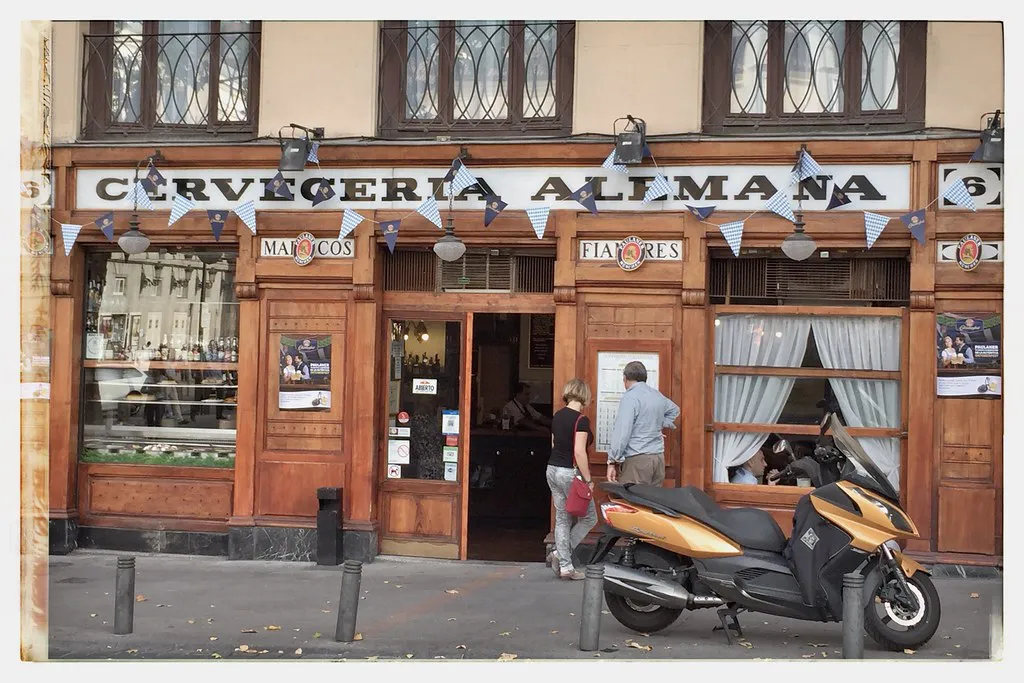
The neighborhood's centrepiece is Plaza de Santa Ana, a wide square ringed with outdoor terraces and cafés. This is where Hemingway drank at the Cervecería Alemana (still open, still good). By day it's relaxed and bohemian; by evening it fills with a mix of locals, jazz bar crowds, and visitors who've graduated from the Sol tourist circuit. The surrounding streets — particularly Calle Huertas and Calle del León — offer some of the best independent wine bars and jazz clubs in the city.
Barrio de las Letras also has the strongest hotel selection of any central barrio. You'll find genuine luxury options within walking distance of the Prado: Hotel Urban (design-led four-star, ~€300/night), Gran Hotel Inglés (~€350/night), The Palace Hotel (~€400+/night), Catalonia Las Cortes (mid-range boutique, ~€175–€225/night), and Room Mate Alicia (overlooks Plaza Santa Ana, ~€150/night). This breadth of options is one reason competitors consistently rank it highly.
The Goldilocks quality is real: you get Old World atmosphere, cultural proximity, and great eating without the overcrowding of Sol or the scarcity of La Latina's hotel supply. The main caveat is that parts of it — especially the streets east of Plaza Santa Ana — can feel busy on weekend nights. Choose a hotel on the quieter western side of the barrio if noise sensitivity is a concern.
Malasaña: Nightlife, Creativity, and the Spirit of La Movida
Malasaña's identity is rooted in La Movida Madrileña, the countercultural explosion of the late 1970s and 1980s when Franco's death unlocked decades of pent-up creative energy. Music, art, film, and sexual freedom burst out simultaneously; the neighborhood was the epicenter. The physical remnants are visible in the graffiti, the tattoo parlors, and bars like La Vía Láctea and El Penta that have been operating since that era. Malasaña is more gentrified now — indie coffee shops and vintage boutiques have replaced much of the grime — but the attitude survives.
The main square is Plaza del Dos de Mayo, a pleasant open space named after the 1808 uprising against Napoleon. By day it's families and dog-walkers; by night it's the focal point of the neighborhood's bar circuit. The surrounding streets — Calle Espíritu Santo, Calle Fuencarral, and the pedestrianized stretches around it — concentrate some of Madrid's best vintage shopping, third-wave coffee, and late-night bars. This is where younger travelers, solo travelers, and anyone chasing an alternative nightlife scene should base themselves.
A practical warning that competitors under-state: Malasaña is genuinely noisy on Friday and Saturday nights. Properties directly on or near Plaza del Dos de Mayo and Calle Espíritu Santo can be difficult to sleep in if you're going to bed before 02:00. Book a room on a quieter side street — or one floor up — and confirm the room faces an interior courtyard if that matters. Hotel prices are generally lower here than in the historic center. The One Shot Malasaña hotel (~€150–€200/night) and Tribu Malasaña (~€150–€250/night) are well-reviewed picks. The area sits just north of Gran Vía, a 10-minute walk from Sol.
Salamanca: Luxury, Shopping, and Elegant Streets
Salamanca is Madrid's most affluent neighborhood, and the contrast with the historic center is immediate. Instead of narrow medieval lanes, you get wide Haussmann-style boulevards lined with 19th-century apartment buildings, designer boutiques, and restaurants with white tablecloths. This is where Madrid's upper classes live, and the neighborhood reflects their preferences: polished, quiet during the week, and expensive.
The commercial artery is Calle de Serrano, known as the "Golden Mile," which runs north through the heart of the barrio. Prada, Louis Vuitton, Loewe, and Tiffany & Co. sit alongside high-end Spanish brands. Calle de José Ortega y Gasset and Calle de Velázquez offer more of the same. Good Spanish boutiques — for leather goods, formal wear, and gourmet food — are more concentrated here than anywhere else in the city. Stores typically open 10:00–20:00 Monday to Saturday; many are closed Sundays.
The neighborhood's restaurants are genuinely excellent, with several Michelin-starred options and a dining culture more serious than anywhere else in Madrid. Budget for tasting menus at €80–€150 per person if you're going for the top tier. For lunch, the menú del día options in Salamanca tend to run slightly higher (€18–€25) but the quality reflects it. Hotels here include the Santo Mauro (boutique luxury, ~€350+/night), NH Balboa (~€150/night), and AC Aitana.
The main trade-off is distance. Salamanca sits northeast of the historic center, a 15–20 minute metro ride or taxi from Sol. Staying here makes sense if you're here primarily for fine dining, shopping, and cultural events at the Fundación Juan March or Fundación MAPFRE — and less so if your itinerary is packed with visits to the Royal Palace and Plaza Mayor.
Retiro: Families, Green Spaces, and the Golden Triangle
Retiro takes its name from the Parque del Buen Retiro, Madrid's main park — 118 hectares of green space with a boating lake, formal gardens, the Crystal Palace greenhouse (free entry), and an enormous rose garden. The park is free, open daily from 06:00–22:00 (until midnight in summer), and genuinely used by locals year-round. This alone sets the neighborhood apart from anything else on this list. Families will find rowing boats for hire (€4–€6 per person), playgrounds, and enough space to decompress after days of urban sightseeing.
The cultural case for staying here is equally strong. The "Golden Triangle of Art" — the Prado, Reina Sofía, and Thyssen-Bornemisza — sits right at the border between Retiro and Barrio de las Letras. The Prado costs €15 per adult (free 18:00–20:00 Monday to Saturday). The Reina Sofía, home to Picasso's Guernica, costs €12 (free 19:00–21:00 on Monday, Wednesday, Thursday, and Friday, and Sunday afternoon from 13:30). If your trip is built around these museums, staying in Retiro means you can walk over in five minutes rather than queuing for the metro.
The neighborhood is residential and notably quieter at night than La Latina or Malasaña. This is a feature for families and anyone who values sleep. The downside is that the evening dining and bar scene is thin — you'll want to take the metro or walk 20 minutes to Barrio de las Letras or Sol for a real night out. Recommended hotels: Palacio del Retiro (boutique, ~€250/night), AC Hotel Palacio del Retiro (~€200–€300/night).
Chueca: Vibrant, Inclusive, and Strong on Food
Chueca is officially the center of Madrid's LGBTQ+ community, and that history has shaped its character: energetic, inclusive, fashion-forward, and proud. Plaza de Chueca anchors the neighborhood — a small square surrounded by terraces, boutiques, and bars that feels like a village square by day and a party hub by night. The area sits between Salamanca to the east and Malasaña to the west, inheriting some of both: the food quality of Salamanca's orbit and the nightlife energy of Malasaña.
The food scene here is among Madrid's best. Restaurant recommendations from competitors include El Cisne Azul for seasonal cooking, Angelita Madrid for high-end Spanish cuisine, and Casa Salvador with its bullfighting memorabilia and traditional cocido madrileño. The cocktail bars are strong too — Museo Chicote on Gran Vía (1930s-era institution, now a landmark), Libertad 8, and Teatro Barceló for clubs. The neighborhood's Madrid Pride (Orgullo) celebrations in late June and early July draw hundreds of thousands of people and are among the largest in Europe — something to bear in mind if you're booking around that time, as prices rise sharply and availability drops.
Lunch menus (menú del día) in Chueca typically run €12–€18 and quality is consistently higher than in Sol. Hotels here include the URSO Hotel (boutique luxury, ~€250–€350/night), Room Mate Oscar, and several mid-range options along Calle de Hortaleza. Like Malasaña, weekend nights can be very loud near the plaza — book a quieter side street property if you need early nights.
The Noise and Sleep Trade-Off: What No One Tells You
Every guide tells you which neighborhood has the best tapas. None of them give you a clear picture of where you can actually sleep. Madrid is a city that lives late, and the gap between "lively" and "sleepless" can be a matter of one street. This is particularly important because Madrid's housing stock features hard floors, stone walls, and single-pane windows that do almost nothing to block street noise.
Here is a practical noise ranking, from loudest to quietest on a Friday night:
- Loudest: Sol/Centro (street performers, crowds until 02:00), Malasaña near Plaza del Dos de Mayo (music, shouting, mopeds until 04:00–05:00 on weekends), Chueca near Plaza de Chueca (similar pattern).
- Moderate: La Latina (lively 20:00–01:00 on weekends, quieter on weekday evenings; calms down earlier than Malasaña), Barrio de las Letras near Plaza Santa Ana (jazz bars close around 02:00–03:00).
- Quieter: Salamanca (residential, little street noise after 23:00), Retiro (the quietest of all seven; very little happening after 22:00).
The actionable advice: if you're a light sleeper staying in Malasaña, Chueca, or La Latina, always request a room on an interior courtyard (patio interior) or at minimum on a street at least one block back from the main squares. In Sol, an upper floor helps. In Salamanca and Retiro you can generally book without worrying about this. This single tip prevents the most common complaint travelers make after visiting Madrid.
Other Madrid Neighborhoods to Consider
If the seven neighborhoods above don't match your needs, a few others are worth knowing. Chamberí sits immediately north of Malasaña and is one of Madrid's most elegant residential barrios. It has outstanding local restaurants, beautiful 19th-century architecture, and almost no tourists — but also fewer major sights within the neighborhood itself. It suits longer stays and repeat visitors who want to live like a local. Metro: Alonso Martínez or Iglesia (Line 4).
Lavapiés is Madrid's most multicultural neighborhood, immediately south of Barrio de las Letras. It's home to one of the city's best Indian restaurant strips (the "Curry Mile" on Calle de Lavapiés), a vibrant underground arts scene centered on the Matadero Madrid cultural center, and the cheapest accommodation in the central area. It's less polished than the other barrios — hilly, dense, and edgy — but genuinely interesting for budget travelers and adventurous eaters. Note that it can feel sketchy late at night on certain side streets; stick to lit and populated routes.
Argüelles and Moncloa, west of the center, are student-heavy residential areas bordering the huge Parque del Oeste. The Templo de Debod — an actual ancient Egyptian temple, gifted to Spain in 1968 — stands here and offers what most locals consider the best sunset viewpoint in Madrid (free, open Tuesday to Sunday). Budget accommodation is plentiful. This area suits longer stays, university visitors, and anyone who wants a residential base with easy access to the center via Line 6 metro.
Choosing Your Perfect Madrid Neighborhood: A Decision Guide
The right neighborhood depends on three things: how long you're staying, what you prioritize, and how sensitive you are to noise. For a 1–3 night sightseeing trip, Sol or Barrio de las Letras wins on convenience. For 4+ nights, La Latina or Chueca give you a richer, more local experience without costing you access to the center. Families should lean toward Retiro. Luxury travelers should look at Salamanca or top-end properties in Barrio de las Letras.
Budget is a real factor. Accommodation in Salamanca and Sol runs 20–40% higher than in Malasaña or Chamberí for comparable quality. If you're spending most of your time out exploring anyway, a lower-cost base in Malasaña makes financial sense — you save the difference over several nights and spend it on better meals instead. For guidance on planning your itinerary around these areas, see our top things to do in Madrid guide.
One final note: Madrid's metro is so good that no central neighborhood leaves you more than 30 minutes from any major sight. The pressure to stay in the absolute center is lower here than in almost any other European capital. Choose the neighborhood that matches your vibe and trust the metro to fill the gaps. For more help deciding where to base yourself, our where to stay in the city guide has deeper hotel recommendations at each price point.
Frequently Asked Questions About Madrid Neighborhoods
Travelers planning their first Madrid trip often share a handful of specific concerns. The answers below address the most common questions clearly and practically.
Frequently Asked Questions
Which Madrid neighborhoods are best for first-time visitors?
For first-time visitors, Sol and Barrio de las Letras are excellent choices due to their central location and proximity to major attractions. They offer easy access to sights like Plaza Mayor, the Royal Palace, and world-class museums, making exploration straightforward.
How do I choose the best neighborhood in Madrid for my travel style?
Consider your priorities: for nightlife, choose Malasaña or Chueca; for culture and history, Barrio de las Letras; for luxury, Salamanca; and for a local, authentic feel, La Latina. Families often prefer the quieter, greener Retiro area.
What are the safest neighborhoods in Madrid?
Madrid is generally a safe city. Neighborhoods like Salamanca, Retiro, and Chamberí are known for being particularly safe and residential. Even in central, bustling areas like Sol and La Latina, basic precautions like being aware of pickpockets are advisable, especially in crowded spots.
Which Madrid neighborhoods are best for nightlife?
Malasaña and Chueca are the undisputed hubs for Madrid's vibrant nightlife, offering a wide array of bars, clubs, and live music venues. La Latina also provides a lively evening atmosphere, especially on weekends, with its abundance of tapas bars.
Is it better to stay in Sol or La Latina?
Sol is ideal if you want to be in the absolute center, steps from major landmarks and transport, though it can be very touristy and noisy. La Latina offers a more authentic, charming atmosphere with fantastic tapas and a lively Sunday market, but it's slightly less central for some sights.
Madrid rewards travelers who choose their neighborhood deliberately. The seven areas in this guide cover every type of visit — first-timer sightseeing trips, family breaks, luxury stays, creative escapes, and long weekends built around food and nightlife. The key is matching your priorities to what each barrio genuinely delivers, rather than defaulting to the most central option by default.
Start with the quick summary, read the sections that apply to your trip, and pay attention to the noise notes if you value sleep. Madrid's metro will handle the rest. Whichever barrio you choose, you'll find one of Europe's most compelling cities waiting on the other side of the hotel door.
You might also like


Continue reading
More guides you'll find useful


