12 Best Free Things to Do in Madrid (2026)
Discover 12 amazing free things to do in Madrid, from iconic parks to museums, with insider tips and planning advice for 2026.
On this page
12 Incredible Free Things to Do in Madrid (2026)
Madrid is one of the best cities in Europe for budget travelers, and not just because food is cheap. A disproportionate share of its best attractions are genuinely free — not "free with a coupon" or "free on one obscure Tuesday." World-class museums open their doors for nothing several evenings a week. Major parks are UNESCO World Heritage Sites. Ancient Egyptian temples stand in public squares. This guide covers what to actually prioritize, when to show up, and what the queues look like in 2026.
Whether you have two days or five, planning around Madrid's free hours unlocks a trip that feels far more expensive than it is. The city is compact enough that you can walk between the Prado, Retiro Park, and the Temple of Debod in a single afternoon — all without paying a euro in entrance fees. Here is how to make that happen.
Plan with trusted sources: cross-check opening hours and seasonal details with the official Madrid tourism site, and read more about the city on its Wikipedia entry before you go.
Must-See Madrid Attractions That Cost Nothing
The heart of Madrid is built for walking and exploring without a budget. Plaza Mayor — completed in 1619 — is a grand arcaded square that comes alive with street performers and mosaic tile portraits above the arches. Spend twenty minutes here in the morning before the tour groups arrive and you get the place nearly to yourself. Adjacent Puerta del Sol holds Madrid's famous Bear and Strawberry Tree statue, the symbolic center of Spain, and is free to photograph and linger in around the clock.
Gran Vía, Madrid's main boulevard, is worth a slow walk for its early 20th-century architecture alone. Look up at the Metropolis Building's winged statue and the ornate facades of the old theaters — this is the "Spanish Broadway" where lights illuminate the street after dark. It costs nothing and takes an hour at a comfortable pace.
Almudena Cathedral, directly beside the Royal Palace, is free to enter. The interior is unusually bright for a Spanish cathedral — colorful neo-Gothic vaulting finished in 1993 gives it an almost contemporary feel despite its Baroque exterior. A small donation is appreciated but not required. Combine a cathedral visit with a free walk through the Sabatini Gardens alongside the Royal Palace, which are open daily and offer views across to the Casa de Campo hills.
The Changing of the Guard at the Royal Palace takes place every Wednesday and Saturday at 11:00, lasting around 10 minutes. It is free to watch from the square outside. Arrive by 10:30 to secure a clear sightline, especially on Saturdays when the crowd is larger.
Free Museum Hours: Prado, Reina Sofía, and Beyond
Madrid's three world-class museums all have free entry windows, and using them correctly saves €30–€50 per person over a three-day trip. The Prado is free Monday to Saturday from 18:00 to 20:00, and Sundays and public holidays from 17:00 to 19:00. Queues form by 17:15 at the latest on weekday evenings — arrive earlier and you will wait outside; arrive right at opening and you walk straight in. Once inside, go directly to the Velázquez rooms or the Goya Black Paintings first; these fill fastest.
| Museum | Free Days | Free Hours | Note |
|---|---|---|---|
| Prado | Mon–Sat | 18:00–20:00 | Sun & holidays 17:00–19:00; arrive 45 min early |
| Reina Sofía | Mon, Wed–Sat | 19:00–21:00 | Sun 13:30–19:00; closed Tuesdays |
| Thyssen-Bornemisza | Monday | 12:00–16:00 | Least crowded free slot of the three |
| Museo Sorolla | Sat & Sun | Sat 14:00–20:00 / Sun 10:00–15:00 | Intimate home-studio setting |
| National Archaeological Museum | Sat & Sun | Sat after 14:00 / Sun morning | Verify on official site for holiday changes |
| Real Jardín Botánico | Tuesday | After 14:00 | Free on Tuesdays only |
The Museo Reina Sofía — home to Picasso's Guernica — is free Monday and Wednesday to Saturday from 19:00 to 21:00, and Sundays from 13:30 to 19:00. Closed Tuesdays. Guernica is on the second floor of the Sabatini Building; allow yourself twenty minutes just for that room, then decide what else you have time for. The queue on Sunday afternoons is the most manageable of the week.
The Thyssen-Bornemisza, which completes the Golden Triangle of Art alongside the Prado and Reina Sofía, offers free entry on Mondays from 12:00 to 16:00. This is the least crowded free slot of any major Madrid museum — a genuine window to see one of the world's best private art collections with room to breathe. The Museo Sorolla is free on Saturdays from 14:00 to 20:00 and Sundays from 10:00 to 15:00. Sorolla's former home-studio is one of the most intimate museum experiences in the city.
Beyond the big four, the National Archaeological Museum is free on Saturdays after 14:00 and Sunday mornings, and the Royal Botanic Gardens (Real Jardín Botánico) are free on Tuesdays after 14:00. Always verify opening times on official museum websites before visiting, as holiday schedules and temporary closures can shift the windows.
Parks, Gardens, and Outdoor Spaces
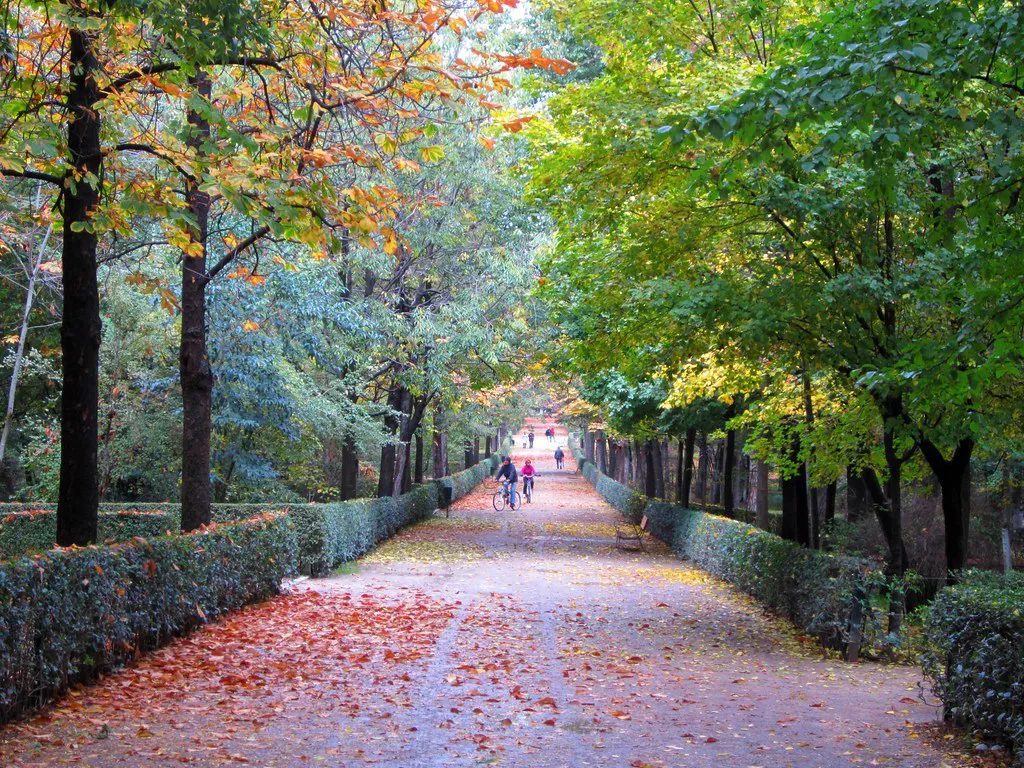
El Retiro Park is Madrid's most famous green space — 125 hectares of lakes, tree-lined avenues, and formal gardens that are free and open daily from 06:00 to 22:00 (summer) or 22:00 (winter). The Palacio de Cristal, a remarkable 19th-century glass-and-iron structure inside the park, hosts free contemporary art exhibitions year-round; check the Reina Sofía website for the current show. The park and its Paseo del Prado surroundings together form a UNESCO World Heritage Site. Go mid-morning on a weekday if you want a quiet walk; Sunday mornings bring locals out in force, which is its own kind of spectacle.
Madrid Río Park stretches for kilometres along the Manzanares riverbank and was transformed from a motorway corridor into a park in 2011. It offers cycling paths, bridges, playgrounds, and a beautiful riverside walk that is especially pleasant at sunset. The park is free and always accessible, and several metro stations (Puerta del Ángel, Pirámides, Marqués de Vadillo) drop you at different entry points.
Casa de Campo is Madrid's largest public park — five times the size of New York's Central Park — and it is free. The Rosaleda rose garden within the park is one of the largest in Europe, with over 650 varieties and 20,000 plants blooming from late April through June. It is open daily from 10:00 to 19:00. The park entrance is a short walk from the Lago metro station (Line 10).
Cerro del Tío Pío in the Vallecas neighborhood gives you one of the best panoramic views of the Madrid skyline from its seven low hills. It is much less crowded than the Temple of Debod at sunset, and the view extends across the whole city. Take Line 1 to Portazgo or Line 3 to Legazpi and walk fifteen minutes uphill. Free and open daily.
Things You Can Only Do in Madrid
A 2nd-century Egyptian temple standing in a public park is not something you find in most European capitals. The Temple of Debod near Plaza de España was gifted to Spain in 1968 after Spain helped save ancient Nubian monuments from the Aswan Dam flooding. The exterior and surrounding park are always free and offer some of the best sunset views in the city. Interior access (free, but timed) is more limited — check the Madrid city website for the current schedule and arrive at least 45 minutes before a session to avoid being turned away.
The Beti Jai Pelota Court in the Chamberí neighborhood is Madrid's only surviving example of a 19th-century Basque pelota court — a sport that once rivaled football in popularity in the city. The facade is an extraordinary piece of ornate brickwork architecture that most visitors to Madrid never see, and it sits on a quiet residential street that takes ten minutes to walk to from Alonso Martínez metro (Line 4). The exterior is always visible from the street; check the Madrid city website for scheduled open-door days when the interior is accessible.
Watching the sunset from the Vistillas viewpoint over the Rio Manzanares and the Royal Palace silhouette is a ritual for madrileños on warm evenings. It sits at the western end of La Latina, costs nothing, and is easy to combine with a walk down the hill to tapas bars on Calle de la Cava Baja afterwards.
Goya Frescoes in a Riverside Hermitage — Madrid's Most Overlooked Free Sight
The Ermita de San Antonio de la Florida contains one of the most remarkable pieces of Goya's work in existence — the ceiling of this small neoclassical chapel, painted by Goya in 1798, is covered entirely with a single fresco depicting the miracle of Saint Anthony. Goya painted himself into the crowd scene, and the intimacy of the space (it seats perhaps 40 people) means you can stand directly beneath a masterpiece that rivals anything in the Prado. It is free to enter.
The hermitage sits in the Madrid Río park area, near the Príncipe Pío transport hub (Líneas 6 and 10, and the Cercanías train). It is open Tuesday to Sunday, 09:30 to 20:00 (summer) and 09:30 to 18:00 (winter). Closed Mondays. Almost none of the standard "free Madrid" lists prioritize it — which means you will likely have the chapel to yourself or share it with just a few other visitors. Goya is buried beneath the altar, though this is a replica hermitage; his remains were brought here from Bordeaux in the 19th century.
Combine this with a walk along the Manzanares riverside or a stop at the Matadero Madrid cultural center (free entry to most exhibitions) about two kilometers south. The Matadero is a converted 19th-century slaughterhouse that now hosts film screenings, contemporary art exhibitions, and live performances — most of which are free or low cost.
Free Neighborhoods: Malasaña, Lavapiés, and La Latina
Malasaña and Lavapiés are the two neighborhoods most worth wandering without a fixed plan. Malasaña, centered around Plaza del Dos de Mayo, is Madrid's bohemian quarter — vintage shops, independent cafés, and murals on nearly every corner. Lavapiés is the city's most culturally diverse neighborhood, with West African grocery stores, South Asian restaurants, and a dense concentration of alternative galleries and theater spaces. Both are free to explore; your only cost is whatever you eat or drink.
La Latina, the old medieval quarter south of Plaza Mayor, has the best-preserved street layout of any Madrid neighborhood. Walk down Calle de la Cava Baja on a Sunday morning after visiting El Rastro flea market — the streets transition from market chaos to quiet neighborhood calm over the course of an hour. The flea market itself runs every Sunday and public holiday from 09:00 to 15:00 and is free to browse. Keep your phone in your front pocket in the denser sections.
For street art specifically, La Tabacalera in Lavapiés is a former tobacco factory turned alternative cultural space with murals, exhibitions, and performance spaces. Most events and all exhibitions are free. The building's courtyards alone are worth the ten-minute walk from Lavapiés metro station.
Free Concerts, Festivals, and Nightlife
Madrid's festival calendar runs almost year-round, and many of the biggest events are free. San Isidro (mid-May) is the city's patron saint festival — for roughly a week, open-air concerts, processions, and traditional food stalls take over multiple plazas. La Paloma (August) brings street parties to the La Latina neighborhood with live music from the balconies and temporary stages in the squares. Both festivals cost nothing to attend.
For regular free music, Plaza de Santa Ana and the surrounding streets in the Huertas neighborhood frequently feature live music spilling out of bars in the evenings. This is not organized entertainment — it is just the rhythm of the neighborhood from about 21:00 onwards on Thursday through Saturday. No ticket required; sit on the square steps or find a table at one of the terrace bars.
Plaza de Oriente, between the Royal Palace and the Teatro Real opera house, occasionally hosts free outdoor performances and always has street musicians of a high caliber. The square is beautifully lit at night and the Royal Palace lit against a dark sky is worth the walk even without entertainment.
Family-Friendly Free Options
El Retiro's lake area is the easiest free option for families — children can watch the boats without needing to rent one, feed the ducks, and explore the rose garden section near the south end of the park. The Palacio de Velázquez (a sister building to the Palacio de Cristal, also in Retiro) hosts free exhibitions from the Reina Sofía collection and is large enough for strollers and pushchairs.
The Atocha Train Station's tropical garden is genuinely worth a stop with children — a small pond with turtles and exotic fish sits inside the Victorian-era iron-and-glass station concourse. It is free to enter the garden area and takes about twenty minutes. Note that as of 2026 it has been temporarily closed for renovation works; check current status before visiting.
Madrid Río has the best children's play infrastructure of any free space in the city — multiple playgrounds, cycling paths with rental bikes (paid), and a paddling area near the Puente de Matadero in summer. The Puppet Theater in Retiro Park runs free shows for children most Saturdays and Sundays near the Estanque lake.
How to Plan a Free Day in Madrid
Group nearby attractions to avoid backtracking. The Paseo del Arte route — the stretch between the Prado, Reina Sofía, and Thyssen — is walkable in under fifteen minutes end to end. Plan free museum hours at the Prado (opens free at 18:00) and arrive in the afternoon to walk El Retiro and the Palacio de Cristal beforehand. This single afternoon covers two UNESCO World Heritage sites and a world-class museum at zero cost.
For a morning route, combine Plaza Mayor, Puerta del Sol, Almudena Cathedral, and the Sabatini Gardens — all within a fifteen-minute walk of each other. Add the Changing of the Guard on Wednesday or Saturday at 11:00 and you have a full morning that costs nothing. Then walk west to the Temple of Debod area for lunch (bring food from a nearby supermarket) and stay for the sunset.
Public transport is efficient. A single metro journey costs €1.50 and a 10-trip card (Metrobús) is €12.20. Most central attractions are walkable, but Line 2 connects Retiro to the center and Line 5 reaches Lavapiés and La Latina easily. For more detailed day-by-day planning, see our guide on how many days you need in Madrid.
Always verify free entry times on official museum websites before your visit — times can shift around national holidays and temporary closures. The four national museum free-entry days each year (18 April, 18 May, 12 October, 6 December) apply to most state-owned institutions simultaneously, so queues are significantly longer on those dates. Weekday evenings are almost always your best bet for a quick, uncrowded free visit. For logistics and transport tips, see our guide on getting around the city.
As you plan, our guides to Best Tapas In Madrid Travel Guide and Day Trips from Madrid cover the rest of the essentials.
Frequently Asked Questions
Which free things to do in Madrid options fit first-time visitors?
First-time visitors should prioritize El Retiro Park, Plaza Mayor, Puerta del Sol, and the Temple of Debod. These iconic landmarks offer a fantastic introduction to Madrid's history and beauty. Attending a free museum hour at the Prado or Reina Sofía is also highly recommended for a taste of Madrid's world-class art scene.
How much time should you plan for free things to do in Madrid?
To comfortably experience a good selection of free things to do in Madrid, plan for at least 2-3 full days. This allows time for leisurely park strolls, exploring multiple historic plazas, and queueing for free museum entries. If your trip is shorter, focus on attractions within a specific neighborhood.
What should travelers avoid when planning free things to do in Madrid?
Avoid trying to cram too many free museum visits into one day, as queues and limited free hours can lead to exhaustion. Also, be wary of overly aggressive street vendors or performers in tourist-heavy areas; a polite 'no, gracias' usually suffices. Always be mindful of your belongings, especially in crowded markets like El Rastro.
Madrid's free offering is genuinely exceptional by European capital standards. The combination of world-class museum free hours, UNESCO parks, ancient temples, and vibrant neighborhood street life means a zero-budget day here feels richer than a paid day in many other cities. The key is planning your timing — free museum windows fill up fast, but with a few hours of research before you arrive, you can see the Prado, Guernica, the Sorolla, and El Retiro all in a single 48-hour visit without paying a single entry fee.
Pack comfortable shoes, download a metro map, and build your days around the free hours rather than around the paid attractions. Madrid rewards that approach more than almost any other city on the continent.
You might also like


Continue reading
More guides you'll find useful