

Sagrada Familia Barcelona Travel Guide
Plan sagrada familia barcelona with top picks, neighborhood context, timing tips, and practical booking advice for a smoother trip.
On this page
Sagrada Familia Barcelona: Your Ultimate Guide
The Sagrada Familia Barcelona is Antoni Gaudí's unfinished masterpiece and the most visited monument in Spain. Construction began in 1882 and continues today — in 2026, the basilica marks the centenary of Gaudí's death, making this one of the most significant years to visit. Every visit is different because the building genuinely changes from year to year.
Getting the most out of a visit means understanding what you are looking at. The facades, towers, interior columns, crypt, and cloister each tell a separate part of the story. This guide walks through each section so you arrive with context and leave with a real sense of what Gaudí was trying to build.
Plan with trusted sources: cross-check opening hours and seasonal details with the official Barcelona tourism board, and read more about the city on its Wikipedia entry before you go.
Tickets, Admission, and Guided Tours
Booking online through sagradafamilia.org is the only reliable way to guarantee entry. Basic admission (€26 adults, children under 11 free in 2026) covers the basilica and the underground museum. Adding a tower visit costs extra and requires choosing either the Nativity or Passion tower at the time of booking — you cannot swap on the day.
Audio guides are available at the entrance for around €7 and work well for independent visitors. Guided group tours run roughly 90 minutes and cover the main nave, crypt, and one facade in depth. For first-timers, a guided tour is worth the price because the symbolism in even a single doorway takes 20 minutes to unpack properly.
| Ticket Type | Price (2026) | Includes | Best For |
|---|---|---|---|
| Basic Admission | €26 adults / free under 11 | Basilica + underground museum | First-time visitors on a budget |
| Basic + Audio Guide | ~€33 | Basilica, museum + self-guided audio | Independent explorers |
| Basic + Nativity Tower | ~€36 | Basilica, museum + Nativity tower lift | Sea & coastline views (northeast) |
| Basic + Passion Tower | ~€36 | Basilica, museum + Passion tower lift | Eixample grid views (west); wider stairwell |
| Guided Group Tour | ~€40–€50 | Basilica, museum + 90-min guide | Deep symbolism, structured visit |
When buying tickets, think carefully about what to combine. Some operators bundle Sagrada Familia with other Gaudí buildings in Barcelona such as Casa Batlló or Park Güell for a full Modernisme day. Official basilica-only tours sell out faster than third-party combo options, so book those first.
Check whether your dates fall during a religious service. Daily mass is held in the basilica and parts of the interior are cordoned off during services. General visiting hours run 09:00–20:00 in summer and 09:00–18:00 in winter. Closing time on Sundays is 14:30 regardless of season.
The Facades of the Sagrada Familia
The three facades are the most immediately striking element and each reads as a separate work of art. The Nativity Facade faces east and was the only one completed under Gaudí's direct supervision. It depicts Christ's birth through three portals named Hope, Mercy, and Faith, with scenes carved from faces of actual construction workers and death masks of deceased laborers. The cypress tree pinnacle above the central portal represents a bridge between earth and heaven.
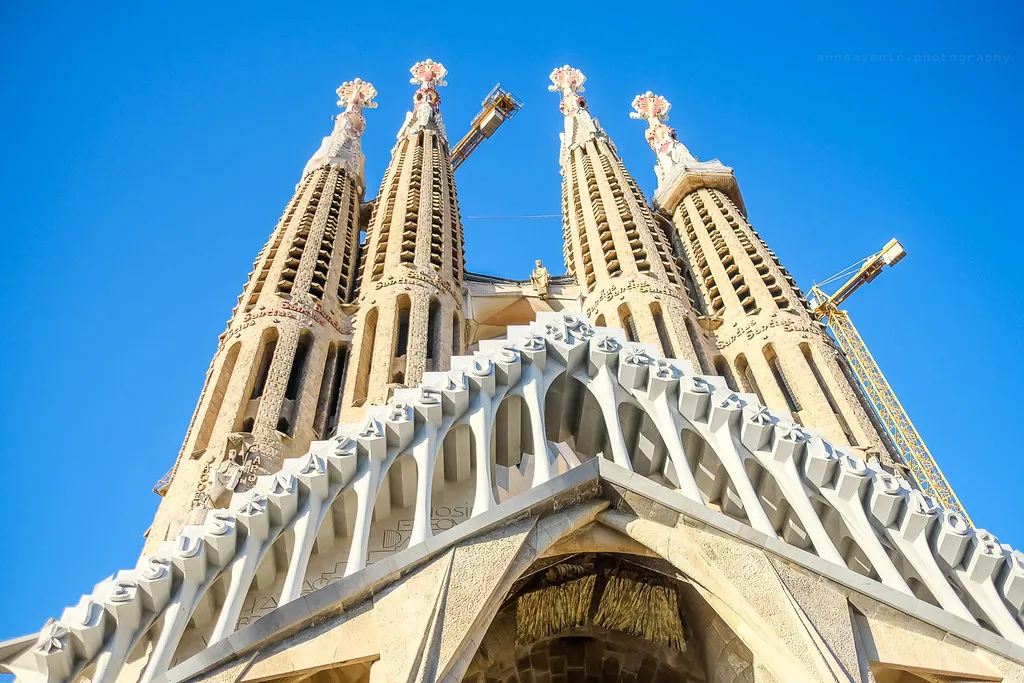
The Passion Facade faces west and is deliberately stark. Gaudí designed it to represent suffering, and sculptor Josep Maria Subirachs executed the angular, expressionist figures after 1989. Look for the magic square on the facade whose rows, columns, and diagonals all sum to 33 — the age of Christ at his death. Subirachs placed it there as a deliberate puzzle for visitors.
The Glory Facade on the south side remains under construction and will be the largest of the three when complete, with seven entrance portals representing the path to God. It faces Carrer de Mallorca and is already visible from street level, though full completion is still years away. Walk around the entire perimeter of the basilica — the contrast between all three facades in a single circuit is remarkable.
The Interior of the Sagrada Familia
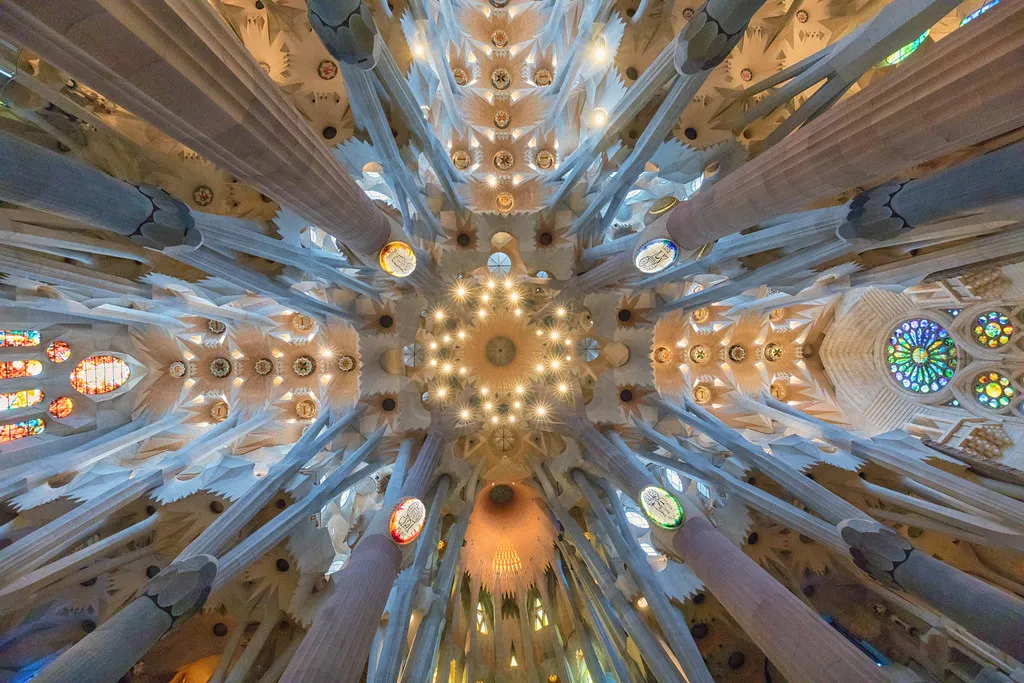
The interior is the single biggest surprise for first-time visitors. Most people expect something Gothic and dark; what they find is closer to being inside a living forest. The branching columns are made of four different stone types — porphyry, basalt, granite, and Montjuïc stone — each calibrated to carry a specific load. The hardest columns are nearest the centre; the softer stone columns line the outer aisles.
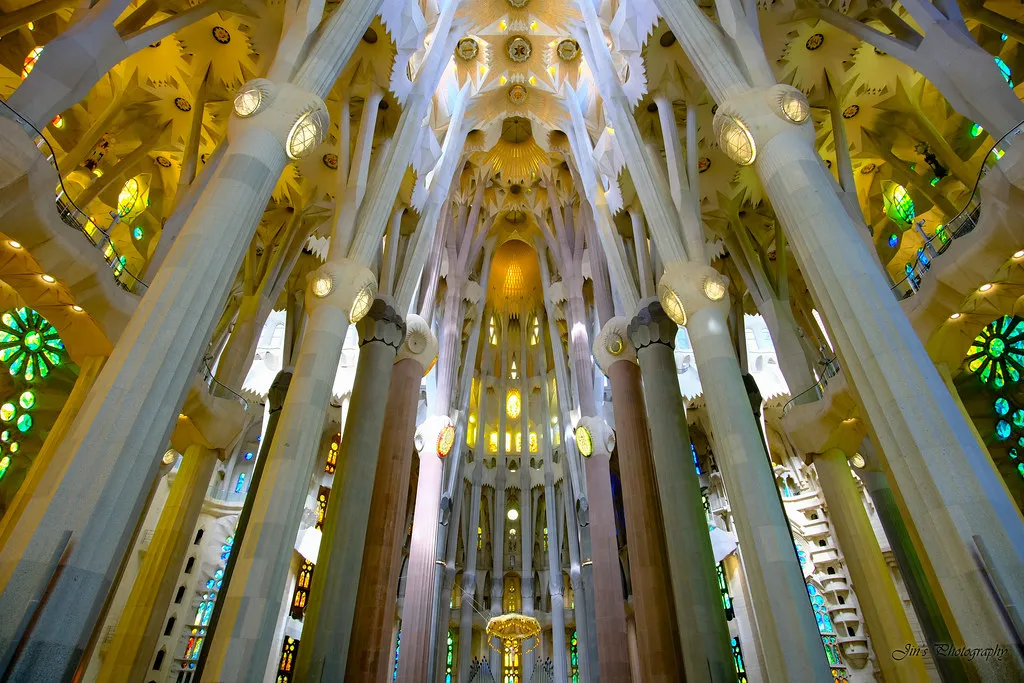
Gaudí developed the column system by building inverted rope models weighted at stress points, photographing the result upside down. The mathematics that emerged from those experiments means the Sagrada Familia uses no flying buttresses — the entire structure is self-supporting through the column geometry alone. This was genuinely revolutionary in 1900 and still unusual in 2026.
The stained-glass windows on the west side use cool blues and greens; those on the east use warm ambers and reds. When morning light streams through the east windows, the nave fills with colour in a way that photographs rarely capture. Arrive between 09:00 and 10:00 for the best light, or after 17:00 when the western windows are backlit by afternoon sun.
The nave can hold around 9,000 people for services. The choir galleries near the crossing offer seating for over 1,500 singers and are positioned on elevated platforms within the side aisles. The altar stands behind the nave in the apse, beneath a hanging canopy decorated with vine leaves — the only element Gaudí described as his concession to classical church design.
The Towers of Sagrada Familia
When complete, the Sagrada Familia will have 18 towers. The 12 lower towers (94–107 metres) represent the apostles; four taller towers (135 metres) represent the evangelists; a tower dedicated to the Virgin Mary rises to 138 metres; and the central tower of Jesus Christ will reach 172.5 metres — one metre shorter than Montjuïc hill, because Gaudí believed nothing built by humans should surpass God's creation.
Visitors can access two sets of towers: the Nativity Facade towers and the Passion Facade towers. Both require a separate ticket booked in advance. On the Nativity side, a lift takes you up and a narrow 16-floor spiral staircase brings you back down — the descent takes around 10 minutes and the stairwell is genuinely tight. The Passion side uses a newer elevator system and the stairwell is slightly wider, which makes it the better option for anyone with mild claustrophobia or knee problems.
The views from each set of towers differ meaningfully. From the Nativity towers you see northeast Barcelona toward the sea, the Parc de la Ciutadella, and the coastline. From the Passion towers you see the Eixample grid running west, and on clear days the Montjuïc hilltop is visible. Both vantage points are roughly 65 metres above street level — high enough to understand the scale of the Eixample district Gaudí worked within.
Tower tickets sell out months ahead in summer. If you are visiting between June and September, book tower access at least 6–8 weeks before your trip. Basic admission without towers remains available 1–2 weeks out for most of the year, but tower slots at popular entry times go much earlier. Book towers first; everything else can follow.
The Crypt, Rosary Chapel, and Cloister
The crypt is the oldest completed section of the Sagrada Familia, finished in 1891 in a Neo-Gothic style that predates Gaudí's radical redesign of the project. It contains seven chapels arranged around a rotunda. Gaudí himself is buried in the Chapel of Our Lady of Carmen, to the right of the central altar. The tomb is visible through a glass panel and receives a steady stream of visitors throughout the day. This is the only part of the building that retains the original Gothic approach — worth seeing precisely because it shows how dramatically Gaudí changed direction after taking over.
The Rosary Chapel sits at the corner of the cloister and is easy to miss. It is a small, intensely decorated space with a dome designed to flood with natural light. The walls are carved in a pattern that Gaudí described as resembling bobbin lace. Below the arches you can find a relief depicting the death of a righteous man, with the Virgin presenting the Christ child. The chapel also contains two unusual sculptural groups showing figures resisting temptation — one offered money by a monster, one offered an anarchist bomb — both turning to the protection of the Virgin. These were carved during Barcelona's period of intense political tension in the early 20th century.
The cloister wraps around the outside of the four facades rather than sitting in the interior as in a conventional cathedral — Gaudí's deliberate inversion of standard church design. It serves as a buffer between street noise and the interior of the basilica. Each side of the cloister corresponds to one facade, with portals that allow passage through. Walk the cloister circuit to see the outer walls of the apse, decorated with frogs, lizards, and salamanders clinging to the stone — symbols of diabolical forces that, as Gaudí put it, cannot enter the church. They also function as gargoyles, channeling rainwater away from the walls.
History and Construction Milestones
The Sagrada Familia was conceived by José María Bocabella, president of the Holy Brotherhood of Saint Joseph, who purchased a plot in the then-peripheral Eixample district in the 1870s. Land nearer the city centre was too expensive. The foundation stone was laid in 1882 under diocesan architect Francisco del Villar, who designed a straightforward Gothic crypt. Villar resigned within a year following disputes with Bocabella. Antoni Gaudí, then 31 years old, took over in 1883 and spent the remaining 43 years of his life on the project.
Gaudí was struck by a Barcelona tram on 7 June 1926 and died three days later. At the time of his death, only the crypt, the apse, and the Nativity Facade were substantially complete. He was reportedly mistaken for a beggar when found on the street due to his worn clothing and absence of documents. The St. Barnabas Tower on the Nativity side — completed 30 November 1925 — was the only tower he saw finished.
The Spanish Civil War (1936–1939) brought construction to a halt. Anarchists burned the crypt and destroyed many of Gaudí's original plaster models and workshop records. The loss was severe: reconstructing what had been destroyed required decades of archaeological work on surviving fragments and photographs. Modern computer-aided design, introduced in the 1980s and accelerated through the 1990s, transformed what was previously guesswork into a technically precise process.
Key milestones since then: the nave and crossing were roofed in 2000; Pope Benedict XVI consecrated the basilica on 7 November 2010, elevating it to a minor basilica; the towers of the four evangelists reached 135 metres in 2022; and the central tower of Jesus Christ broke 100 metres in 2023. The entire project is funded exclusively by ticket sales and private donations — no public subsidy. The 2026 completion target for the main structures marks the centenary of Gaudí's death, though final detailing on the Glory Facade will continue beyond that date.
Gaudí's School Building: The Detail Most Visitors Walk Past
In the corner of the Sagrada Familia grounds, just off Carrer de Provença, stands a small brick building with a remarkably undulating roof. This is the Escoles de la Sagrada Família, built by Gaudí in 1909 as a school for the children of construction workers. It is one of the most technically inventive structures Gaudí ever built: the walls and roof are formed from a single catenary surface, giving enormous structural strength from very thin brick. Le Corbusier visited in 1928 and wrote about it. The building still stands and now functions as an exhibition space within the complex — it is included with standard admission.
Almost nobody slows down to look at it properly. Most visitors walk straight past on their way to the main entrance. Spend five minutes examining the roof profile from the outside before you go in; then, once inside the exhibition, look at how the same catenary geometry that defines the school walls reappears at every scale in the basilica itself — from the crypt vaulting to the column branching in the nave. The school building is Gaudí's structural logic made visible in miniature.
Best Time to Visit and Practical Tips
The best entry times for photography and atmosphere are 09:00–10:00 (east light through the Nativity-side windows) and 17:00–19:00 (west light through the Passion-side windows). Midday from 12:00–15:00 is the busiest period regardless of season and offers flat overhead light with limited atmospheric quality. Even in winter, the 09:00 slot sells out by the time most visitors book, so secure it early.
Crowds are at their lowest in January, February, and November. July and August bring the highest footfall — around 10,000–12,000 daily visitors — but the summer light through the stained glass is spectacular if you can time your entry for morning. Spring (April–May) and autumn (September–October) offer a reasonable middle ground: fewer queues than summer, better weather than winter. You can find more context on the best time to visit Barcelona.
Getting there is straightforward. Metro Line 2 and Line 5 stop at Sagrada Família station (exit on Avinguda de Gaudí). The walk from the station exit to the main entrance is about two minutes. Buses 19, 33, 34, 50, and 51 also stop nearby. Cycling is feasible — there are Bicing stations on Carrer de la Marina and Avinguda de Gaudí. For full transport options, see getting around the city.
Allow at least 90 minutes for the basilica and museum. Add 45 minutes if you plan to do a tower visit. Large bags (over 30 × 20 × 10 cm) must be left at the bag check near the entrance. The audio guide is available in Catalan, Spanish, English, French, German, Italian, Portuguese, Russian, Japanese, and Mandarin.
10 Amazing Facts About Sagrada Familia
The Sagrada Familia is the tallest church in Europe. The central Jesus Christ tower at 172.5 metres will surpass the Ulm Minster in Germany (161.5 m) once complete. Gaudí capped the height at one metre below Montjuïc hill — he believed no human work should outreach nature.
UNESCO designated the Nativity Facade, the crypt, and the cloister as World Heritage in 1984, while the basilica was still under construction — an almost unprecedented recognition for an unfinished building. The full complex received an expanded UNESCO listing in 2005.
The builders' faces are literally in the walls. Gaudí used plaster casts of living workers and death masks of deceased ones as models for the sculptural figures on the Nativity Facade. You can find their likenesses in the Portal of Mercy nativity scene — ordinary Catalan workers rendered as biblical figures in stone.
Construction is entirely self-funded through ticket sales and donations. No government or church body provides ongoing subsidy. In a high-season year, the roughly 4.5 million visitors generate enough revenue to sustain a construction workforce of several hundred people year-round.
- Construction started 1882, still ongoing after 144 years — the longest active construction project in Spain.
- Gaudí is buried in the Chapel of Our Lady of Carmen in the crypt — visible through a glass panel.
- The 1909 school building on the grounds was cited by Le Corbusier as an influence on his own structural ideas.
- The magic square on the Passion Facade always sums to 33 in any direction — the age of Christ at his death.
- The basilica is not and never has been a cathedral — it has no bishop's seat. It is a minor basilica as of 2010.
- There are elevators inside the towers despite the towers being only metres wide at the upper levels.
Frequently Asked Questions
When will the Sagrada Familia be finished?
The Sagrada Familia is projected to be completed in 2026, marking the centenary of Antoni Gaudí's death. This date is an ambitious target, and construction progress depends on various factors. Visitors can follow updates on the official Sagradafamilia.org website.
Which Sagrada Familia Barcelona options fit first-time visitors?
First-time visitors should prioritize a general admission ticket with an audio guide. This provides essential information about the basilica's history and architecture. Consider adding a visit to one of the towers for panoramic city views. Booking a guided tour is also highly recommended for deeper insights.
How much time should you plan for Sagrada Familia Barcelona?
Plan for at least 1.5 to 2 hours for a basic visit to the basilica and museum. If you include a tower visit, allow 3 to 4 hours in total. This timeframe ensures you can comfortably explore all the main areas without rushing. Adjust based on your interest level.
What should travelers avoid when planning Sagrada Familia Barcelona?
Avoid arriving without pre-booked tickets, especially during peak season, as entry is often sold out. Do not miss visiting the museum in the basement, which offers crucial context. Also, avoid carrying large backpacks, as they may not be allowed inside or require checking. Always check official guidelines before your visit.
Is Sagrada Familia Barcelona worth including on a short itinerary?
Absolutely. Sagrada Familia is a must-see for any Barcelona itinerary, even a short one. Its unique architecture and ongoing construction make it an unforgettable experience. Allocate at least two hours for your visit to fully appreciate its grandeur and history.
The Sagrada Familia Barcelona is unlike any other building on earth — still incomplete after 144 years, self-funded through every ticket sold, and genuinely different every decade as new sections are added. The 2026 centenary of Gaudí's death makes this a particularly significant year to visit.
Book tower tickets first, plan your entry time around the light, and give yourself time to find the small things: the workers' faces in the Portal of Mercy, the school building with the undulating roof, the frog gargoyles on the cloister walls. The big picture overwhelms on first sight; the details are what stay with you.
You might also like


Continue reading
More guides you'll find useful


