Getting Around Barcelona: Your Ultimate Transport Guide
Navigate Barcelona like a local! Discover public transport, walking tours, taxis, and more with practical tips, costs, and decision-making advice for a smooth trip.
On this page
Getting Around Barcelona: Your Ultimate Transport Guide
Barcelona packs an enormous amount into 101 square kilometres. Mountains on one side, the sea on the other, and a dense urban grid in between — all of it connected by one of the best public transport networks in southern Europe. For most visitors, a combination of walking and the metro covers 90% of daily movement. The rest of this guide handles every other scenario: buses, trams, taxis, cycling, driving, and getting to and from the airport.
Plan with trusted sources: cross-check opening hours and seasonal details with the official Barcelona tourism board, and read more about the city on its Wikipedia entry before you go.
Barcelona's Transport Network at a Glance
The city's public transport is divided into six fare zones. Almost everything tourists want to see sits within Zone 1, which covers the entire city and inner suburbs. All metro, bus, tram, and FGC journeys within Zone 1 use the same ticket — the T-casual or Hola BCN! card. You do not need to buy separate tickets for each mode. The one exception is airport travel, which requires a dedicated airport supplement or ticket regardless of your pass.
Two agencies run the network. TMB (Transports Metropolitans de Barcelona) operates the metro and city buses. FGC (Ferrocarrils de la Generalitat de Catalunya) runs suburban rail lines toward Sarrià, Tibidabo, and longer routes like Sant Cugat and Manresa. RENFE's Rodalies network covers coastal and suburban connections beyond the city. All three are integrated under Zone 1 ticketing for in-city travel.
The metro runs from 05:00 to midnight Monday through Thursday and Sunday. On Friday it runs to 02:00. On Saturday and the night before public holidays it runs all night. Night buses (NitBus, line codes beginning with N) cover the gaps between midnight and 05:00 on other nights, though frequency drops to one bus every 20–30 minutes on most lines.
Metro, Bus, and Tram: Practical Guide
The metro has eight lines and over 160 stations. It is the fastest option for cross-city journeys — a trip from Barceloneta to Gràcia takes about eight minutes versus 25 on foot. Trains run every four to six minutes during peak hours on weekdays, and every eight to twelve minutes on weekends. The system is clean, air-conditioned, and well-signed in Catalan, Spanish, and English.
City buses run over 80 lines and are useful for routes between metro stations or for staying above ground. Regular lines are coded with a number or letter-number combination (D20, V19, H10). You can pay by tapping a contactless bank card, in cash, or with a metro pass. Night buses operate the same Zone 1 pass, but carry cash as a backup — not all NitBus routes accept card payment on board.
The tram network has six lines and 56 stops covering 29 km, mainly in the Diagonal corridor and newer districts toward Diagonal Mar and Sant Martí. It is quieter and less crowded than the metro. Your Zone 1 metro pass is valid on trams. The tram is particularly handy for reaching the Forum and Diagonal Mar area without changing metro lines.
For Montjuïc, use the Montjuïc funicular from Paral·lel station (covered by your Zone 1 pass), then continue up to the castle on the Montjuïc cable car. A one-way cable car ticket costs around 10 EUR; a return is 16 EUR. A separate Port cable car runs from Barceloneta beach to Montjuïc via the San Sebastian Tower — return tickets cost around 20 EUR and offer sea-level-to-hilltop views in one journey.
Choosing the Right Ticket: T-Casual vs. Hola BCN!
This is the decision most first-timers get wrong. The two main options are the T-casual and the Hola BCN! card, and the right choice depends entirely on how many journeys you plan to make per day.
The T-casual gives you 10 single journeys within Zone 1 for 12.50 EUR (2026 price). Each journey allows unlimited transfers between metro, bus, tram, and FGC within 75 minutes of validation. A single journey without a pass costs 2.55 EUR. If you make four or fewer journeys per day, the T-casual is almost always better value. It is also shareable — two people can load trips from the same card and take turns validating.
The Hola BCN! travel card gives unlimited journeys for a fixed period: 17.50 EUR for 2 days, 25.50 EUR for 3 days, 33.30 EUR for 4 days, and 40.80 EUR for 5 days (2026 estimates — verify current prices at the TMB website). It breaks even at roughly five or six journeys per day. If you are moving between neighborhoods frequently — beach in the morning, Sagrada Família in the afternoon, dinner in Gràcia, nightclub in Poble Sec — the Hola BCN! pays off from day one.
One critical point that trips up many visitors: you cannot tap a contactless bank card at metro turnstiles. The metro requires a physical ticket. You buy tickets at vending machines in every station, which accept cash and cards. Buses, by contrast, do accept contactless payment directly on the reader. So if you run out of T-casual journeys late at night, you can still board a bus with your bank card — but not the metro.
Neither pass covers airport travel. The L9 airport metro line requires a separate airport supplement (around 5.50 EUR in 2026). The RENFE Rodalies train to Terminal 2 uses a standard Zone 1 T-casual trip if your card has trips remaining, making it the cheapest option from the airport at roughly 1.25 EUR per journey used.
Exploring Barcelona on Foot
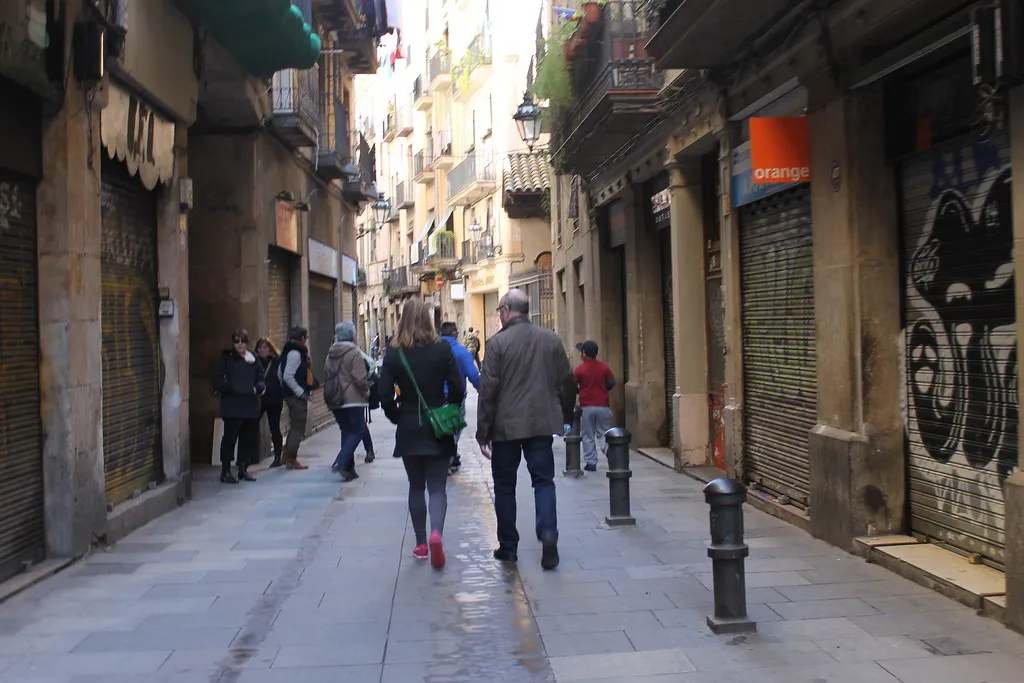
Many of Barcelona's most visited areas are compact enough that walking is faster than waiting for a train. The Gothic Quarter, El Born, El Raval, and the waterfront from Barceloneta to the Port Olímpic are all walkable from each other in under 20 minutes. The Eixample grid is straightforward to navigate because Cerdà's 19th-century urban plan makes every block roughly the same size.
The Gothic Quarter is best explored on foot — the streets are too narrow for buses and the metro does not run beneath the old Roman grid. Entering from Plaça de Catalunya and winding through Carrer del Bisbe toward the Cathedral takes about 45 minutes at a leisurely pace. El Born, immediately to the east, adds another 30–40 minutes and gets you to the Picasso Museum and the Basilica de Santa Maria del Mar.
Gràcia, north of the Eixample, rewards walkers with a quieter, village-like atmosphere. The neighbourhood's squares — Plaça del Sol, Plaça de la Virreina, Plaça de la Vila de Gràcia — are best approached on foot from the Fontana or Diagonal metro stops. Poblenou, to the east near the coast, is another walkable district that most tourists skip, with converted industrial lofts, street art, and a rambla of its own.
One practical note: Barcelona is flatter than it looks on a map in the central areas, but Montjuïc and the Tibidabo hill require mechanical assistance. Save your legs and use the funicular for both. For guided walking tours of Barcelona, many operators run free-with-tip Gothic Quarter tours starting from Plaça Reial at 11:00 and 15:00 daily.
Taxis, Ride-Sharing, and Cycling
Barcelona's taxis are black and yellow and can be hailed anywhere a green light is showing on the roof. The base fare is around 2.15 EUR (2026), with a per-kilometre rate that rises during night hours (21:00–07:00), on Sundays, and on public holidays. Airport trips carry a flat supplement. Radio-Taxi 033 (+34 93 303 3033) and Servitaxi (+34 93 330 0300) both operate 24 hours. Tipping is not expected, though rounding up is common.
Uber and Cabify operate legally in Barcelona as pre-booked ride-hailing services — you cannot hail them on the street the way you would in the US. Both apps work reliably and prices are competitive with taxis, though surge pricing applies during peak times and after major events. For late-night returns from clubs in areas like Poble Sec or the Forum, these apps are the most practical option when the metro is closed and NitBus routes are infrequent.
Cycling is genuinely viable in Barcelona. The city has over 200 km of dedicated bike lanes, and the seafront passeig from Barceloneta toward Diagonal Mar is almost entirely on protected cycle infrastructure. Tourist bike hire is available across the city — a standard bike typically costs 10–15 EUR per day. For longer stays, the Bicing subscription service offers city bikes for 50 EUR per year, but it is designed for residents and requires a local address to register.
Driving and Car Hire in Barcelona
A car is not useful for getting around Barcelona city centre. Roads are congested during rush hours, parking in the centre is expensive (3–5 EUR per hour in blue-zone street parking) and often impossible to find near major attractions. The Eixample's superblocks scheme has further restricted through-traffic in large parts of the central grid since 2022. You will cover more ground in less time on the metro.
Where a car does make sense is for day trips and regional exploration outside the city. Montserrat, the Costa Daurada, the Penedès wine country, and the Dalí Triangle in northern Catalonia are all easier by car than by train if you want flexibility. The minimum age for car hire in Spain is 21. You need a valid driving licence, passport, and proof of international insurance — which rental companies sell at the counter if you do not already have cover.
Major hire companies (Avis, Hertz, Europcar, and local operators) all have desks at Barcelona El Prat Airport, making it easy to pick up a car on arrival if you plan a mixed city-and-road-trip itinerary. If you are spending your first days in the city, collect the car on the day you plan to leave — not on arrival.
Barcelona has a Low Emission Zone (ZBE) that restricts older vehicles from entering the city. If hiring or driving your own car, check that the vehicle has the DGT environmental badge required to enter. Rental cars from major companies will meet the standard, but verify if you are bringing a personal vehicle from outside Spain.
Getting To and From Barcelona El Prat Airport
Barcelona El Prat Airport (BCN) sits about 12 km southwest of the city centre. Four options cover most travellers: Aerobús, metro, RENFE train, and taxi. Each involves a different trade-off between cost, speed, and convenience.
The Aerobús is the simplest choice for most visitors. Express buses run every 5–10 minutes from both terminals to Plaça Catalunya, with stops at Plaça Espanya and Gran Via on the way in. Journey time is around 35 minutes. A one-way ticket costs around 6.75 EUR in 2026; a return is 10.50 EUR. It runs from 05:35 to 01:05, covering early flights and late arrivals. You can also connect from Barceloneta and Diagonal.
The metro L9 Sud connects both terminals to the metro network, but does not run all the way to the city centre — you must change at Torrassa or Europa Fira onto L1 or L3. Total journey time including the transfer is 40–50 minutes. An airport-specific single ticket costs around 5.50 EUR (2026). This is useful if your accommodation is in the south or west of the city near one of those transfer stations.
The RENFE Rodalies train (line R2 Nord) serves Terminal 2 only, stopping at Barcelona Sants and Passeig de Gràcia. Journey time is around 20 minutes to Sants. A T-casual journey covers this route if you have trips remaining on your card, making it essentially free if you already bought a pass. Terminal 1 passengers need the free T1–T2 shuttle bus first, adding around 10 minutes. This is the fastest and cheapest land option for passengers arriving at or going to Terminal 2.
Taxis from the airport to the city centre cost roughly 30–40 EUR depending on destination and time of day. For groups of three or more sharing a fare, the taxi competes on value with the Aerobús. Cabify and Uber also operate from the airport with pre-booked pickups from designated zones outside arrivals. For a detailed breakdown, see our dedicated guide to getting from Barcelona Airport to the city centre.
| Option | Cost (one-way) | Journey Time | Terminals | Best For |
|---|---|---|---|---|
| Aerobús | ~6.75 EUR | ~35 min | T1 & T2 | Most visitors; direct to Plaça Catalunya |
| Metro L9 Sud | ~5.50 EUR | 40–50 min (with transfer) | T1 & T2 | Travellers staying in south/west city |
| RENFE Rodalies | ~1.25 EUR (T-casual trip) | ~20 min to Sants | T2 only | Budget travellers; T2 arrivals with pass |
| Taxi | 30–40 EUR | 25–45 min | T1 & T2 | Groups of 3+; heavy luggage; late night |
| Uber / Cabify | ~25–40 EUR | 25–45 min | T1 & T2 | Pre-booked convenience; surge pricing applies |
Practical Tips for Getting Around Barcelona
Validate your ticket every time you board. The yellow validation machines at metro gates and on buses record each journey — if you tap an unvalidated card and an inspector checks, you face a fine of around 100 EUR even if you have a valid pass loaded. Fines are issued on the spot and are non-negotiable.
Pickpocketing is a genuine problem on the L1 and L3 metro lines between the airport, Plaça Catalunya, and Las Ramblas. Keep your phone in a front pocket and your bag in front of you on crowded platforms. Incidents spike in summer when the metro is most crowded. The restaurant and tapas areas around Las Ramblas and La Boqueria see the highest reported rates in the city.
Most metro stations in the city centre have lift access, and buses have low-floor ramps as standard. However, around 30% of stations — particularly on the older L1 and L5 lines — still lack full step-free access. The TMB website lists accessibility status for every station. Newer tram lines and the L9/L10 lines are fully accessible. If you are travelling with a wheelchair or pushchair, check your specific route on the TMB journey planner before you travel.
Google Maps works well for planning public transport routes in Barcelona and shows real-time delays. Citymapper is an alternative that handles bike and tram routing more reliably. Both apps show which exit to use at metro stations, which saves time in larger interchanges like Passeig de Gràcia or Universitat. Download offline maps before you go — roaming data can be unreliable in the tunnels.
Frequently Asked Questions
What is the best way to get around Barcelona for tourists?
For most tourists, a combination of walking and using Barcelona's excellent public transport (metro and bus) is ideal. Consider a T-casual ticket for 10 journeys or a Hola BCN! card for unlimited travel. Walking allows you to discover charming neighborhoods like the Gothic Quarter.
Is Barcelona easy to walk around?
Yes, many parts of Barcelona are very walkable, especially the central districts. The city center is relatively flat and compact, making it pleasant to explore on foot. Areas like El Born, Gràcia, and the Gothic Quarter are particularly suited for walking tours.
How much does public transport cost in Barcelona?
A single public transport ticket costs approximately 2.55 EUR (2026 estimate). A T-casual card, valid for 10 journeys in Zone 1, costs around 12.50 EUR. The Hola BCN! travel card offers unlimited travel for 2-5 days, with prices varying based on duration. These options provide flexibility for different travel styles.
How do I get from Barcelona airport to the city center?
You have several options: the Aerobús (express bus), public bus (line 46), metro (L9 Sud), or RENFE train. Taxis and ride-sharing services are also available. The Aerobús is fast and direct, while the metro and train offer good value. Check our airport transfer guide for detailed comparisons.
Barcelona's transport network is genuinely one of the easiest in Europe to navigate. Buy a T-casual or Hola BCN! card on arrival, use your legs for the historic centre, and fall back on the metro for anything more than a 20-minute walk. For airport transfers and regional day trips, the options are plentiful and well-priced. The city rewards visitors who explore beyond the obvious routes — and getting there is usually the easy part.
You might also like


Continue reading
More guides you'll find useful