Park Guell Barcelona Travel Guide
Plan park guell barcelona with top picks, neighborhood context, timing tips, and practical booking advice for a smoother trip.
On this page
Park Guell Barcelona: Your Essential Travel Guide
Park Güell Barcelona stands as one of Antoni Gaudí's most ambitious creations. Perched in the Gràcia district above the city, it blends organic architecture, vibrant mosaic work, and sweeping views across the skyline to the Mediterranean. No other site in the city gives you the same combination of Gaudí's genius and open sky.
The park divides into two distinct zones: the ticketed Monumental Area, where the famous structures sit, and the surrounding free forest park. Both are worth your time. Planning the visit carefully — particularly around tickets and timing — makes the difference between a smooth morning and a frustrating queue.
Plan with trusted sources: cross-check opening hours and seasonal details with the official Barcelona tourism board, and read more about the city on its Wikipedia entry before you go.
A Short History of Park Güell
Park Güell's story began in 1900, when wealthy industrialist Eusebi Güell commissioned Antoni Gaudí to design a garden city for Barcelona's elite. Güell was inspired by the British garden-city movement and wanted 60 private residential plots laid out across the Collserola hillside, each with views of the sea. Construction progressed for over a decade, but buyers never materialised — only two houses were ever completed.
Gaudí himself purchased one of those houses in 1906 and lived there until 1925. Güell died in 1918, and in 1922 the Barcelona City Council acquired the estate. The park opened to the public in 1926, the same year Gaudí was struck and killed by a tram just a few streets away. In 1984, UNESCO awarded it World Heritage status alongside six other Gaudí works in the city.
The original failed housing venture actually gave the park its character. Because no residents moved in, the infrastructure Gaudí designed — the viaducts, the market hall, the grand staircase — was never put to ordinary daily use. It survived intact as pure architecture, which is why what you see today is essentially as Gaudí left it.
Tickets and Opening Times in 2026
Entry to the Monumental Area requires a timed ticket booked in advance. In 2026, adult tickets cost €18. A reduced rate of €13.50 applies to children aged 7–12 and visitors over 65. Children under 7 enter free but must still be listed on the booking. Buy directly through the official site at parkguell.barcelona to avoid inflated prices on third-party platforms.
One detail many first-timers miss: your ticket is only valid for entry within 30 minutes of your booked time slot. If you arrive late, you lose access. Give yourself a full 45 minutes of travel time from wherever you are staying, especially during peak season when public transport can be slow. Once inside, you can stay as long as you like.
The Monumental Area opens at 09:30 and closes at 18:00 in winter months (roughly November through February), extending to 19:30 from late March onward. The free forest park surrounding it has no set closing time. The Gaudí House Museum inside the park requires a separate ticket and operates on its own schedule — check parkguell.barcelona for current hours before your visit.
The wider forest area, including the viaduct paths and the Three Crosses hilltop, is entirely free and requires no booking. Many visitors spend an hour in the Monumental Area and another hour in the free zone without spending anything beyond the entrance ticket.
| Visitor Type | Monumental Area Ticket (2026) | Gaudí House Museum | Free Forest Park |
|---|---|---|---|
| Adults | €18.00 | Separate ticket required | Free, no booking |
| Children 7–12 / Over 65 | €13.50 | Separate ticket required | Free, no booking |
| Children under 7 | Free (must be listed on booking) | Separate ticket required | Free, no booking |
What to See at Park Güell
The Dragon Stairway at the main entrance is the image most people associate with the park. Twin flights of steps climb toward the Hypostyle Room, flanked by fountains and mosaic crenellations. Halfway up sits El Drac — the famous mosaic salamander, 2.4 metres long and covered in broken ceramic tiles in shades of turquoise, orange, and midnight blue. This is the park's most photographed spot; visit early or late to get a clear photo.
Above the stairway, 86 slanted Doric columns support the Hypostyle Room, which Gaudí originally designed as a covered market for the housing estate. The columns tilt slightly off-axis on purpose, creating a sense of movement. The ceiling domes are studded with circular trencadís mosaics — look up and you will spot astrological symbols, references to the seasons, and an octopus pattern. Designed by Gaudí's collaborator Josep M. Jujol, they are some of the most intricate ceramic work in the city.
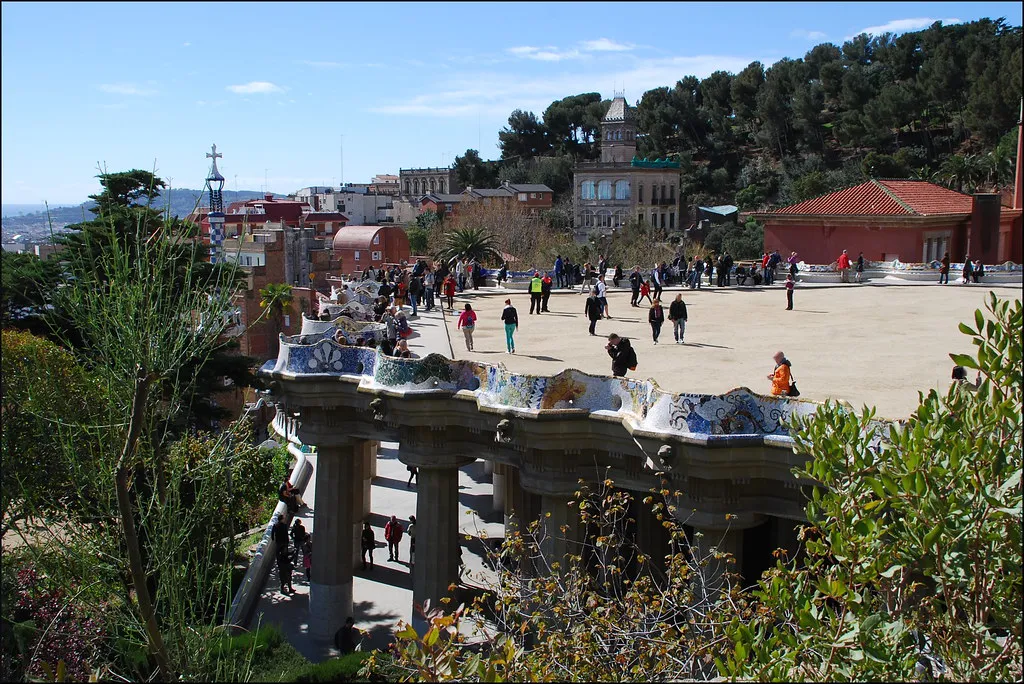
The Serpentine Bench crowns the terrace above and curves for roughly 110 metres around the panoramic square known as La Plaça de la Natura or the Greek Theatre. The bench was shaped ergonomically — the story goes that a worker pressed wet cement with his body to determine the seat profile. Gaudí also built hidden drainage into it: rainwater collects through tiny holes in the backrest and channels through the stone lion-head spouts visible on the Hypostyle ceiling below. From the bench, the views across the city and out to the Mediterranean are the best in the park.
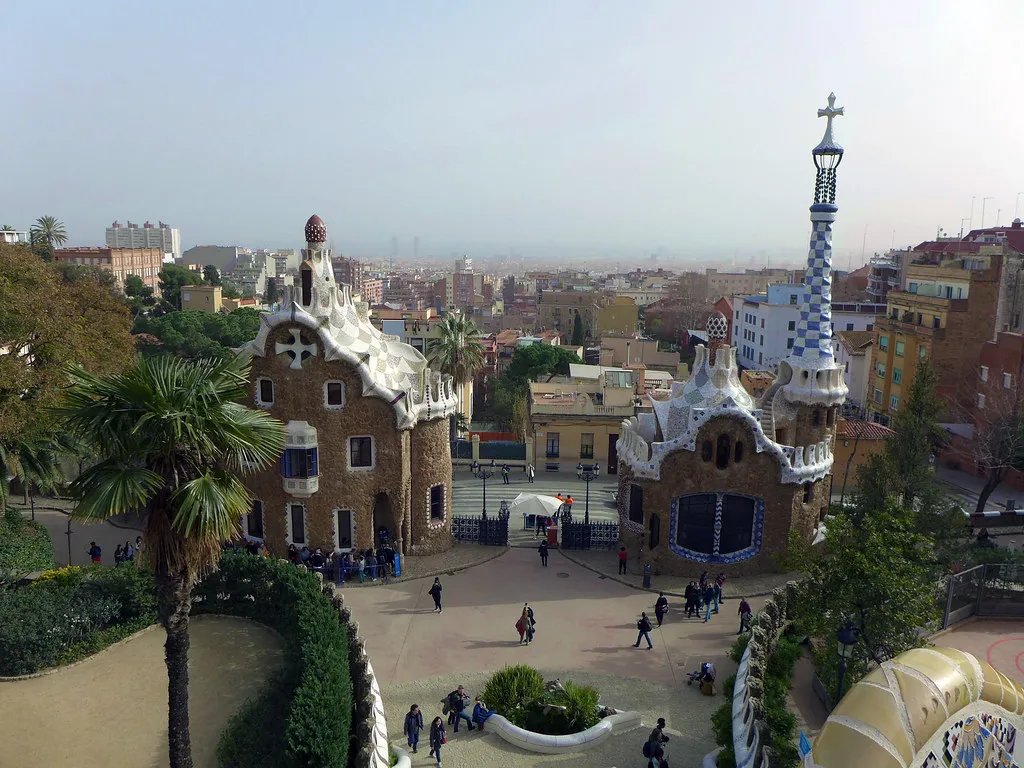
At the main entrance, the twin Porter's Lodge Pavilions flank the gate like oversized gingerbread houses. Their tiled roofs and mosaic details were deliberately designed to evoke the fairy-tale houses from a production of Hansel and Gretel staged in Barcelona the same year work began. The left pavilion is now a souvenir shop; the right one houses a small exhibition on the park's history.
The Viaducts and Laundry Room Portico
The viaducts are the most underrated structures in the park. Gaudí designed three tiered walkway bridges — the Low, Middle, and High Viaducts — to connect the different levels of the hillside estate. They were intended for residents and horse-drawn carriages, but today function as shaded walking paths. The High Viaduct is lined with stone columns that look like palm trunks; the Middle Viaduct resembles a natural cave at its base. These paths are in the free zone, requiring no ticket.
Connecting the viaduct area to the Larrard House gardens is the Laundry Room Portico (Rentadors). The portico's leaning stone columns angle dramatically outward, mimicking an ocean wave. Gaudí built it to look eroded rather than constructed — rough-hewn and organic. Set in a pine forest, it is one of the quietest and most atmospheric corners of the entire park. Look carefully at the columns: one of them is carved into a figure of a washerwoman carrying a laundry basket, a reference to the caryatids of ancient Greek temples.
From here you have a clear view toward the Austria Gardens and the Gaudí House Museum. This section of the park receives fewer visitors than the Monumental Area even on busy days, which makes it a reliable escape from the crowds.
Austria Gardens and the Gaudí House Museum
The Austria Gardens occupy the area that was originally earmarked for private plots. When the municipal authorities took over the park in 1922, the land became a plant nursery. In the 1970s, the Austrian government donated thousands of trees, and the gardens took their current name. Today they are among the most tranquil parts of the park — bougainvillea climbs along the paths and the planting is dense year-round.
Visible from the gardens is the Gaudí House Museum, the house where the architect lived from 1906 until a year before his death. The building was not designed by Gaudí himself — it was the work of his collaborator Francesc Berenguer — but Gaudí furnished and occupied it for nearly two decades. The museum holds personal furniture, drawings, and religious objects. It is one of only two houses ever completed on the original estate.
A separate ticket is required for the museum, priced independently of the Monumental Area entry. If you plan to visit both, buy the museum ticket in advance alongside your park entry. It is easy to overlook on a general park visit, but for anyone interested in Gaudí's personal life rather than just his public architecture, the house is genuinely revealing.
How to Get to Park Güell
The park sits in the La Salut neighbourhood of the Gràcia district, well above the city centre. The nearest metro station is Lesseps on Line L3 (green line). From there, the walk to the main entrance at Carrer Olot 7 takes about 20 minutes and is uphill all the way. Escalators on Avinguda del Santuari de Sant Josep de la Muntanya ease part of the climb. Line L3's Vallcarca stop also works and connects to more escalators on the hillside.
Several bus lines run closer to the entrance. The H6 and D40 stop at Travessera de Dalt, about 10 minutes from the gate. Bus 24 also serves the area. These can save 10–15 minutes of walking compared to the metro route, which is useful if you are on a tight schedule or have young children.
One important detail: the park has multiple entrances, but several are reserved for residents of the surrounding neighbourhood. Navigate specifically to the main ticket office at Carrer Olot 7 — not just "Park Güell" on a map, which may route you to a resident-only gate. This is a common first-timer mistake that costs 15 minutes at minimum. For top things to do in Barcelona across multiple sites, factor in that the park's distance from the Gothic Quarter or Eixample means at least 30 minutes of travel. For full transport options across the city, see our guide on getting around the city.
When to Visit and How Long to Allow
The park draws roughly 9 million visitors a year, making timing a real consideration. Weekday mornings shortly after 09:30 are the least crowded slots. Weekends between 11:00 and 15:00 in summer are the busiest. Late afternoon visits, from about 17:00 onward, offer calmer conditions and better light for photography — the city below turns golden in the hour before closing.
Allow 2 to 3 hours for a full visit covering both the Monumental Area and the free forest zone. If you only want the main structures — Dragon Stairway, Hypostyle Room, Serpentine Bench — 90 minutes is enough. Add time if you plan to visit the Gaudí House Museum separately, or if you want to walk up to the Three Crosses at El Calvari (182 metres above sea level), which adds roughly 30 minutes round trip.
Avoid visiting without a pre-booked ticket in summer. Walk-up tickets sell out days in advance, and same-day availability is not guaranteed. The 30-minute arrival window is strictly enforced — unlike many European attractions, there is no grace period for late arrivals.
Gaudí's Barcelona Beyond the Park
Barcelona is the only city in the world where a single architect's work defines an entire urban identity. Gaudí spent nearly his entire career here, and the concentration of his buildings within a few kilometres is extraordinary. Park Güell, Sagrada Família, Casa Batlló, Casa Milà (La Pedrera), and Palau Güell together account for most of what draws visitors to the city. All but the park are in or near the Eixample district.
The trencadís technique you see on the Serpentine Bench appears again on the rooftop chimneys of Casa Milà. The organic column forms of the Hypostyle Room echo in the forest of stone columns inside the Sagrada Família nave. Visiting the park with this context makes the individual elements easier to read — Gaudí was developing a consistent visual language across all of his work rather than reinventing the style each time.
For visitors with limited time, Park Güell and Sagrada Família are the two sites that work best together as a single day. Both are north of the city centre; the metro journey between them takes about 20 minutes. For more on how to combine Gaudí's major works, see our guide to Gaudí buildings in Barcelona. If you are working out how many days the city deserves, our overview at Barcelona 1-day itinerary covers the fastest possible route through the essentials.
Practical Tips Before You Go
Book tickets on the official site, parkguell.barcelona. Third-party resellers charge a premium and some operate with unofficial or resold tickets. The official site supports multiple languages including English, Spanish, and Catalan, and confirms your booking by email with a QR code for entry.
Wear shoes with grip. The stone paths, viaducts, and hillside trails are uneven, and some sections are steep. The park is not stroller-friendly in the Monumental Area — stairs are unavoidable there — but the wider forest paths are more accessible. The park has no formal bag storage, so pack light.
The Monumental Area gets full sun by late morning. Bring water, especially from May through September. There is a small café near the main entrance but no food service inside the ticketed zone. The free forest park offers more shade and is a reasonable place for a picnic outside the monumental section.
Mobile data coverage inside the park is generally good and the free Parc Güell app includes a map and itinerary suggestions. The official app tends to skip the viaducts and the Three Crosses in its recommended routes — worth noting if you want to see everything.
Frequently Asked Questions
What is Park Güell?
Park Güell is a public park in Barcelona designed by Antoni Gaudí. It features unique architectural elements, colorful mosaics, and lush gardens. The park is a UNESCO World Heritage site and a top tourist attraction.
How much time should you plan for Park Güell Barcelona?
Plan at least 2 to 3 hours to fully explore Park Güell, including the monumental zone and free areas. This allows time to appreciate Gaudí's architecture and enjoy the panoramic views. Allocate extra time for travel to and from the park.
Which Park Güell Barcelona options fit first-time visitors?
First-time visitors should definitely purchase tickets for the monumental zone to see the iconic Gaudí structures. Consider a guided tour to gain deeper insights into the park's history and design. Exploring the surrounding free areas also offers lovely views and peaceful walks.
What should travelers avoid when planning Park Güell Barcelona?
Avoid visiting Park Güell without pre-booked tickets, especially during peak season, to prevent long waits or denied entry. Do not wear uncomfortable shoes, as there is significant walking and uphill climbing. Also, try to avoid midday visits in summer due to intense heat and larger crowds.
Is Park Güell Barcelona worth including on a short itinerary?
Yes, Park Güell is absolutely worth including even on a short Barcelona 1-day itinerary. Its unique architecture and stunning views offer a memorable experience that captures the essence of Gaudí's work. Plan your visit efficiently to maximize your time.
Park Güell rewards visitors who go prepared. Book tickets early, navigate to the correct entrance at Carrer Olot 7, and build in time for the viaducts and free forest zone beyond the main structures. The Monumental Area is the headline draw, but the quieter corners of the park are where the visit becomes genuinely memorable.
From its origins as a failed housing estate to its current status as a UNESCO World Heritage site welcoming 9 million visitors a year, the park tells a story as compelling as its architecture. Gaudí's work here was never meant to be a public spectacle — which may be exactly why it feels so unlike anything purpose-built for tourism.
You might also like


Continue reading
More guides you'll find useful