

10 Must-See Gaudi Buildings in Barcelona (2026)
Discover the top 10 iconic Gaudi buildings in Barcelona, from Sagrada Familia to Park Güell. Get practical tips, history, and visitor info for your trip.
On this page
10 Essential Gaudi Buildings to Explore in Barcelona
Barcelona is the world's greatest open-air architecture museum, and Antoni Gaudí is the reason. No other city has one architect's fingerprints on so many world-class landmarks, and 2026 marks a particularly significant moment: the final towers of the Sagrada Família are due to be completed a century after Gaudí's death. If you've ever planned to visit, now is the year. This guide covers all 10 essential Gaudí buildings in Barcelona with current prices, practical logistics, and honest notes on which ones are worth the ticket.
Seven of Gaudí's Barcelona works are recognized as UNESCO World Heritage Sites. Several are among the most visited attractions in all of Spain. Planning which ones to see, and in what order, makes the difference between a rushed day of queuing and a deeply memorable architectural journey. You'll find everything you need here, from hidden gems to the must-see giants. For broader trip planning, check our guide to top things to do in Barcelona.
Plan with trusted sources: cross-check opening hours and seasonal details with the official Barcelona tourism board, and read more about the city on its Wikipedia entry before you go.
Antoni Gaudí: An Architectural Legend
Antoni Gaudí i Cornet was born in Reus, Catalonia, on 25 June 1852. He moved to Barcelona at 16 to study architecture and never really left. His early works already rejected the straight lines common in 19th-century construction. Gaudí believed nature was the supreme teacher — he observed how trees branch, how bones bear load, how leaves channel light — and built accordingly.
His signature techniques included trencadís (mosaics of broken ceramic and glass), parabolic arches that distribute weight without buttresses, and hyperbolic vaults modelled on tree canopies. These were not decorative choices; they solved structural problems in cheaper, lighter ways than conventional methods. His deeply Catholic faith drove his symbolism, especially in the Sagrada Família, where every column, pinnacle, and stained-glass window encodes scripture.
Gaudí died on 10 June 1926 — three days after being struck by a tram near his beloved basilica. He was initially mistaken for a beggar due to his worn clothing. He is buried in the crypt of the Sagrada Família. His cause for beatification has been open in the Vatican since 2003, giving him the informal title "God's architect" among devotees.
1. La Sagrada Família: Barcelona's Unfinished Masterpiece
No building on earth compares to the Sagrada Família. Construction began in 1882 under a different architect; Gaudí took over in 1883 and spent the final 43 years of his life on it. The basilica has been under construction for over 140 years and is finally approaching completion in 2026, with the central Jesus tower — the tallest at 172 metres — expected to be finished this year. Visiting in 2026 means you can witness a once-in-a-century milestone.
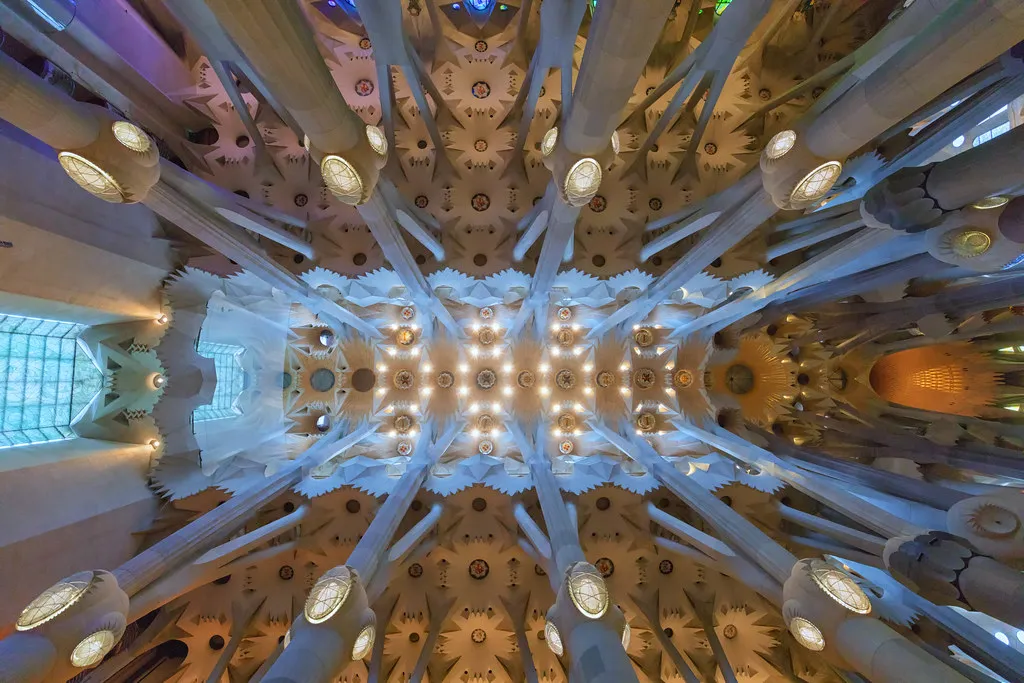
The exterior presents three façades telling the full arc of Christ's life: the Nativity (east, worked on by Gaudí himself), the Passion (west, stark and angular), and the Glory (south, still being completed). Inside, twisted stone columns branch like a stone forest, and stained-glass windows flood the nave in deep greens on one side and warm ambers on the other depending on the time of day. The late afternoon light through the west windows is extraordinary — plan your visit for 16:00–18:00 if possible.
Book tickets well in advance: the Sagrada Família sells out weeks ahead in summer. Basic entry costs around €26; add €9 for tower access (book the Nativity Tower for better views). Modest dress is required — no bare shoulders or shorts. The site is accessible via Metro L2/L5 (Sagrada Família stop), a short walk from the entrance.
2. Park Güell: A Whimsical Urban Oasis
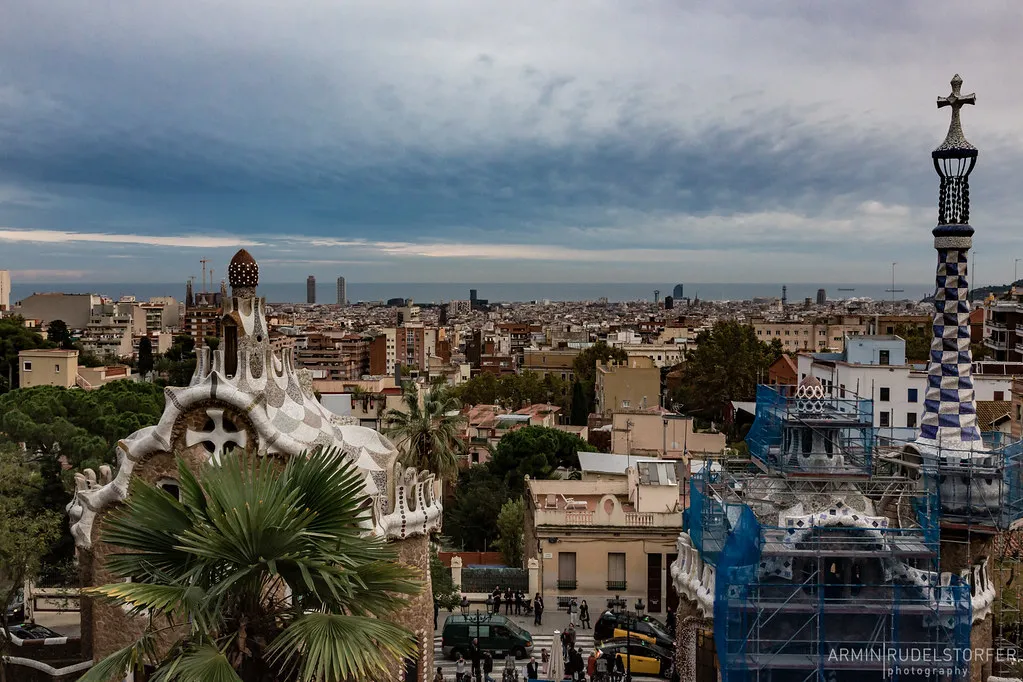
Originally designed as a luxury residential estate for Eusebi Güell, Park Güell was abandoned as a housing project in 1914 after only two houses sold. Barcelona took over the grounds in 1926 and opened them as a public park. Today the Monumental Zone — the ticketed central area — contains Gaudí's most iconic public works: the dragon staircase, the Hall of a Hundred Columns (actually 86), and the sinuous Serpentine Bench covered in trencadís mosaics. The bench offers panoramic views of the city and the sea.
Entry to the Monumental Zone costs €10 for adults (timed entry, book online). Arrive at opening time (08:00) or after 17:00 to avoid the heaviest crowds. The surrounding parkland — forest paths, viaducts, and residential streets — is free to explore at any time. Within the ticketed area, the Gaudí House Museum (separate €5.50 ticket) occupies the pink house where Gaudí lived from 1906 to 1925; it contains original furniture and personal objects. The park sits in the Gràcia district and is reached via Metro L3 (Lesseps or Vallcarca) plus a 10-minute uphill walk, or bus 24 from Passeig de Gràcia.
3. Casa Batlló: The House of Bones
Casa Batlló on Passeig de Gràcia is Gaudí's most theatrical building and the one that stops pedestrians cold. Completed in 1906 as a renovation of an existing structure, the façade is clad in shimmering blue-green ceramics and broken glass, the balconies shaped like skulls, the columns like femur bones. The locals call it the "House of Bones" or the "House of Yawns" — the balcony openings look like open mouths from the right angle.
Inside, the Noble Floor is the highlight: butterfly-wing windows, a blue-tiled light well that deepens in colour toward the bottom, and a swirling ceiling in the main salon. The rooftop mimics a dragon's scaly back. Recent additions include the Gaudí Dôme immersive experience (opened after 2018 renovations) and a basement staircase by Japanese architect Kengo Kuma. Standard tickets cost around €35–€45 depending on the level of access; the Silver ticket includes rooftop access, which is essential. Book at least 2–3 weeks in advance in summer. Metro: Passeig de Gràcia (L2/L3/L4).
4. Casa Milà (La Pedrera): The Stone Quarry
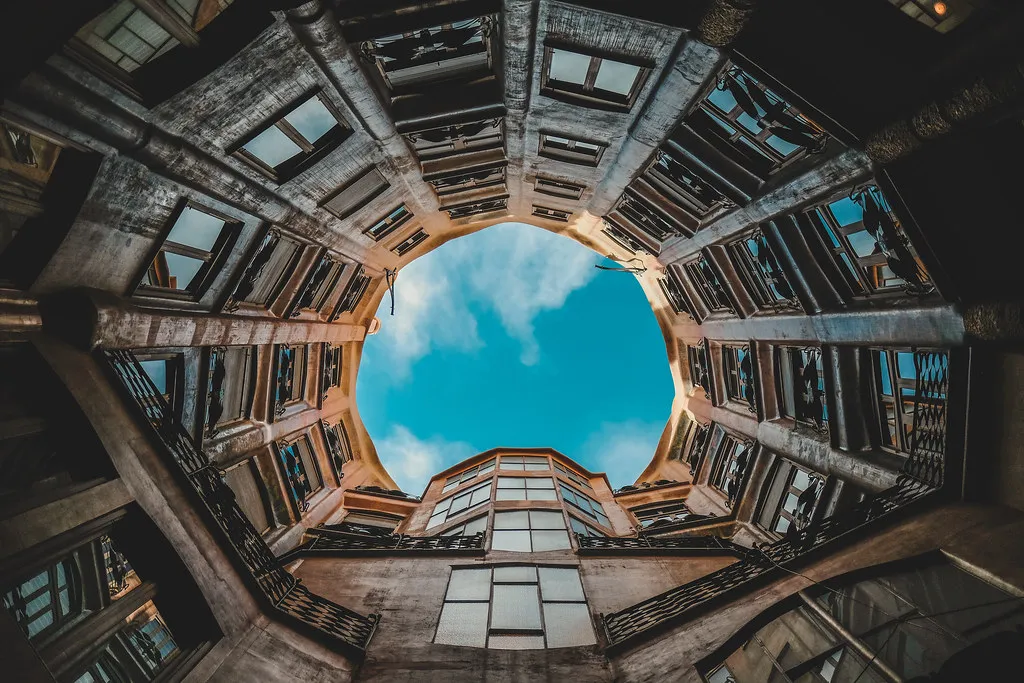
Built between 1906 and 1910, Casa Milà was Gaudí's last secular commission and his most structurally radical. The limestone facade undulates like a cliff face, earning its nickname La Pedrera — "The Quarry." Wrought-iron balconies that resemble tangled seaweed wrap every floor. Gaudí eliminated interior load-bearing walls entirely by hanging the floors from the stone facade and a central iron skeleton — a technique that was decades ahead of its time.
The rooftop is the standout feature: helmeted chimneys and ventilation towers twisted into warriors and witches, arranged around a terrace with views across the Eixample. The arched attic houses the Espai Gaudí exhibition on his life and work, and a reconstructed bourgeois apartment on the fourth floor shows how the building's first residents lived. Adult tickets run €24–€28; the Night Pedrera evening event (summer months only, €39) includes music and a rooftop cocktail and is excellent. Metro: Diagonal (L3/L5), on Passeig de Gràcia at the corner of Carrer de Provença.
5. Casa Vicens: Gaudí's First House
Casa Vicens was Gaudí's debut major commission, built between 1883 and 1885 for tile manufacturer Manuel Vicens Montaner in the Gràcia neighbourhood. It is the earliest statement of everything he would later refine: Moorish-influenced decorative tiles (the repeating marigold and palm-leaf patterns came from plants Gaudí found growing on the plot), parabolic arches, and a fusion of Spanish Islamic and Catalan Gothic influences. The exterior is striped yellow and green ceramic over brick, exuberant where his later buildings lean more organic.
Casa Vicens only opened to the public in 2017 and remains the least visited of the four main ticketed Gaudí houses — meaning queues are shorter and the visit is more relaxed. Tickets cost €16 (online) and include an audio guide. It is a UNESCO World Heritage Site. The main draw is the garden patio, which brings Gaudí's nature-first philosophy to life with a fountain and citrus plantings. Address: Carrer de les Carolines 20, Gràcia. Metro: Fontana (L3).
6. Palau Güell: The Industrialist's Palace
Palau Güell, completed in 1888 in the Raval district, was the private palace of Eusebi Güell — the industrialist who became Gaudí's most important patron. Compared to Gaudí's later, more exuberant works, the exterior is relatively restrained: a Gothic-influenced stone facade with two parabolic ironwork gates. The surprise is entirely interior. Rooms radiate outward from a soaring, domed Central Hall designed for live music; Güell appreciated acoustics and the space reflects that.
The rooftop is a precursor to Park Güell's dragon aesthetic, covered in mosaic-encrusted chimneys. Tickets cost €12 (free on the first Sunday of each month). It is one of the most affordable Gaudí buildings to visit and is considerably less crowded than Casa Batlló or Milà. The location on Carrer Nou de la Rambla, steps from La Rambla, makes it easy to slot into any itinerary. Metro: Liceu (L3) or Drassanes (L3).
7. Bellesguard (Casa Figueres): The Modernist Castle
Bellesguard is the Gaudí building that surprises people most. Built between 1900 and 1909 on the slopes of Tibidabo in the upper city, it sits on the ruins of the 15th-century summer palace of the last Catalan-Aragonese king, Martí I. Gaudí treated the project as a tribute to Catalan history, incorporating Gothic towers, a crenelated roofline, and the colours of the Catalan flag in the stained-glass windows. It looks medieval — the owners often had to reassure visitors it was not actually an ancient castle.
It remains a private residence but is open for guided tours (€16 adults, check schedule at bellesguardgaudi.com). The ground floor and stables show Gaudí's structural innovations most clearly, with slender brick columns supporting the whole building from below. The rooftop walkway and panoramic views over Barcelona are a genuine reward. Bellesguard is listed as a UNESCO World Heritage Site. Getting there requires a taxi or bus to the upper Sarrià-Sant Gervasi district — less convenient than the Eixample cluster, but worth the extra effort for a crowd-free experience.
8. Colonia Güell and the Crypt: Gaudí's Laboratory
Located 20 km southwest of Barcelona in the village of Santa Coloma de Cervelló, the Colonia Güell crypt is technically outside the city but deserves inclusion: it was Gaudí's testing ground for the Sagrada Família. Eusebi Güell commissioned an entire workers' village — factory, housing, school, and church — around his textile mill from 1890. Gaudí worked on the church from 1908, completing only the crypt before funding was cut in 1914.
The crypt is extraordinary precisely because it is unfinished and raw. You can see Gaudí's experiments with slanted basalt columns, brick arches, and stained-glass windows in a small, intimate space. The structural solutions he tested here — including the famous string-and-weight scale model he built upside-down to calculate forces — were directly applied to the Sagrada Família at a much larger scale. Entry costs around €7. The site is reached via FGC commuter rail (line S4 or S8 from Plaça Espanya, Colònia Güell stop, 30 minutes). It is a UNESCO World Heritage Site.
9. Casa Calvet: The Early Modernist Gem
Built in 1900 for the Calvet textile family in the Eixample grid, Casa Calvet is the most conventional-looking of Gaudí's buildings — symmetrical, stone-faced, Baroque in its ornamental detailing — and the one that earned him his only official prize from the City of Barcelona. The facade features a double staircase entrance flanked by carved stone letters and a cross at the summit. The iron door knockers, shaped as crosses colliding with a bug (a reference to pests destroying crops, a Calvet family concern), are a typically Gaudían detail hiding in plain sight.
The building is not open for public tours, but the ground-floor restaurant (currently operating as an upscale dining room) is accessible and allows you to sit inside a Gaudí building over lunch without paying an entrance fee — a rare and underrated option. Address: Carrer de Casp 48, just off Passeig de Gràcia. Metro: Urquinaona (L1/L4).
10. Colegio Teresiano: A Functioning Hidden Gem
The Colegio Teresiano de Barcelona, built for the Discalced Carmelites of Saint Teresa between 1888 and 1890, is one of Gaudí's most restrained works — and deliberately so. The school was built on a strict budget, and Gaudí responded with elegant austerity: a brick facade with Gothic-inspired blind arches, and repeated catenary arches inside that run the length of every corridor, creating tunnel-like passages filled with natural light. The building is still a functioning school, which limits public access to the exterior and occasional events.
Its architectural significance is primarily in structure and proportion rather than decoration. The repeated parabolic arch, used here in brick for economy, became a template Gaudí scaled up across his later career. Address: Carrer dels Ganduxer 85, in the Sant Gervasi neighbourhood. Metro: La Bonanova (FGC). It is a UNESCO World Heritage Site. View the facade from the street for free at any time.
Why 2026 Is the Year to Visit Gaudí's Barcelona
The year 2026 marks the centenary of Gaudí's death and the long-anticipated completion of the Sagrada Família's central towers. The Jesus tower (the tallest, at 172 m) and the Glory façade — the main entrance on the south side, facing Carrer de Mallorca — are scheduled to open this year. When finished, the Sagrada Família will be the tallest church in the world by a comfortable margin. No competitor article fully captures what this means for a visitor: the building will look fundamentally different from photographs taken even five years ago.
Beyond the basilica, 2026 also sees increased programming at several Gaudí sites marking the centenary. Casa Batlló, Casa Milà, and the Gaudí House Museum in Park Güell are all running special exhibitions. The Gaudí Year events and commemorations mean higher demand for tickets than usual — book everything at least a month in advance if you are travelling between April and October 2026.
For visitors who want the full picture without the crowds, consider pairing the big four (Sagrada Família, Park Güell, Casa Batlló, Casa Milà) with at least one lesser-known site — Palau Güell or Casa Vicens work best logistically. The contrast between the famous landmarks and the quieter works gives a much richer sense of how Gaudí's style evolved over 40 years.
Planning Your Gaudí Tour: Practical Tips and a Walking Route
| Gaudí Site | Adult Ticket (2026) | Free Entry Option | Booking Required |
|---|---|---|---|
| Sagrada Família | €26 (+ €9 tower) | No | Yes — weeks ahead |
| Park Güell (Monumental Zone) | €10 | Surrounding park free | Yes — timed entry |
| Casa Batlló | €35–€45 | No | Yes — 2–3 weeks ahead |
| Casa Milà (La Pedrera) | €24–€28 | No | Yes — recommended |
| Casa Vicens | €16 | No | Recommended |
| Palau Güell | €12 | 1st Sunday of month | Recommended |
| Bellesguard | €16 (guided tour) | No | Check schedule |
| Colonia Güell Crypt | €7 | No | No |
| Casa Calvet | Not open for tours | Restaurant access | N/A |
| Colegio Teresiano | Exterior only | Free exterior view | N/A |
Booking tickets online in advance is non-negotiable for all four major ticketed sites (Sagrada Família, Park Güell, Casa Batlló, Casa Milà). All operate timed entry, and during peak season (April–October) they sell out days or weeks ahead. Cancellations do appear, but count on booking. A combined Gaudí ticket (available at some sites) covers multiple buildings at a slight discount — worth calculating if you plan to visit three or more.
The most efficient walking route for the Passeig de Gràcia cluster starts at Palau Güell (near La Rambla), heads up La Rambla to Plaça de Catalunya, then follows Passeig de Gràcia north past Casa Batlló (around the corner from the Block of Discord) and then 10 minutes further to Casa Milà. From there, it is about 20 minutes on foot to Casa Vicens in Gràcia, and a further 30 minutes uphill (or bus 24) to Park Güell. The Sagrada Família is a 30-minute walk east from Park Güell, or two metro stops from Diagonal. The route is roughly 8 km total. Allow 2–3 hours per major building if you are going inside. A realistic single day covers three buildings with interior visits plus one exterior.
For families with children, Park Güell's open space and colourful mosaics work best for young children; Casa Batlló's augmented reality smartphone experience engages older kids. For budget travellers: Palau Güell is free on the first Sunday of each month; the Sagrada Família exterior can be appreciated at no cost; the open areas of Park Güell (outside the Monumental Zone) are free; and the Casa Calvet restaurant gives access to a Gaudí interior for the price of a meal. For more trip planning, see our guide on how many days you need in Barcelona.
FAQs About Gaudi Buildings in Barcelona
As you plan, our guides to Barcelona Neighborhoods Guide Travel Guide and Barcelona 3 Day Itinerary cover the rest of the essentials.
Frequently Asked Questions
What is Gaudí best known for?
Gaudí is best known for his distinctive Catalan Modernist architecture, characterized by organic forms, vibrant colors, and intricate details inspired by nature. His most famous works include the Sagrada Familia, Park Güell, and Casa Batlló, which have become iconic symbols of Barcelona.
How many Gaudí buildings are there in Barcelona?
There are numerous Gaudí buildings and works in Barcelona, with at least 14 significant projects attributed to him, including structures, parks, and smaller commissions. Seven of his works in Barcelona are designated as UNESCO World Heritage Sites, highlighting their global importance.
What Gaudí building should I see first?
Many visitors choose to see the Sagrada Familia first due to its monumental scale and iconic status, but Park Güell offers a great outdoor introduction to his whimsical style. If you prefer interiors, Casa Batlló or Casa Milà provide immersive experiences of his residential genius. Consider your interests and time.
Which Gaudí site is best for kids or families?
Park Güell is often considered the best Gaudí site for kids and families, thanks to its expansive outdoor spaces, colorful mosaics, and playful structures that encourage exploration. Casa Batlló also offers an engaging, interactive audiovisual tour that can captivate younger audiences.
How much do Gaudi building tickets cost?
Ticket prices for Gaudí buildings vary significantly, ranging from about €10 for Park Güell's Monumental Zone to €35–€45 for Casa Batlló or Sagrada Familia. Many sites offer discounts for students, seniors, or children, and booking online usually secures the best price and guarantees entry.
Antoni Gaudí's architectural legacy is undeniably one of Barcelona's greatest treasures, transforming the city into a living work of art. Each building tells a unique story, reflecting his profound connection to nature, religion, and Catalan culture. From the awe-inspiring Sagrada Familia to the whimsical Park Güell, these structures offer an unparalleled journey into the mind of a visionary. Exploring these sites provides a deeper appreciation for Barcelona's rich artistic heritage.
Planning your visits with the practical tips provided will ensure a smooth and memorable experience. Don't rush through these masterpieces; take your time to absorb the intricate details and innovative designs. Gaudí's buildings are more than just tourist attractions; they are enduring symbols of creativity and human ingenuity. Allow them to inspire and amaze you on your next trip to this incredible Spanish city.
You might also like


Continue reading
More guides you'll find useful


