La Pedrera Casa Mila Barcelona Travel Guide
Plan la pedrera casa mila barcelona with top picks, neighborhood context, timing tips, and practical booking advice for a smoother trip.
On this page
La Pedrera Casa Mila Barcelona: Your Ultimate Guide
La Pedrera Casa Milà stands as the last civil building Antoni Gaudí ever completed, finished in 1912 and declared a UNESCO World Heritage Site in 1984. Its undulating limestone facade, wrought-iron balconies, and warrior-like rooftop chimneys make it one of the most photographed buildings on Passeig de Gràcia. For anyone visiting Barcelona in 2026, it belongs at the top of the list alongside Sagrada Família.
The building earned its nickname, "La Pedrera" (Catalan for "the quarry"), because Barcelona residents compared the rough-hewn stone exterior to a stone quarry when it was unveiled. What looks raw and bold on the outside conceals one of the most structurally revolutionary interiors of the 20th century. This guide covers everything you need to know — tickets, prices, the rooftop, the interior, and how to get there.
Plan with trusted sources: cross-check opening hours and seasonal details with the official Barcelona tourism board, and read more about the city on its Wikipedia entry before you go.
La Pedrera, Casa Milà
Casa Milà sits at Passeig de Gràcia 92, on the corner with Carrer de Provença, in Barcelona's Eixample district. Pere Milà and his wife Roser Segimon commissioned the building in 1906; Gaudí spent six years on it before his attention turned fully to the Sagrada Família. The couple wanted a prestigious residence, but Gaudí delivered something far beyond that — a building with no straight lines, no load-bearing interior walls, and a rooftop that reads as pure sculpture.
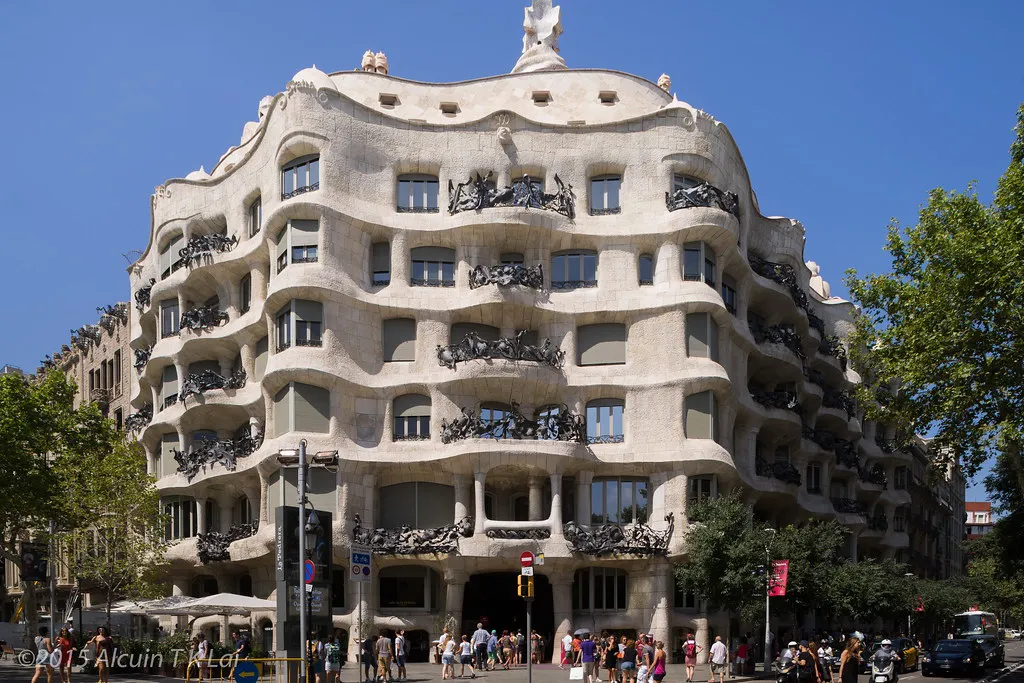
The facade is divided into two blocks, each with its own oval courtyard. The stone used for the ground floor came from the Garraf quarry, about 30 km south of Barcelona; upper floors used stone from Vilanova. Gaudí's ironwork balconies, each welded from recycled scrap iron, are all different — there are no two identical units in the entire building. The city of Barcelona declared Casa Milà an architectural work of art immediately upon its completion.
Today, one portion of the building still functions as private residential apartments. The public areas — rooftop, attic, apartment, and courtyards — are managed by the Fundació Catalunya La Pedrera as a cultural centre. Temporary exhibitions occupy the noble floor (the "belletage"), where the original owners once lived.
The Quarry House: Facade, Courtyards, and Architecture
The facade of La Pedrera is the most immediately striking feature — a continuous wave of pale limestone that seems to shift as you walk along Passeig de Gràcia. Gaudí abandoned colour almost entirely here, in sharp contrast to the mosaic blues and greens of Casa Batlló a few hundred metres down the same street. He wanted to demonstrate that form alone, without decoration, could be extraordinary.
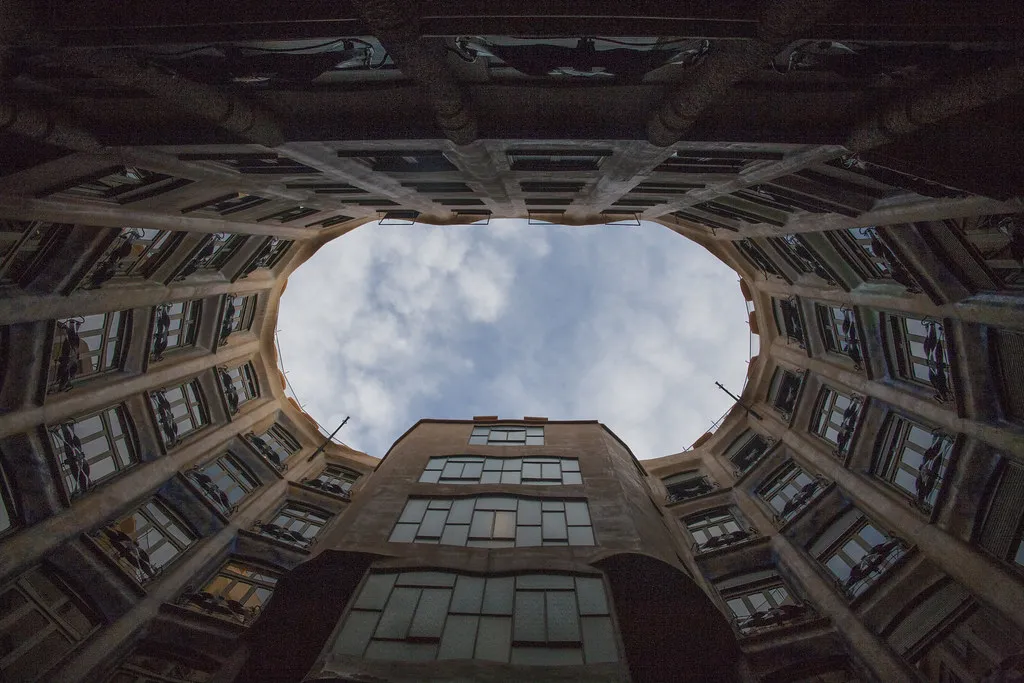
Step through the entrance and you reach one of two round internal courtyards. These spaces flood the building's apartments with natural light, negating any need for air conditioning — a passive ventilation system built into the structure over a century ago. The painted frescoes on the courtyard walls, in muted greens and blues, are easy to miss when crowds fill the space. Look up as well as around. The stairways that wind along the courtyard walls are functional art in themselves.
The structural engineering breakthrough here is worth pausing on. Casa Milà was one of the first buildings in Spain to use a self-supporting exterior wall system — essentially a steel and concrete skeleton that bears the load, not the walls themselves. This meant Gaudí could design the interior layout without fixed partition walls. Apartments could be reconfigured, rooms merged or separated, a concept that was decades ahead of common practice. The hanging chain model in the Espai Gaudí attic demonstrates this principle: Gaudí suspended chains to find the natural catenary arc, then inverted those curves to create his structural arches.
The Roof of La Pedrera
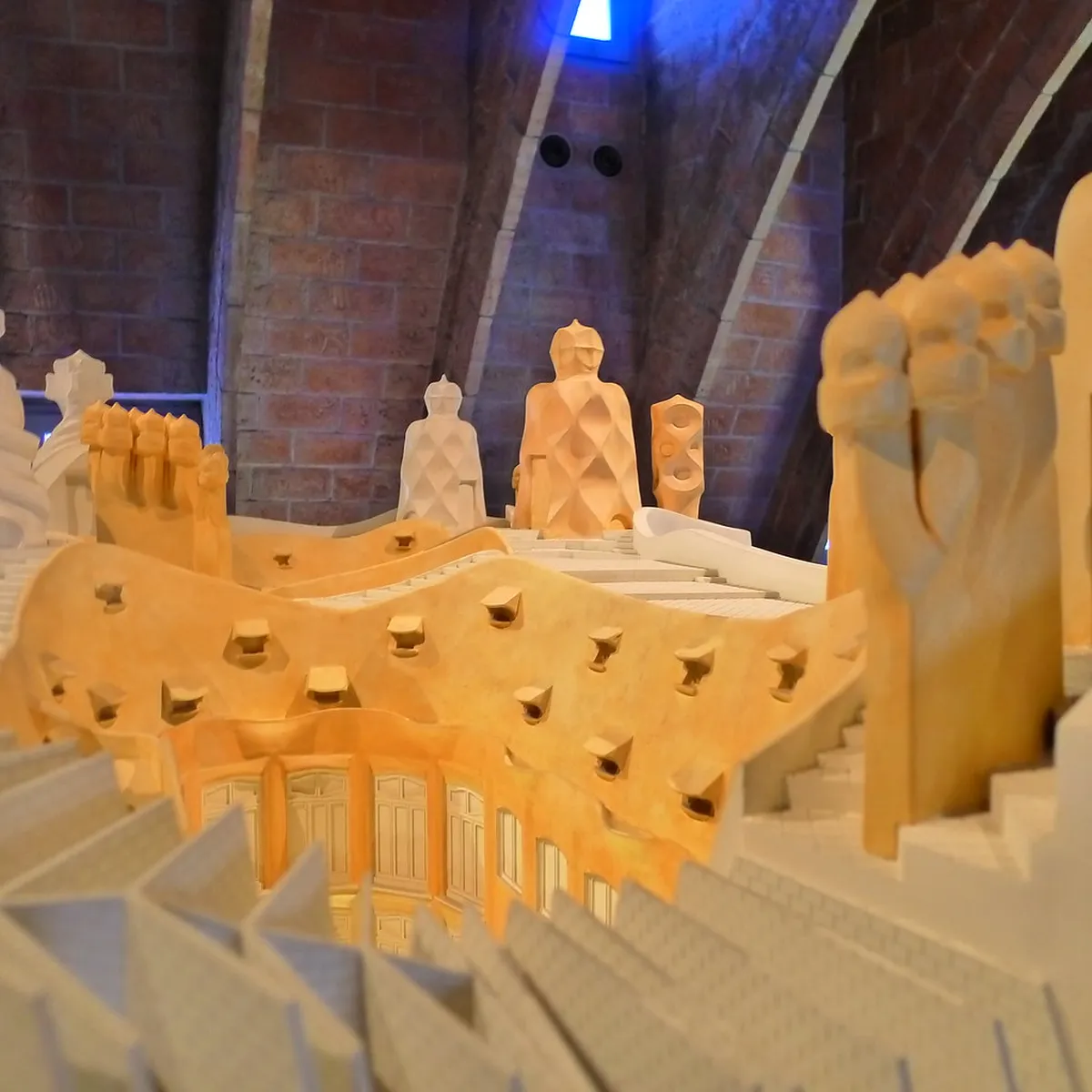
The rooftop terrace is the single most memorable part of any visit to Casa Milà. Gaudí covered it with 28 chimneys, six ventilation towers, and four stairwell exits, each one sculpted into a distinct shape. The chimneys — often called "witch's hats" or "warrior sentinels" — are clad in trencadís mosaic of broken ceramic and glass. No two are exactly alike, and they create a surreal skyline when viewed from the terrace floor.
The terrace is not flat. You walk up and down steps between different levels, weaving between the chimneys. This layout means the views change constantly, framing different parts of the Barcelona skyline through the arches and spirals. On a clear day you can see the towers of Sagrada Família to the northeast — Gaudí reportedly designed the rooftop sight lines with this connection in mind. The 1975 film "The Passenger" with Jack Nicholson used the rooftop as a key location; its atmosphere is undeniable even now.
One practical note: the rooftop closes when it rains. Barcelona gets wet spells even in spring and summer, so check the forecast before your visit. If you arrive on a grey morning and the terrace is closed, staff can advise whether it is expected to reopen. The night experience (see below) keeps the rooftop open under shelter, so the weather risk is lower for evening visits.
A local tip that no competitor mentions in print: if the lift queue for the rooftop looks long during the daytime visit, ask a staff member at the first-floor patio about the servants' staircase. It is eight floors of climbing but moves much faster than the lift queue in peak season, and gives you the building at a slower pace.
The Interior of Casa Milà
The Espai Gaudí occupies the entire attic, a cavernous space with bare red-brick parabolic arches forming the ceiling. The exhibition here covers Gaudí's complete body of work through scale models, photographs, drawings, and audiovisuals. The hanging chain model of Colonia Güell is the standout exhibit: you look into a mirror below a suspended chain model and see the inverted catenary curves that became Gaudí's structural system. It is a genuinely illuminating few minutes for anyone curious about how this building actually stays up.
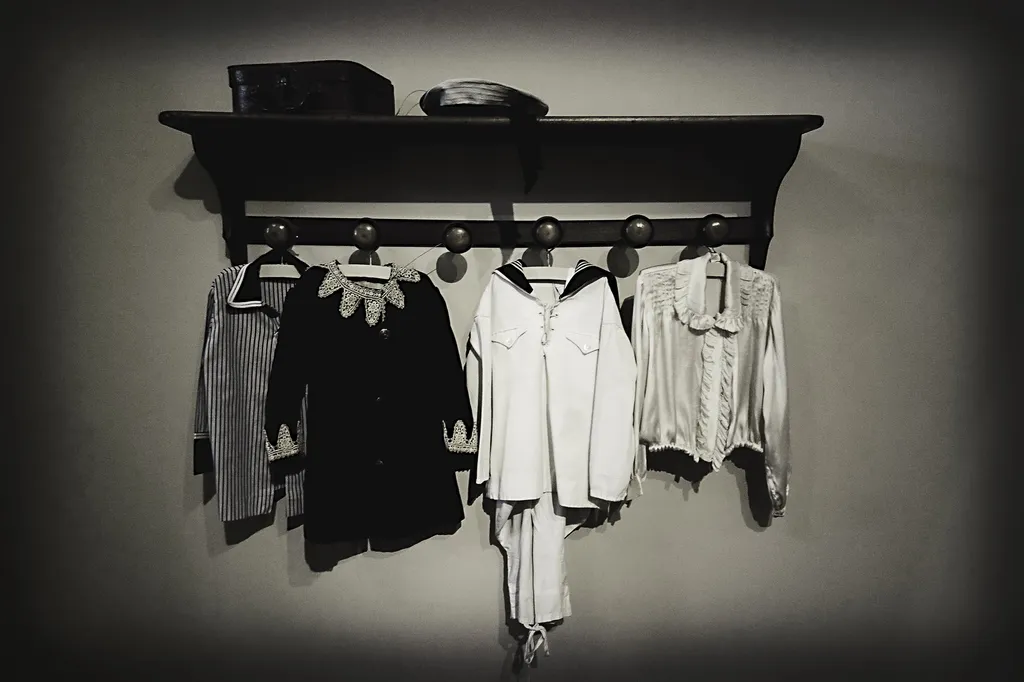
The fourth-floor apartment is fully furnished in the style of a bourgeois Barcelona household of the early 1900s. Unlike Casa Batlló's apartment, where several rooms were removed over the decades, this one preserves the full layout — kitchen, servants' quarters, dining room, bedrooms. The curved walls and door frames follow the oval courtyard below, which means no room has a conventional rectangular shape. Walking through it disorients most visitors in a fascinating way.
The noble floor hosts temporary exhibitions, which change several times a year. In 2026 the programme continues to focus on Modernisme and contemporary design. If you want to include the temporary show, buy the Art Season ticket (€35) rather than the Essential ticket (€29) — it adds free entry to the current exhibition and is cheaper than paying separately at the door.
Tickets for Admission: Prices and Options in 2026
La Pedrera offers three main daytime ticket tiers and two special experience tickets. The Essential ticket (€29) covers the rooftop, Espai Gaudí attic, and the furnished apartment — this is the standard visit and covers everything most visitors want to see. The Art Season ticket (€35) adds free entry to the current temporary exhibition on the noble floor. Both include an audio guide, which is worth using; it runs about 90 minutes if you follow it fully.
The Sunrise ticket (€39) grants access before the building officially opens to the general public. You explore with a much smaller crowd, and the early light on the rooftop chimneys is genuinely special for photography. The Night Experience ticket (€39) covers a guided evening visit — courtyards, apartment, attic — finishing with a light-and-sound projection show on the rooftop, plus a glass of cava. Both special experiences sell out faster than daytime slots, so book early. Children under 12 enter free on all tickets.
| Ticket | Price (2026) | What's Included | Best For |
|---|---|---|---|
| Essential | €29 | Rooftop, Espai Gaudí attic, furnished apartment, audio guide | Most visitors |
| Art Season | €35 | Everything in Essential + current temporary exhibition | Design & art fans |
| Sunrise | €39 | Pre-opening rooftop access, small group, golden-hour light | Photographers |
| Night Experience | €39 | Guided evening visit, rooftop light & sound show, glass of cava | Couples, special occasions |
A surcharge of €1 applies if you buy at the box office on the day. Buy online to avoid this and to guarantee your time slot. There are discounts for seniors (65+), students with valid ID, and visitors with disabilities. The Barcelona Card gives 20% off the standard admission price, which makes it worth checking if you are already planning to use the card for transport and other sites. Official tickets only at lapedrera.com — third-party resellers charge booking fees on top.
Experience La Pedrera in a New Light at Night
The night visit, "Gaudí's Pedrera: The Origins," runs after the daytime closing time and is a genuinely different experience from the daytime tour. The group size is capped at a smaller number than the standard visit, so the courtyards and apartment feel quieter and more intimate. A guide leads the group through the building, answering questions as you go — this personal element is what separates the night visit from an audio-guided daytime slot.
The climax is on the rooftop, where an audiovisual projection maps light and animation onto the chimneys and ventilation towers. The show tells the story of Gaudí's design process and the history of the building. Paired with a glass of cava and the Barcelona skyline behind you, it is one of the most atmospheric evenings you can spend in the city. Night tickets cost €39 in 2026 and book out weeks ahead during summer.
If budget is a factor, there is a cheaper alternative for a quieter daytime visit: arrive with a standard Essential ticket about 90 minutes before the daytime closing time. By late afternoon, most group tours have finished and the building is noticeably less crowded. You get the atmosphere without the night-experience price. The rooftop stays open until closing, weather permitting.
How to Get to La Pedrera
Casa Milà is at Passeig de Gràcia 92, on the corner of Carrer de Provença, in the Eixample district. The nearest metro stop is Diagonal, served by Line 3 (Green) and Line 5 (Blue). It is a two-minute walk from the Diagonal exit on Passeig de Gràcia. The building is also a short walk from the Provença stop on the FGC suburban rail line if you are coming from the upper part of the city.
The Barcelona Bus Turístic stops at Pg. de Gràcia–La Pedrera on its Blue Route, which is useful if you are combining a visit here with other stops along the circuit. Taxis and Cabify drop off directly on Passeig de Gràcia. Avoid driving; parking in this part of Eixample is metered and difficult to find during the day. The building has no on-site car parking for visitors — the famous underground garage in Gaudí's original design was for the residents.
Casa Batlló vs Casa Milà: Which Gaudí Building to Visit?
Both buildings sit on the same stretch of Passeig de Gràcia, roughly 400 metres apart. If you have time for only one, the choice comes down to what you want from the visit. Casa Batlló is more immediately spectacular — the colourful tiled facade, the bone-like balconies, and the dragon-scale roof make an unforgettable first impression. But the interior has had several rooms removed over the decades, and it has acquired a series of high-tech art installations in recent years that divide opinion among visitors.
La Pedrera is quieter in visual impact from the outside, but deeper inside. The furnished apartment is complete and intact. The Espai Gaudí exhibition is more informative than anything at Casa Batlló, and the rooftop is widely regarded by architecture guides as the superior of the two. For serious architecture interest, Casa Milà wins. For families with younger children, Casa Batlló's interactive experience may be more engaging. The Essential ticket for La Pedrera at €29 is also meaningfully cheaper than the equivalent Casa Batlló entry.
If you visit both in one day, do La Pedrera first in the morning when energy is high and light on the rooftop is better. Walk down Passeig de Gràcia to Casa Batlló in the afternoon. The buildings are close enough that splitting a day between them is practical. You can combine both with other things to do in Barcelona on a well-planned Eixample day.
10 Interesting Facts About La Pedrera
Casa Milà was Gaudí's third and last private residential commission. His first was the modest Casa Calvet (1898), then Casa Batlló (remodelled 1904–1906), and finally Casa Milà. After finishing here, he devoted the rest of his life entirely to the Sagrada Família.
- Gaudí originally wanted a large sculpture of the Virgin Mary at the top of the building, but the Milà family vetoed it. The dispute was one of several that soured his relationship with his clients.
- When the building was unveiled, Barcelona's satirical press mocked it mercilessly. One cartoon compared the facade to a garage for zeppelins. The nickname "La Pedrera" was itself originally an insult.
- There is not a single load-bearing interior wall in the entire building. The steel and concrete skeleton does all the structural work, a technique decades ahead of its time in Spain.
- The stone for the facade came from two quarries: Garraf (30 km south) for the lower floors, and Vilanova (50 km south) for the upper levels. The slight tonal differences between floors are visible if you look closely.
- Gaudí reused waste glass and broken ceramic tiles for the trencadís mosaic covering the chimneys — an early example of recycling in architecture.
- La Pedrera was the first building on Passeig de Gràcia with an underground garage, designed for horse carriages when it opened and later adapted for cars.
- The Sagrada Família is visible from the rooftop. Gaudí is said to have designed the rooftop's sight lines so his two major Barcelona works could "see" each other.
- George Lucas reportedly cited La Pedrera's chimneys as a visual reference for the helmets of the Imperial Stormtroopers in Star Wars. The claimed connection has never been confirmed by Lucas himself, but the silhouette comparison is striking.
- In 1984, Casa Milà became the first 20th-century building included in UNESCO's World Heritage List, before the Sagrada Família received the same designation.
- The current opening hours in 2026 are 09:00–20:30 daily from 1 March to 3 November, and 09:00–18:30 from 4 November to 28 February. The building closes on 25 December.
When to Visit and How to Beat the Queues
La Pedrera is open 365 days a year except Christmas Day (25 December). Summer (June–August) and Easter week are the busiest periods. Tour buses regularly park nearby and their groups enter via a separate entrance, which does not affect the individual traveller queue — but the rooftop and attic still feel crowded when multiple groups are inside at the same time.
The most effective crowd-avoidance tactic is a first-slot booking — the 09:00 entry. Arrive five minutes early and you will have the courtyards and apartment noticeably quieter before the first wave of tour groups arrives around 10:30. Late afternoon (17:00 onwards for the summer schedule) is the second-best window. Shoulder season — October, November, and March — offers the best combination of manageable crowds and mild weather.
Pre-booked tickets are essential, not optional, from April through September. Walk-up tickets are available but carry the €1 box-office surcharge and offer no guaranteed time slot. On the busiest summer days, daytime tickets are sold out by mid-morning. Book through lapedrera.com; budget at least one week ahead in summer, two weeks ahead for the Sunrise or Night Experience slots. You can fit La Pedrera into a Barcelona 3-day itinerary comfortably with a morning visit.
Frequently Asked Questions
Casa Batlló vs Casa Milà: What is the best Gaudí building to visit?
Both Casa Batlló and La Pedrera Casa Milà are stunning Gaudí masterpieces, each offering a unique experience. Casa Batlló features a more fantastical, colorful design with marine inspirations. La Pedrera showcases a more austere, organic, and sculptural aesthetic. Your preference depends on whether you prefer vibrant fantasy or innovative naturalism. Many travelers enjoy visiting both for a complete understanding of Gaudí's range. Consider the specific exhibits and architectural details that appeal most to you. You can BOOK CASA BATLLÓ tickets in advance too.
Is it worth going inside Casa Batlló or Casa Milà?
Yes, visiting the interiors of Casa Batlló or Casa Milà is highly recommended for a full appreciation of Gaudí's genius. The facades are impressive, but the true innovation and artistic detail lie within. The interiors reveal his mastery of light, space, and organic forms. An interior visit provides context for the building's history and purpose. It truly brings the architecture to life for visitors. Consider adding this to your Barcelona 3-day itinerary.
How much time should you plan for La Pedrera Casa Mila Barcelona?
You should plan to spend approximately 1.5 to 2 hours exploring La Pedrera Casa Milà. This allows ample time to visit the rooftop, the Espai Gaudí exhibition in the attic, and the recreated period apartment. If you opt for the audio guide, factor in additional time to listen to all the commentary. Night visits typically last around 1.5 hours, including the show. Adjust your schedule based on your personal interest level and desired pace.
What should travelers avoid when planning La Pedrera Casa Mila Barcelona?
Travelers should avoid visiting La Pedrera without pre-booked tickets, especially during peak season, to prevent long queues. Do not arrive at midday during summer if you dislike crowds. Avoid rushing through the exhibits; take time to absorb the details. Also, do not forget comfortable shoes, as there is a fair amount of walking and stairs. Finally, avoid relying solely on public transport schedules without checking for updates.
Which La Pedrera Casa Mila Barcelona options fit first-time visitors?
First-time visitors to La Pedrera Casa Milà should choose the 'Essential' ticket with an audio guide. This option provides a comprehensive overview of the building's key areas, including the rooftop, Espai Gaudí, and the apartment. The audio guide offers valuable insights into Gaudí's work and the building's history. Visiting early in the morning is also ideal for a less crowded and more enjoyable first experience. This combination ensures a thorough and informative introduction.
La Pedrera Casa Milà stands as a testament to Antoni Gaudí's boundless imagination and architectural prowess. Its organic forms and innovative design continue to inspire visitors from around the globe. Planning your visit with these tips ensures a smooth and enriching experience. You will gain a deeper appreciation for this iconic Barcelona landmark.
From its whimsical rooftop to its historically rich interior, La Pedrera offers a unique journey through Modernisme. Whether you choose a daytime exploration or a magical night show, this building promises lasting memories. Embrace the opportunity to witness one of Gaudí's most significant works. Your trip to Barcelona would be incomplete without it.
You might also like


Continue reading
More guides you'll find useful