Picasso Museum Barcelona Travel Guide
Plan Picasso Museum Barcelona with top picks, neighborhood context, timing tips, and practical booking advice for a smoother trip.
On this page
Picasso Museum Barcelona: A Comprehensive Guide
The Picasso Museum Barcelona — known locally as the Museu Picasso — holds over 4,000 works by Pablo Picasso, making it one of the three largest Picasso collections in the world alongside the Prado in Madrid and the Musée Picasso in Paris. Its focus is narrow and deliberate: the formative years, roughly 1895 to 1904, when a teenage Picasso studied in Barcelona and began to break every rule his teachers had taught him.
The museum sits on Carrer de Montcada in the El Born district, occupying five interconnected Gothic palaces from the 13th to 15th centuries. The stone courtyards and medieval staircases are themselves worth the entrance fee. Understanding what is and is not in the collection before you arrive makes the visit far more rewarding.
Plan with trusted sources: cross-check opening hours and seasonal details with the official Barcelona tourism board, and read more about the city on its Wikipedia entry before you go.
The Museum Building: Five Gothic Palaces
The Picasso Museum is housed inside five adjoining medieval palaces on one of Barcelona's best-preserved medieval streets. The core building, the Palau Aguilar (Montcada 15), opened as a museum in 1963. By 1970 two more palaces — Castellet and Meca — were absorbed, and further expansions in 1999 added Casa Mauri and Palau Finestres.
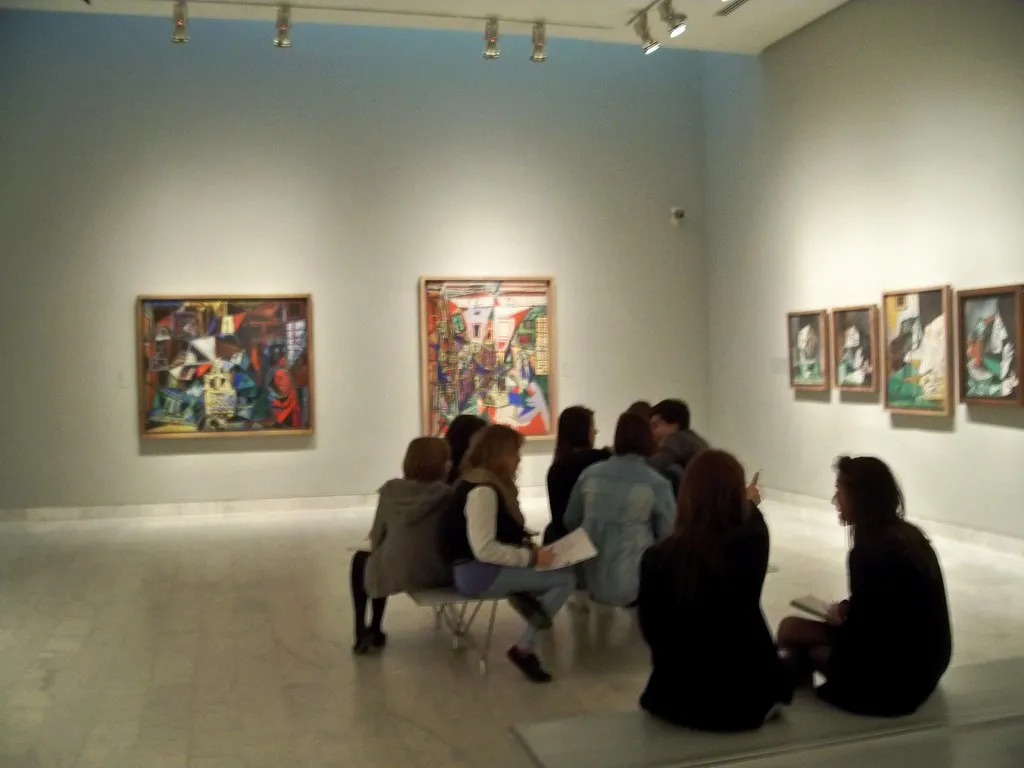
Walking between rooms means passing through shared courtyards connected by open staircases. Many visitors spend as much time looking up at the carved stone galleries as they do looking at the art. The street itself, Carrer de Montcada, was declared an architecturally protected heritage zone in 1947 — the short stretch from the 12th-century Romanesque Marcus chapel to Plaça del Born is one of the finest pieces of medieval urban planning in Spain.
The museum is managed by the Fundació Museu Picasso, which took over from the city council in 2014. It runs the building, the collection, and temporary exhibitions, typically mounted in the ground-floor galleries while the permanent collection occupies the upper floors.
Why the Museum Exists: Picasso, Sabartés, and Franco
The Museu Picasso opened in March 1963, but it could not legally use Picasso's name. The Franco dictatorship despised Picasso as a vocal critic of the regime — the artist had been an outspoken anti-Francoist since the Civil War and had painted Guernica as direct protest. So the museum opened under the name "Sabartés Collection," after Jaume Sabartés, Picasso's longtime secretary and friend from his Barcelona days, who donated the founding artworks.
Sabartés had collected Picasso's works for decades and gifted hundreds of pieces to the City of Barcelona. It was only after Sabartés died in 1968 that Picasso himself donated the complete Las Meninas series of 58 paintings in his friend's memory — and only then, with the political climate slightly thawed, did the museum quietly begin using the Picasso name. Picasso's wife Jacqueline later donated a 41-piece ceramics collection in 1982.
This backstory matters when you visit: a significant proportion of the collection exists specifically because of that friendship, and several rooms are dedicated to works Picasso created of or for Sabartés. None of the other major Picasso museums share this origin story.
Highlights of the Collection: Key Works to Seek Out
Science and Charity (1897) is the largest canvas in the museum and arguably its most important early work. A 14-year-old Picasso painted it for the Fine Arts Exhibition in Madrid, where it won an honorable mention. The composition — a sick woman attended by a doctor and a nun — is technically flawless, demonstrating a classical mastery that makes his subsequent rejection of academic painting all the more striking. Look for it in the rooms covering his time at the La Llotja academy.
Menu of Els Quatre Gats (1900) is a small but culturally loaded piece. Els Quatre Gats was a modernist café on Carrer Montsió that Picasso frequented as a teenager — modeled on the Chat Noir in Paris, it was where Barcelona's avant-garde gathered. The café owner commissioned the young Picasso to design the bar's menu, and the resulting sketch of fashionable Barcelonans beneath gothic arches became his first paid design commission. The original café still operates today, about a 15-minute walk from the museum.
The Wait (Margot) (1901) is one of the most powerful Blue Period works in the museum. The woman's vacant stare and extravagant headdress are painted in Picasso's newly post-impressionist style, all frenzied brushwork and unsettling color. It appeared in his landmark 1901 solo show at the Vollard Gallery in Paris — the exhibition that first put him on the map internationally.
Las Meninas series (1957) occupies an entire dedicated gallery and is the collection's undisputed centerpiece. Over five intense months in 1957, Picasso produced 44 variations on Velázquez's 17th-century royal portrait. The series is not reproduction — it is systematic deconstruction. The Infanta Margarita María recurs across dozens of canvases, recognizable despite radical formal distortion. Picasso donated all 58 paintings in the series (the 44 Meninas variations plus 9 pigeon paintings and 5 other works) to the museum at once. Give this gallery at least 30 minutes.
Portrait of Jaume Sabartes with Ruff and Cap (1939) is a late work that stands apart from the museum's early-years focus. Sabartés asked Picasso to paint him in the costume of a 16th-century Castilian nobleman, and the result is a rare example of humor in Picasso's portraiture — the sitter's features are lovingly distorted in the Cubist manner but unmistakably recognizable. Given how much of the collection Sabartés made possible, this portrait carries obvious emotional weight.
Picasso in Barcelona: What the City Gave Him
Pablo Picasso arrived in Barcelona in 1895, aged 13, when his father was appointed professor at the La Llotja School of Fine Arts. He enrolled alongside students many years his senior and reportedly completed the month-long entrance examination in a single day. His father gave him his own studio at Carrer de la Plata 4, where he painted Science and Charity.
The El Born neighborhood, the Gothic Quarter, and Els Quatre Gats café formed the geography of his formative years. He sketched prostitutes in the Barri Xino, attended bullfights at the Arenes, and first exhibited his work at the Sala Parès gallery on Carrer Petritxol in 1900. The museum's chronological layout maps these experiences directly onto the paintings — each room corresponds to a period and place in his Barcelona life.
After 1904 Picasso settled in Paris permanently, but he returned to Barcelona regularly until the Civil War made it impossible. The city never stopped appearing in his work: the Barcelona cityscape painted from the Ranzini Hotel during his 1917 visit, The Passeig de Colom, is one of the few identifiably Barcelona cityscapes in his entire catalogue and is in the permanent collection.
Practical Visitor Information: Tickets, Hours, and Prices
The museum is at Carrer de Montcada 15–23. The nearest metro stop is Jaume I on Line 4 (yellow), about a 5-minute walk. Bus Turístic stops at Pla de Palau, roughly 10 minutes on foot.
- Opening hours (summer, 15 April to 12 October): Tuesday, Wednesday, Sunday 09:00–20:00; Thursday, Friday, Saturday 09:00–21:00. Closed Mondays except public holidays.
- Opening hours (winter, 14 October to 13 April): Tuesday to Sunday 10:00–19:00. Closed Mondays.
- Closed: 1 January, 1 May, 24 June, 25–26 December.
- Admission (permanent collection only): Adults €11.00, reduced (under 25 or retired) €7.00, under 18 free.
- Admission (collection plus temporary exhibition): Adults €14.00, reduced €7.50.
- Free admission: Every Thursday afternoon from 17:00–21:30, the first Sunday of each month, and on 12 February, 18 May, and 24 September.
- Free with passes: Barcelona Card and Articket Barcelona.
| Ticket Type | Price | Notes |
|---|---|---|
| Adult (permanent collection) | €11.00 | Standard paid entry |
| Adult (collection + temp exhibition) | €14.00 | Includes current temporary show |
| Reduced (under 25 or retired) | €7.00 / €7.50 | Collection only / with temp exhibition |
| Under 18 | Free | Always free; reservation required |
| Thursday evenings (17:00–21:30) | Free | Online reservation required |
| First Sunday of the month | Free | Sells out 2–3 weeks ahead in summer |
| Articket Barcelona | ~€38 | Covers 6 major Barcelona art venues |
Book tickets online at the official museum website (museupicassobcn.cat) before you arrive. The museum sells timed-entry slots and free-admission slots both require a reservation — walk-up free-day queues stretch around the block in summer. Phone group reservations: +34 932 563 022, 10:00–13:00.
For free admission on Thursdays, arrive at 17:00 or book the 17:00 slot online as soon as it opens. Slots for the first Sunday of the month typically sell out two to three weeks in advance during peak season (June through September).
How to Get the Most From Your Visit
Allow two to three hours for a thorough visit. The collection follows a strict chronological path across the upper floors of the five palaces, so it is difficult to get lost. Start on the top floor of Palau Aguilar and follow the room numbering down and across to the adjacent buildings. The Las Meninas gallery, which takes up much of Palau Meca, should be your penultimate stop before the ceramics rooms.
The audio guide (available in several languages, around €5) is worth taking. Exhibition labels in the permanent collection are sometimes sparse, particularly in the early academic rooms, and the audio guide fills gaps that make the progression from room to room coherent. Guided tours in English depart from the reception desk — check current schedules on the website as times change seasonally.
Large bags and backpacks must be checked at the cloakroom on the ground floor — plan an extra five minutes. Photography is permitted in most of the permanent collection but banned in temporary exhibitions. The museum café in the Palau Finestres courtyard is a good spot for a break mid-visit; the courtyard itself is one of the most beautiful spaces in the building.
For families, children under 18 enter free. The museum occasionally runs weekend family workshops tied to the current temporary exhibition — check the website's "Education" section a few weeks before your visit. The permanent collection is accessible to prams and wheelchairs via lifts, though the medieval courtyard cobblestones can be uneven.
The El Born Neighborhood Before and After Your Visit
El Born has changed dramatically since Picasso's time but retains more of its medieval street pattern than almost any other European city center. Carrer de Montcada itself is among the best-preserved medieval commercial streets on the continent — the palaces that house the museum were merchant and aristocratic residences from the 15th and 16th centuries. Arriving by foot from the Barceloneta metro stop, through Passeig del Born and the shadow of Santa Maria del Mar basilica, gives you the best sense of the neighborhood's scale and density.
For coffee or a meal before entering, the Passeig del Born — the wide tree-lined promenade a two-minute walk from the museum entrance — has a concentration of cafés and tapas bars. After the visit, walking northwest into the Gothic Quarter takes about ten minutes and brings you to Els Quatre Gats at Carrer Montsió 3, the actual café where the young Picasso designed that menu now displayed inside the museum. The juxtaposition of artwork and place is genuinely striking.
Parc de la Ciutadella is a seven-minute walk east of the museum and provides a large, relatively uncrowded green space to decompress after two hours of art. The park contains the Barcelona Zoo and a boating lake, and on weekdays in particular it is one of the calmer outdoor spaces in the city center. Consider other things to do in Barcelona to build out a full day in this part of the city.
Budget Options and Who This Museum Suits
The Thursday free evening slot (17:00–21:30) and the first-Sunday-of-the-month free day are the best ways to visit without paying admission. Both require an online reservation, and both fill up quickly — the Thursday slots tend to have more availability mid-week of the week they open. The Articket Barcelona (around €38 in 2026) gives access to six major art institutions including the Picasso Museum, MNAC, Fundació Joan Miró, Fundació Antoni Tàpies, CCCB, and MACBA — worth it if you plan to visit three or more of these in a single trip. A Barcelona city pass also covers admission.
The museum suits art enthusiasts who want to understand why Picasso became Picasso, rather than visitors hoping to see Guernica or the famous analytical Cubist canvases. Those works are in Madrid (Reina Sofía) and Paris (Musée Picasso). If your interest is specifically his late period, the Museu Picasso Málaga has a broader cross-period collection. Barcelona's museum is strongest precisely where others are weakest: the teenage academic work, the Blue Period originals, and the complete Las Meninas series.
Solo travelers and couples find the layout easy to navigate at a self-directed pace. Families with children under 18 benefit from free admission and the occasional hands-on workshop programs. Groups should phone the group reservation line (+34 932 563 022) at least two weeks ahead during the summer season. Large tour groups are permitted only during certain time slots — the museum's website lists the current restrictions.
Getting to the Museum and What to Do Nearby
The Jaume I metro stop on Line 4 (yellow) is the closest, roughly a five-minute walk along Carrer de la Princesa. From the city center or Las Ramblas, the walk through the Gothic Quarter and over into El Born takes 20–25 minutes and is worth doing on foot at least once. If you are staying near Barceloneta or the Port Olímpic, the museum is also accessible on foot in under 20 minutes.
After the Picasso Museum, a logical sequence for the afternoon is: Santa Maria del Mar basilica (two minutes on foot, free to enter, the finest Gothic building in the city), then the Basílica interior or a walk through El Born's covered market structure (Mercat del Born, now a cultural center with Roman ruins visible beneath the floor), then dinner in one of the restaurants on Carrer del Parlament or Carrer del Rec. For more detailed route planning, see getting around the city.
If you want the full Picasso-in-Barcelona experience, the walk from the museum to Els Quatre Gats and then up through the Gothic Quarter to Carrer de la Plata (where his father rented him a studio) takes about 40 minutes and passes most of the key sites associated with his time in the city.
Frequently Asked Questions
Which Picasso Museum Barcelona options fit first-time visitors?
First-time visitors should focus on the main collection's chronological flow. Start with Picasso's academic works and progress through his Blue Period. Allow ample time for the 'Las Meninas' series. Guided tours offer deeper insights into key pieces.
How much time should you plan for Picasso Museum Barcelona?
Plan at least two to three hours for a thorough visit to the Picasso Museum Barcelona. This allows you to absorb the art and read the descriptions. If you are a keen art enthusiast, you might want even more time.
What should travelers avoid when planning Picasso Museum Barcelona?
Avoid visiting without pre-booked tickets, especially during peak tourist season. Long queues can significantly cut into your sightseeing time. Also, avoid carrying large bags, as they must be checked. Check official hours on the Picasso Museum of Barcelona website.
Is Picasso Museum Barcelona worth including on a short itinerary?
Yes, the Picasso Museum Barcelona is definitely worth including, even on a short itinerary. Its focused collection provides a crucial understanding of Picasso's early development. It offers a distinct experience compared to other major art museums. Consider a Barcelona 3-day itinerary to maximize your time.
Which Museums, Art, and Culture in Picasso Museum options fit first-time visitors?
First-time visitors should prioritize the permanent collection at the Picasso Museum Barcelona. Then, explore the surrounding El Born and Gothic Quarter neighborhoods. These areas offer historical context and vibrant cultural experiences. Look for local artisan shops and historic sites.
The Picasso Museum Barcelona offers a profound journey into the origins of a modern art master. Its focus on Picasso's formative years provides unique insights. This collection reveals the depth of his early talent and influences.
Planning your visit with practical tips ensures a rewarding experience. From booking tickets to exploring the vibrant El Born neighborhood, every detail counts. Make the most of your time in this culturally rich city.
This museum stands as a testament to Barcelona's enduring artistic legacy. It is a must-see for anyone seeking to understand Picasso's genius. Your visit will surely be an inspiring highlight of your trip.
Embrace the opportunity to connect with art history in a truly unique setting.
You might also like

Continue reading
More guides you'll find useful