

How to Get to Málaga: Airport & City Transport Guide
Discover the best ways to get to Málaga and navigate the city. Find practical tips for airport transfers, trains, buses, metro, and more for a smooth trip.
On this page
How to Get to Málaga: Your Complete Transport Guide
Málaga sits 8 km from its international airport and connects to the rest of Spain by high-speed rail, long-distance bus, and motorway. Getting from the airport to your hotel takes under 15 minutes on the cheapest public transport in any Spanish city. Once you're settled, the same network of trains, buses, metro, and bike-share covers almost everywhere you'll want to go. This guide covers every option for 2026, with current fares, schedules, and the practical details that make the difference on arrival day.
Plan with trusted sources: cross-check opening hours and seasonal details with the official Andalusia tourism board, and read more about the city on its Wikipedia entry before you go.
Getting to Málaga: An Overview
Málaga-Costa del Sol Airport (AGP) is the fourth-largest airport in Spain and the main gateway for international visitors. It handles over 20 million passengers a year and has direct flights from most European capitals plus seasonal routes from North America. The city centre is 8 km northeast, and the C1 commuter train connects them in 12 minutes for €1.80.
Travelers arriving by train from Madrid or Seville use María Zambrano station, which is the terminus for AVE high-speed services and also the hub for local Cercanías lines. Long-distance coaches from across Andalucía and the rest of Spain arrive at the Estación de Autobuses de Málaga, directly adjacent to María Zambrano. Both stations are 15 minutes on foot from the historic centre.
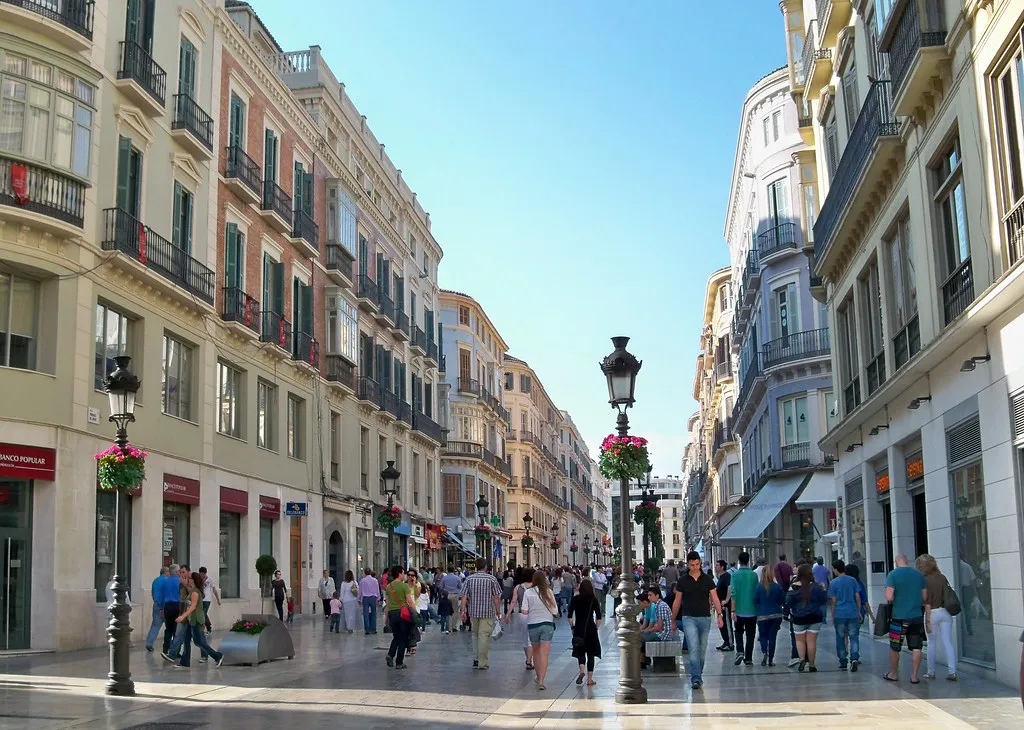
Once in the city, the combination of EMT buses, two metro lines, Cercanías commuter trains, and the Málaga Bici bike-share covers almost every neighbourhood. The historic core — from the Alcazaba to Calle Larios — is compact and very walkable. Most first-time visitors only need public transport for the airport connection and a couple of beach or neighbourhood trips.
From Malaga Airport (AGP) to the City Centre
Four transport options connect the airport to the city: the Cercanías train, the Airport Express Bus (Line A), taxi, and pre-booked private or shared transfer. The table below summarises the key differences so you can choose at a glance.
- Cercanías C1 train — €1.80, ~12 min. The fastest and cheapest option. The station is directly opposite the Terminal 3 arrivals exit. Trains run every 20 minutes from 06:44 to approximately 00:54. Buy tickets at vending machines (English available); validate at the turnstile. Ride to Málaga Centro Alameda for the city centre, or alight one stop earlier at María Zambrano for long-distance connections.
- Airport Express Bus (Line A) — €4, ~20–30 min. Departs from just outside Terminal 3 arrivals every 30–45 minutes, 07:00–00:00. Stops include Estación FFCC (María Zambrano), Avenida de Andalucía, Alameda Principal, and Plaza del General Torrijos near the waterfront. Pay the driver in cash; exact change appreciated. Slightly slower than the train but drops you closer to beach hotels on the western edge of the centre.
- Taxi — €20–25, ~15–20 min. The official taxi rank is to the right as you exit Terminal 3 arrivals. All licensed taxis are white with a blue diagonal stripe. A €5.50 airport supplement applies to all fares. Night journeys (00:00–06:00) carry a €2 surcharge. Luggage over 60 cm costs €0.45 extra per item. The meter runs; ask the driver to confirm it's running if in doubt.
- Private or shared transfer — €10–40, ~15–20 min. Pre-book online before arriving. Private transfers suit families and groups with heavy luggage (€30–40); shared shuttles serve solo and pair travelers (€10–15 per person) but may stop at multiple hotels. A confirmed driver waiting at arrivals is worth paying extra for late-night or early-morning flights.
| Option | Cost | Journey time | Frequency | Best for |
|---|---|---|---|---|
| Cercanías C1 train | €1.80 | ~12 min | Every 20 min (06:44–00:54) | Budget travellers, solo arrivals |
| Airport Express Bus (Line A) | €4 | ~20–30 min | Every 30–45 min (07:00–00:00) | Beach-hotel travellers, heavy bags |
| Taxi | €20–25 | ~15–20 min | On demand | Convenience, late-night arrivals |
| Private / shared transfer | €10–40 | ~15–20 min | Pre-booked | Families, groups, guaranteed pick-up |
Returning to the airport follows the same logic. From Centro Alameda, the C1 train runs to the airport every 20 minutes; first departure around 05:20, last around 23:00. The Express Bus picks up at Alameda Principal (in front of Burger King), El Parque (Paseo del Parque), and Plaza General Torrijos. Allow 40–60 minutes from the city centre before your check-in deadline to be safe.
Navigating Málaga by Train
Málaga has two main rail stations for visitors: María Zambrano and Centro Alameda. Both are connected by the C1 Cercanías line, so you can use either for the airport run or for trips along the coast to Fuengirola and Torremolinos.
María Zambrano is the city's primary intercity hub. AVE high-speed trains to Madrid (2h 30 min, from €30) and Córdoba (1h, from €15) depart here, as do medium-distance trains to Seville and Granada. Inside the station, the Vialia Centro Comercial shopping mall has food, pharmacies, and luggage storage lockers. Lockers cost €4–6 for up to 24 hours — useful if you're checking out of a hotel before an evening flight. There's also a tourist information desk and hotel on the upper floors.
Centro Alameda is the last stop on the C1 line and sits just west of the river, a 10-minute walk from Calle Larios. From the Calle Alemania exit you're on the east bank and 2 minutes from CAC Málaga contemporary art museum; from the Avenida de Andalucía exit you reach the western quayside. This is the better arrival point if you're staying in the historic centre. It has no long-distance services but is quieter and easier to navigate.
Cercanías single tickets cost €1.80 for 1–2 zones (city centre to airport), rising to €3.60 for 5 zones (Fuengirola). Children under 6 travel free; groups of up to 10 get a 30–40% discount. Tickets must be used within 2 hours of purchase. Buy at any station vending machine (English available) or via the Renfe app. You can check current schedules on the Renfe Cercanías Málaga timetable page.
Exploring Málaga by Bus
EMT Málaga runs an extensive city bus network with over 30 lines covering the entire urban area including beaches, residential districts, and the university campus. Most routes run from 06:45 to 23:00, with the busiest lines every 8–12 minutes during the day. Three night Búho lines operate 23:00–05:00 covering the main corridors.
A single fare costs €1.40, paid in cash to the driver (coins and small notes). For multiple trips, the Tarjeta de Transporte (transport card) reduces the cost to €0.83 per journey. The card itself costs €0.30 (paper) or €1.80 (PVC). You can buy and top it up at estancos (tobacco shops), newsstands, and metro stations. The Bonobús 10-trip card costs €8.40 and allows one ticket to cover an entire group within the first hour of validation — useful for families. Download the EMT Málaga app for real-time arrivals and route planning; it also shows whether the next bus has room. Full routes and timetables are on the EMT Málaga official website.
The main long-distance bus station (Estación de Autobuses de Málaga, Paseo de los Tilos) sits directly beside María Zambrano and has 38 platforms. From here, ALSA and other carriers run frequent services to Granada (1h 45 min), Seville (2h 30 min), and Almería. There is also a smaller port bus station at Muelle de Heredia for coastal day trips to nearby villages.
Using the Málaga Metro System
Málaga's metro has two lines and 21 stations, all underground. Line 1 (L1) runs from Andalucia Tech (Universidad campus area) to El Perchel, with key stops including the university, the hospital, and El Perchel interchange. Line 2 (L2) runs from El Perchel to Palacio de los Deportes, with stops near the beach and the sports arena. Both lines meet at El Perchel, which is one stop from María Zambrano on the Cercanías.
Frequency is high: every 6–10 minutes on weekdays, every 10 minutes on weekends. Hours are Monday–Thursday 06:30–23:00, Friday and public holidays 06:30–01:30, Saturday 07:00–01:30, Sunday 07:00–23:00. A single metro ticket costs €1.35; combined metro and bus travel on the transport card costs €0.83 per trip. Vending machines at every station accept cards. Check real-time service status at the Metro Málaga official website.
The metro doesn't yet reach the historic centre directly — that expansion is still planned. For most sightseeing, the Cercanías to Centro Alameda or bus lines are more useful. Where the metro earns its keep is for trips between the university, the hospital, the western beaches, and María Zambrano when you're making onward connections. It's also a reliable option on rainy days when buses slow down in traffic.
Getting Around Málaga by Taxi, Uber, and Cabify
Licensed taxis in Málaga are white with a diagonal blue stripe on the front door. A green roof light means the cab is free. Ranks are at all major hubs — the airport, María Zambrano, the port, and the main tourist squares. You can also hail in the street or call (+34) 952 33 33 33 or (+34) 942 04 04 04. Note: calling for a taxi adds a small dispatch fee; using Uber or Cabify instead avoids this. All taxis run on a meter.
Daytime rates (06:00–22:00) start at €3.60 plus €0.86/km. Night and weekend rates (22:00–06:00) start at €4.50 plus €1.06/km. A typical short city hop — say, María Zambrano to the Alcazaba — runs €7–10. Uber and Cabify are both active in Málaga and offer fixed-price quotes upfront via app; they often undercut taxis for shorter routes and eliminate the need for cash.
One practical note for timing your taxi or ride-hailing trip: during Semana Santa (Holy Week, late March/April) and the Feria de Málaga (mid-August, typically the third week), large sections of the city centre are closed to traffic. Processions and street parties can block roads for hours. During these periods, taxis to the historic centre may be rerouted significantly, adding 20–40 minutes. The C1 train to Centro Alameda is the only transport that stays reliably on schedule because it runs underground — it's the strong recommendation for airport arrivals during both festivals.
Cycling and Other Ways to Explore Málaga
Málaga Bici is the city's public bike-share scheme, with docking stations spread across all central neighbourhoods. Residents and tourists can borrow a bike from any station and return it to any other. Pickup is available 07:00–23:00; drop-off is 24/7. The first 30 minutes of each ride are free, then €0.017 per minute. For trips under 30 minutes — which covers most city-centre hops — you pay nothing beyond the registration fee. If your ride approaches 30 minutes, dock the bike at any station and immediately pick up a fresh one to reset the clock. Failing to return a bike within 2 hours while under-credited incurs a usage block, so keep an eye on your app timer.
Cycling is well-suited to the flat seafront promenade (Paseo Marítimo) from Málagueta Beach westward, and the tree-lined boulevards around the Alcazaba. Traffic on narrow old-town streets is light in the mornings. A few private operators also offer guided bike tours and day rentals with helmets; these typically run €12–20 for a full day and include a city map. Málaga Bici's app shows you live dock availability and nearby stations.
Renting a car is worth considering only if you plan day trips to the villages of the interior — Ronda, the Caminito del Rey gorge, or the Axarquía wine villages — since city parking is expensive and many central streets are pedestrianised. The Málaga attractions guide covers those day-trip options in detail. For everything within the city, public transport and walking are faster and cheaper than driving.
Buying Tickets and Travel Passes
Single tickets for every mode of transport can be bought on the spot — at airport vending machines, bus station counters, metro platform machines, or directly from a bus driver. All machines accept cards and cash and offer English. There is no need to pre-purchase anything except for long-distance AVE trains, where booking in advance online almost always gets you a cheaper fare. The Renfe app and website both show real-time availability and prices; aim to book AVE at least a week ahead for the best rates.
For city travel, the Tarjeta de Transporte (transport card) is worth getting if you'll use buses or the metro more than three times. One card works for both services. Cost €0.30 for paper or €1.80 for the reloadable PVC version, then top up as needed. Each validated journey costs €0.83 on the card versus €1.40 (bus) or €1.35 (metro) for a paper ticket. The Bonobús 10-trip card (€8.40) is an alternative for bus-only travelers and allows group use within the first hour.
For frequent commuters or longer stays, Renfe also offers a Bonotren (10 trips on one route, valid 1 month) and personalised monthly or student passes with significant discounts. These are overkill for a standard tourist stay but useful if you're based in Málaga for a month or more. All multi-trip cards must be validated at the turnstile or reader before boarding — a common beginner mistake is buying the card and then boarding without swiping it.
Essential Tips for Málaga Public Transport
Always keep your ticket until you exit the station or finish the journey. Cercanías trains require you to scan out, not just scan in. Bus inspectors do board and check — the fine for riding without a valid ticket is significantly higher than the fare. On buses, stand near the front and have your card or coins ready before the doors open; drivers will not wait long at stops.
For travellers with reduced mobility: all EMT buses have low-floor ramps and designated wheelchair spaces. Metro stations have lifts at every entrance. Cercanías trains are level-boarding at all Málaga stops. Airport Terminal 3 to the Cercanías platform is fully step-free via lift. Taxis in the larger MPV category (up to 7 seats) can accommodate foldable wheelchairs — request specifically when calling or confirm with Uber's wheelchair-accessible option in the app.
For night arrivals: the last C1 train from the airport departs at approximately 00:54. After that, Line A Express buses also run until midnight. If you land between midnight and 06:00, your options are taxi or pre-booked private transfer. There is no all-night train or airport bus — this is a real gap in the network. If your flight regularly arrives after midnight, factor in a taxi budget of €22–27 rather than relying on public transport. Keep the taxi numbers saved: (+34) 952 33 33 33 or (+34) 942 04 04 04.
Finally, Málaga's historic centre is genuinely walkable for most sightseeing. The Alcazaba, Picasso Museum, Cathedral, Calle Larios, and the seafront are all within a 20-minute walk of Centro Alameda. On a short trip, you may use public transport only for the airport connection and spend the rest of your time on foot. Check out our full getting-around guide and where to stay in the city to plan your base accordingly.
Frequently Asked Questions
What is the cheapest way to get from Malaga Airport to the city centre?
The Renfe Cercanías C1 train is the cheapest option, costing €1.80 / ~$2 for a single ticket. It takes about 12 minutes to reach María Zambrano station.
How long does it take to get from Malaga Airport to the city centre?
By train, it takes approximately 12 minutes. The Airport Express Bus takes 15-25 minutes, and a taxi or private transfer usually takes 15-20 minutes, depending on traffic.
Are there direct trains from Malaga Airport to the city centre?
Yes, the Renfe Cercanías C1 line offers direct trains from Malaga Airport to both María Zambrano and Centro Alameda stations in the city center.
How late do public transport options run in Málaga?
The C1 train runs until approximately 11:45 PM. The Airport Express Bus runs until 12:00 AM, and night buses operate until around 6:00 AM. Metro hours are extended until 1:30 AM on weekends.
Which Málaga train station is closer to the city center?
Centro Alameda station is closer to the historic city center and many major attractions. María Zambrano is a larger hub for long-distance trains.
Getting to and around Málaga is straightforward once you know the network. The C1 train from the airport to Centro Alameda is the single most useful piece of information for most visitors — cheap, fast, and direct. Beyond that, the combination of EMT buses, metro, bike-share, and walkable historic streets means you rarely need a taxi within the city. Plan your base in the centre, pick up a transport card on arrival, and you'll spend almost nothing on getting around. Discover more about planning your trip in our 3-day Málaga itinerary and the best time to visit guide.
You might also like


Continue reading
More guides you'll find useful


