

10 Best Málaga Neighborhoods Guide: Where to Stay & Explore (2026)
Discover Málaga's best neighborhoods for your trip. Our guide covers top areas, local insights, and practical tips for choosing where to stay, from historic charm to beachside vibes.
On this page
Málaga Neighborhoods Guide: Best Areas to Stay & Explore
Choosing where to stay in Málaga shapes everything — your walk to the cathedral, your morning coffee ritual, your chances of hearing live flamenco through an open window. After several visits to this Andalusian city, I've found that the neighborhood decision matters far more than which hotel you pick within it. This guide covers ten distinct areas in 2026, with honest pros, cons, and the kind of detail that helps you commit.
The core question is always the same: do you want the city or the beach? Once you answer that, the rest falls into place. For culture, museums, and tapas bars, the historic core is hard to beat. For waking up to the Mediterranean, you'll be looking east along the coast. Both are within reach of each other, but they feel like different cities.
Plan with trusted sources: cross-check opening hours and seasonal details with the official Andalusia tourism board, and read more about the city on its Wikipedia entry before you go.
Overview of Málaga's Layout: Finding Your Bearings
Málaga has two defining features you need to understand before you book anything. The first is the Mediterranean coast, which runs east to west and is where almost all visitor interest concentrates. The second is the Río Guadalmedina, a mostly dry river channel that cuts north to south through the city, effectively dividing it into two very different halves.
Everything worth visiting as a tourist sits east of the river. The Centro Histórico lies just east of the riverbank, and moving further east along the coast you hit La Malagueta, La Caleta, Pedregalejo, and El Palo — a chain of increasingly relaxed beach neighborhoods. North of the historic center you find La Merced, La Victoria, and Lagunillas: residential, authentic, and far more affordable than the tourist core.
West of the river is a different story. Most of western Málaga is residential and modern, with no major sights and little to draw visitors. The exception is the innermost strip — El Perchel, La Trinidad, and Mármoles — which are cheaper, well-connected to transport, and only a short metro or bus ride from the center. If budget matters more than walkability, these western fringe neighborhoods are worth considering.
The city is broadly walkable. Centro Histórico to La Malagueta beach takes about 20 minutes on foot. Centro Histórico to Pedregalejo takes 45 minutes to walk or about 15 minutes on bus line 3. Teatinos, the university district to the northwest, is the main neighborhood not walkable from the center — plan on the metro for that one.
Quick Summary: Top Málaga Neighborhoods at a Glance
Here is a straightforward breakdown of which neighborhood fits which traveler. Each is covered in detail below, but this summary helps you orient before reading the full profiles.
- Centro Histórico — Best for first-timers, culture lovers, and anyone who wants everything walkable. Most expensive and busiest.
- Soho — Best for art-seekers and those wanting boutique hotels, modern dining, and proximity to the port without the full tourist crush.
- La Merced / La Victoria / Lagunillas — Best for independent travelers who want local life, lower prices, and a short walk to the historic center.
- La Malagueta / La Caleta — Best for beach-first visitors who still want a city feel. Upscale, limited accommodation, book early.
- Pedregalejo — Best for foodies and families wanting a slower pace. Excellent espetos (grilled sardines), relaxed vibe, inconvenient for sightseeing.
- El Palo — Best for budget beach stays with a very local atmosphere. The least touristy of the coastal neighborhoods.
- El Perchel — Best for budget travelers and day-trippers using the train network. No atmosphere to speak of, but very practical.
- La Trinidad — Best for budget-conscious visitors wanting a residential base close to both the center and the river.
- Teatinos — Best for long stays, students, or digital nomads. Modern, cheap, and metro-connected.
- Ciudad Jardín — Best for families seeking green space and quiet. Home to the Jardín Botánico La Concepción.
| Neighborhood | Vibe | Approx. Price/Night | Best For |
|---|---|---|---|
| Centro Histórico | Lively, tourist-facing | €100–€200+ | First-timers, culture lovers |
| Soho | Bohemian, artsy | €130–€250 | Art-seekers, boutique hotel guests |
| La Merced / La Victoria / Lagunillas | Local, authentic | €80–€150 | Independent travelers, budget-conscious |
| La Malagueta / La Caleta | Upscale, beachfront | €150–€300+ | Beach-first visitors |
| Pedregalejo | Relaxed, village-like | €60–€120 | Foodies, families |
| El Palo | Very local, quiet beach | €50–€100 | Budget beach stays |
| El Perchel | Practical, transit hub | €60–€110 | Day-trippers, rail travelers |
| La Trinidad | Residential, low-key | €50–€90 | Budget travelers wanting central access |
| Teatinos | Modern, student district | €40–€80 | Long stays, digital nomads |
| Ciudad Jardín | Green, family-friendly | €60–€100 | Families, nature seekers |
Centro Histórico: The Heart of Málaga
The Centro Histórico is Málaga's ancient core and, for most first-time visitors, the obvious choice. It is compact, pedestrianized, and filled with the city's main sights: the Málaga Cathedral, the Alcazaba, the Roman Theatre, and the Picasso Museum are all within a few minutes' walk of each other. Calle Marqués de Larios, the city's main shopping boulevard, runs through the center and leads to Plaza de la Constitución, from which the rest of the old town fans out.
The atmosphere here is genuinely lovely — narrow marble-paved streets, classical buildings, churches half-hidden on side lanes, and terraces busy from mid-morning until late. That said, it is heavily tourist-facing. Many locals have moved out over the past decade as short-term rentals have taken over much of the housing stock. In peak summer the crowds are intense, especially around Calle Larios and the Alcazaba.
One practical warning most guides skip: noise. Parts of the historic center sit directly above or adjacent to clubs and late-night bars. If your hotel is near Calle Granada, Calle Comedias, or the streets between Plaza de la Merced and the cathedral, expect noise until 03:00 or 04:00 on weekends. Always check whether your accommodation is on a street with nightlife before booking — this is the single most common complaint from visitors staying in the centro.
Budget range: mid to high. Expect €100–€200+ per night for a decent hotel. The Marriott AC Hotel Málaga Palacio (the only large hotel in the historic center, rooftop bar with cathedral views) and Palacio Solecio (renovated 18th-century palace, from €250) are the most recommended upscale options. Madeinterranea Suites offers good value at the boutique end (around €150).
Soho (Ensanche Centro): Málaga's Arts District
Soho sits immediately south of the Centro Histórico, between Alameda Principal and the port. It is a grid-planned, primarily residential neighborhood that has been undergoing rapid creative and commercial reinvention for several years. The street art here is among the most ambitious in southern Spain — large-scale murals by international artists (including Obey and D*Face) cover entire building facades, and the density of independent galleries makes wandering genuinely rewarding.
The Contemporary Art Centre of Málaga (CAC), one of Spain's more significant modern art spaces, is located here. The neighborhood also contains Parque de Málaga and Plaza de la Marina on its eastern edge — good for morning walks before the day heats up. The overall feel is bohemian and locally oriented, without the saturation of tour groups you find in the historic core. Walking to the Alcazaba takes about five minutes.
Soho has the best concentration of larger boutique and luxury hotels in central Málaga. The Only YOU Hotel Málaga (5-star, rooftop infinity pool with port views, from €250) and Room Mate Valeria (modern 4-star design hotel, port and garden views, from €175) both sit on or near Plaza de la Marina. These hotels are frequently cited as the best-located upscale stays in the city. Budget travelers can look at NONO Charming Stay, an apart-hotel with kitchenettes at around €130.
La Merced / La Victoria / Lagunillas: Authentic Local Life
These three small adjacent neighborhoods sit immediately north of the Centro Histórico and offer a completely different atmosphere at noticeably lower prices. They are still historic — older buildings, small streets, neighborhood squares — but they are working-class and genuinely local in a way the tourist center no longer is. You will find supermarkets, family-run bars, bookshops, and vintage clothing stores rather than souvenir shops.
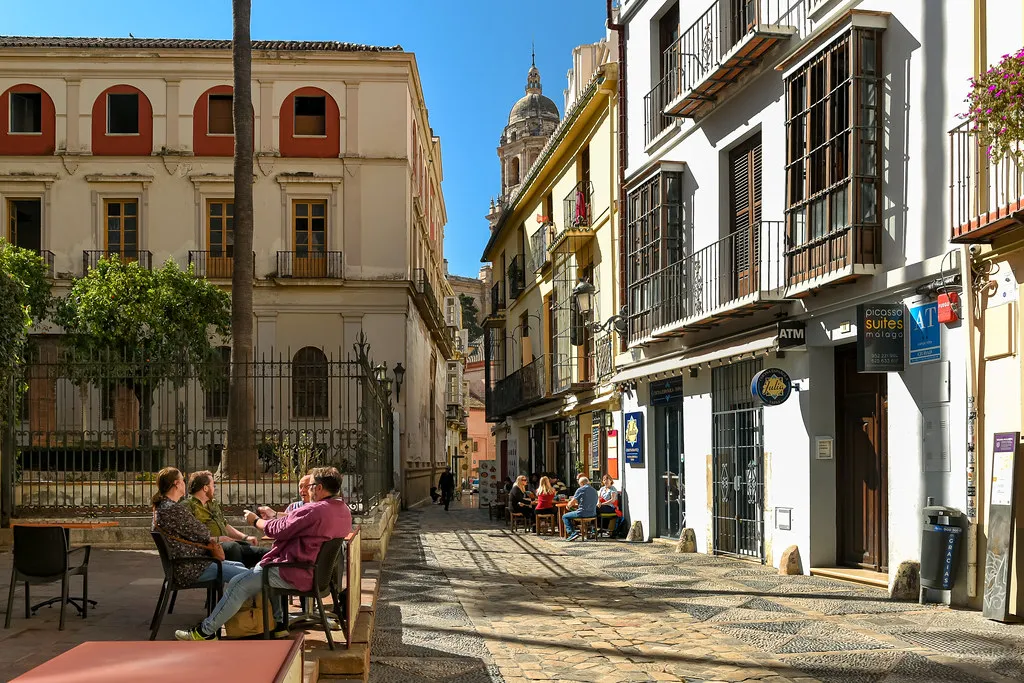
La Merced centers on Plaza de la Merced, a lively square busy from morning to midnight. Pablo Picasso's birthplace — now the Fundación Picasso museum — is located here. La Merced also edges into the LGBTQ+-friendly nightlife zone of the city, so check street-level noise before booking accommodation on the plaza itself. La Victoria runs along Calle Victoria, with good local restaurants and the baroque Santuario de la Victoria church. Lagunillas, historically a Roma neighborhood just outside the old city walls, has the rawest character of the three and the best street art outside of Soho — if you walk through on a weekend evening, there is a real chance of hearing flamenco sung spontaneously in the street, not performed for tourists.
Hotel options are fewer here than in the centro. The Parador de Málaga Gibralfaro — perched atop Mount Gibralfaro next to the castle, with sweeping views of the city and coast — is technically in this zone and is one of the most unique stays in the city at around €200 per night. Well&Come Boutique Hotel near Plaza de la Merced is a solid mid-range option (€100–€250).
La Malagueta / La Caleta: Beachfront Bliss
La Malagueta and La Caleta are Málaga's inner-city beach neighborhoods, sitting just east of the historic center along the seafront. La Malagueta beach itself is the most famous city beach — wide, sandy, and backed by the palm-lined Paseo Marítimo. The neighborhood has a more modern and upscale feel than the historic center, with high-rise apartment blocks and the Gran Hotel Miramar (a grand five-star beachfront property, from €250) as its architectural anchor.
The appeal is straightforward: you wake up 200 meters from the Mediterranean. On a hot July or August afternoon, that proximity to cool water is worth far more than any museum proximity. The area is also close enough to the historic center — a 20-minute walk or five-minute taxi — to make day trips into the old town easy. Chiringuitos (beachside bars and restaurants) line the promenade and serve grilled fish and cold beer from midday until midnight.
The main downside is accommodation scarcity. This is not a neighborhood built for hotels — most residents are long-term locals or wealthy second-home owners. What hotel stock exists books up quickly in summer. Book La Malagueta accommodation at least two to three months ahead for July and August stays. The Hotel MS Maestranza (mid-range, just off the beach, from €150) is the most consistently available option. Also near here: the iconic Plaza de Toros de La Malagueta bullring, a prominent 19th-century landmark on the seafront road.
Pedregalejo: Charming Fishing Village Vibes
Pedregalejo is the neighborhood that most convincingly maintains a pre-tourist-boom character. Located about 4 km east of the historic center, it was once a self-contained fishing village and still looks and feels like one — low-rise buildings, a seafront promenade, and boats still pulled up on the beach alongside the chiringuitos. The promenade (Paseo de Pedregalejo) is one of the nicest walking and cycling routes in the city.
The food scene here is the main draw for visitors. Pedregalejo is the spiritual home of espetos — sardines grilled on bamboo skewers over open charcoal fires on the beach. These are not the same as sardines served in the centro tourist restaurants. Here they are prepared by families who have been doing it the same way for generations, served on wax paper with crusty bread and cheap local wine. El Cabra and Chiringuito Los Mellizos are two of the most cited spots. Budget around €15–€25 for a full seafood meal.
Getting here: bus lines 3 or 11 from the city center take 15–20 minutes and cost around €1.40 per journey. A bike ride along the seafront from La Malagueta takes about 25 minutes and passes through La Caleta along the way — this is a genuinely good way to arrive if you have the time. The main inconvenience is sightseeing access: every visit to the Cathedral or Alcazaba requires a 30-minute round trip, which adds up over a multi-day stay.
El Palo: Local Beaches and Seafood
El Palo sits just beyond Pedregalejo to the east and is the most genuinely local of Málaga's coastal neighborhoods. It was also a fishing village, and the transition from urban city to small coastal community is even more pronounced here than in Pedregalejo. The beach is quieter, the restaurants are cheaper, and you will rarely hear English spoken. This is where malagueños from the interior of the city come for a weekend lunch, not where tourists typically end up.
For families and budget travelers, El Palo offers the best combination of beach access and value in Málaga. Set-menu lunches (menú del día) at local restaurants run €10–€14 including wine. The beaches are less crowded than La Malagueta even in peak summer. There are small supermarkets and a local market that gives the neighborhood a functional, lived-in feel that beach resort areas typically lack.
The trade-off is the same as Pedregalejo: distance from central sights. Bus lines 3 and 11 connect El Palo to the city center in 20–25 minutes, but you are effectively commuting to the historic quarter for every museum or cultural visit. El Palo works best as a base for visitors who have already seen the main sights and want to spend most of their time at the beach, or for families who prioritize calm over convenience.
El Perchel: Traditional & Transport Hub
El Perchel sits just west of the Guadalmedina River, directly adjacent to Málaga's main transport infrastructure. Málaga María Zambrano station — the hub for high-speed AVE trains to Madrid (2h30), Seville (2h), and Granada (1h30), as well as regional trains and the airport line — is in El Perchel. The main bus station is a short walk away. If you are using Málaga as a base for day trips across Andalusia, nowhere beats El Perchel for transport convenience.
The neighborhood itself is one of Málaga's oldest working-class barrios and has a lived-in, unpretentious character. It is not pretty by the standard of the historic center, but it is real. The Atarazanas Market — a stunning 14th-century Moorish building repurposed as a covered food market, open Monday to Saturday 08:00–14:00 — is the neighborhood's main draw. Stalls sell local produce, spices, and fresh seafood. Grabbing breakfast here among local shoppers is one of the more authentic experiences the city offers.
Accommodation is cheaper than the centro, and options have expanded in recent years as tourism to the city has grown. A 10-minute metro ride gets you to the historic center. The trade-off is atmosphere: El Perchel at night is quiet and functional rather than vibrant. It suits practical travelers who spend their days out in the city or region and just need a comfortable, affordable base to sleep.
La Trinidad: The Quiet, Affordable Option Locals Actually Use
La Trinidad rarely appears in neighborhood guides, yet it occupies one of the most useful positions in Málaga's map. It sits between El Perchel and the historic center, just north of Alameda Principal along the riverbank. It is middle- and working-class, genuinely residential, and has none of the tourist saturation of the centro. Prices for accommodation and food are noticeably lower.
The location is what makes it worth considering. You can walk to the historic center in about 10–15 minutes, crossing the river at Puente de los Alemanes or Puente de Tetuán. The beach at La Malagueta is 30–35 minutes on foot or a short bus ride. The transport connections to the rest of the city are good. For visitors who want to experience a more everyday side of Málaga — and who are comfortable navigating a neighborhood with few English menus and no tourist infrastructure — La Trinidad offers solid value.
The downside is limited hotel stock and low nighttime energy. There are a handful of small hostels and budget guesthouses but nothing in the boutique or luxury category. If you want character and local life on a budget without committing to the full 20-minute bus ride from El Palo or El Perchel, La Trinidad is the underutilized answer that most travel guides skip past entirely.
Teatinos: Modern & University Life
Teatinos is Málaga's main university district, located northwest of the city center and reached in about 15–20 minutes on the metro. It has a completely different energy from any of the neighborhoods described above — contemporary architecture, wide boulevards, student bars, and the kind of affordable, unpretentious restaurants that only exist where a large student population needs feeding. There are no historic buildings and no tourist attractions in the traditional sense.
For long-term visitors, remote workers, or digital nomads spending a week or more in Málaga, Teatinos offers monthly apartment rates and a modern living infrastructure that the historic center cannot match. Coffee shop culture is strong. Coworking spaces have multiplied in recent years. The metro connection means the Alcazaba is 20 minutes door-to-door on a good day.
Teatinos is not a good short-stay choice. Spending two or three nights here and commuting into the old town each day sacrifices the atmosphere that makes Málaga worthwhile. But for visitors planning a week or longer — especially those mixing work and travel — it is worth pricing against the centro. You can expect to pay 40–60% less for equivalent apartment space than in the historic center.
Málaga Planning Cheatsheet: Essential Tips for Your Trip
The best time to visit Málaga depends heavily on what you want. April–May and September–October offer the most pleasant combination: warm enough for the beach, cool enough for walking, and far fewer crowds than summer. July and August are hot (regularly 35–38°C), expensive, and busy — but the beach neighborhoods come alive and the nightlife is at its peak. Winters are mild (14–18°C), ideal for city exploration, and accommodation is cheapest.
Transport within the city is well-covered by a combination of EMT buses (flat fare ~€1.40, or rechargeable bono card) and the metro (two lines, most useful for Teatinos and the airport). Walking covers most of the central neighborhoods efficiently. A bike-share scheme (BiciMálaga) operates throughout the city and is excellent for the coastal promenade between La Malagueta and Pedregalejo. Taxis and rideshare are reliable and not expensive by western European standards.
Booking in advance matters more in Málaga than in many Spanish cities. Hotel stock in desirable neighborhoods — especially La Malagueta and the best boutique options in the Centro Histórico — fills up 6–8 weeks ahead for summer weekends. The Alcazaba and Picasso Museum also benefit from pre-booked tickets to skip queues. For more on how to structure your days here, see our Málaga 3-Day Itinerary for a practical framework.
A note on safety: Málaga is safe by any European standard, including all ten neighborhoods in this guide. Petty theft (pickpockets) is the only real concern, concentrated in the busiest tourist zones of the Centro Histórico in peak summer. Keep valuables off tables in busy tapas bars and use basic awareness on Calle Larios on crowded Saturday afternoons. No neighborhood in this guide should be avoided on safety grounds.
Map of Recommended Neighborhoods & Hotels
Understanding the relative position of neighborhoods on the map saves real time. The Centro Histórico is the geographic center. Soho is directly south of it, between the centro and the port. La Merced sits north, walkable in under ten minutes. East along the coast: La Malagueta, then La Caleta, then Pedregalejo (3 km east), then El Palo (4.5 km east). West of the river: El Perchel, La Trinidad directly across from the centro, Mármoles just north of that.
For luxury stays, the concentrated options are Gran Hotel Miramar (beachfront, La Malagueta), Palacio Solecio and Marriott AC Hotel (Centro Histórico), and Only YOU Hotel Málaga (Soho). Mid-range travelers do well in the Centro Histórico boutiques or in Soho. Budget travelers have the most options in El Perchel, La Trinidad, and the eastern beach neighborhoods. Pedregalejo has the most affordable beachside accommodation — La Moraga Hostal is the most-cited budget option at around €60–€90 per night.
For more specific hotel recommendations across all budgets and categories, see our full guide to where to stay in Málaga, which pairs each neighborhood profile with current options and price ranges.
Key Takeaways: Choosing Your Perfect Málaga Base
The Centro Histórico wins for first-timers on short trips who want everything walkable and don't mind a premium. Soho is the better pick if you want upscale hotels, a slightly more local feel, and access to the port and park. La Merced and its adjacent neighborhoods are the right call for budget-conscious independent travelers who want authenticity over convenience. La Malagueta and Pedregalejo serve beach-first visitors, with the former better for nightlife and the latter better for food and family pace.
For the best food in Málaga — particularly seafood — staying in or day-tripping to Pedregalejo or El Palo is non-negotiable. No restaurant in the historic center serves espetos the same way. For nightlife, the La Merced / Lagunillas zone has the densest bar concentration after midnight. For day-trip logistics, nothing beats El Perchel's transport access. For a long digital-nomad style stay, Teatinos wins on price and infrastructure.
Whatever you choose, plan three to four days minimum to cover the Centro Histórico, one beach neighborhood, and a morning in La Merced. If you want to add day trips to Ronda, the Caminito del Rey, or the wine villages of the Axarquía, extend to five to seven days. See our guide on how many days to spend in Málaga for a fuller breakdown by trip type and travel pace.
Frequently Asked Questions
Which Málaga neighborhoods are best for first-time visitors?
For first-time visitors, the Centro Histórico is undoubtedly the best choice. It places you within walking distance of major attractions like the Alcazaba and Malaga Cathedral. This area also offers abundant dining, shopping, and nightlife options, ensuring a vibrant introduction to the city.
How many days should you plan for exploring Málaga neighborhoods?
To truly explore Málaga's diverse neighborhoods and main attractions, plan for at least 3 to 4 days. This allows ample time for the Centro Histórico, a visit to Soho, and a relaxed day at the beach in La Malagueta or Pedregalejo. If you wish to include day trips, extend your stay to 5-7 days.
What's the difference between Centro Histórico and Soho?
The Centro Histórico is Málaga's ancient core, filled with historical landmarks, traditional tapas bars, and classical architecture. In contrast, Soho (Ensanche Centro) is a modern, revitalized arts district known for its vibrant street art, contemporary galleries, and trendy cafes. While close, they offer distinctly different atmospheres.
Málaga's charm lies in its diverse neighborhoods, each offering a unique slice of Andalusian life. From the historic grandeur of the Centro Histórico to the laid-back seafood shacks of El Palo, there's a perfect spot for every traveler. By understanding the distinct character of each area, you can tailor your visit to match your interests and budget. We hope this guide helps you choose the ideal base for your unforgettable Málaga adventure.
Remember to embrace the local pace, savor the delicious cuisine, and immerse yourself in the vibrant culture. Whether you're exploring ancient ruins or relaxing on sunny beaches, Málaga promises a rich and rewarding experience. Enjoy discovering the many facets of this beautiful Spanish city.
You might also like


Continue reading
More guides you'll find useful


