

Getting Around Málaga: Your Complete Transport Guide
Navigate Málaga like a local! Discover the best ways to get around by bus, metro, bike, or taxi, with practical tips on tickets, routes, and apps for a seamless trip.
On this page
Getting Around Málaga: Public Transport, Bikes, Taxis & More
Málaga is a compact, flat city where most central attractions sit within easy walking distance of each other. The Alcazaba, Picasso Museum, and the seafront promenade are all linked by wide pedestrian streets — you could spend a long weekend here without ever needing a bus. But the moment you want to reach the airport, catch a train to El Chorro for the Caminito del Rey, or get home from the Fair at midnight, knowing how the city's transport network fits together saves real time and money.
This guide covers every option available in 2026: metro, bus, train, taxi, bike, scooter, and car. Prices, timetables, and practical tips are included for each so you can make the right call for your itinerary.
Plan with trusted sources: cross-check opening hours and seasonal details with the official Andalusia tourism board, and read more about the city on its Wikipedia entry before you go.
Walking Around Málaga: Exploring the Historic Centre
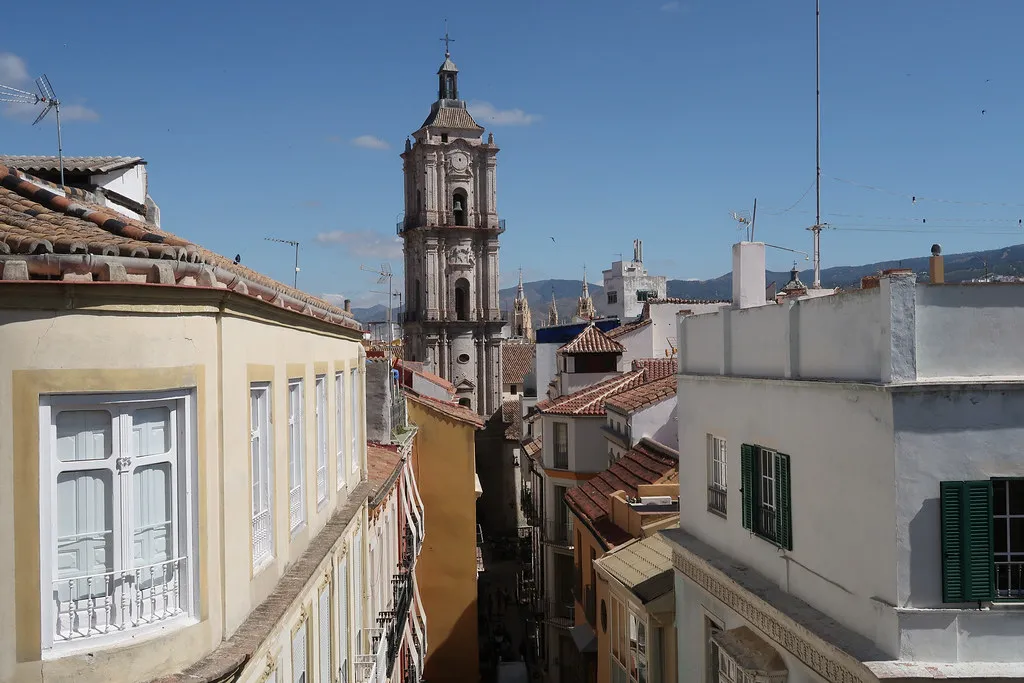
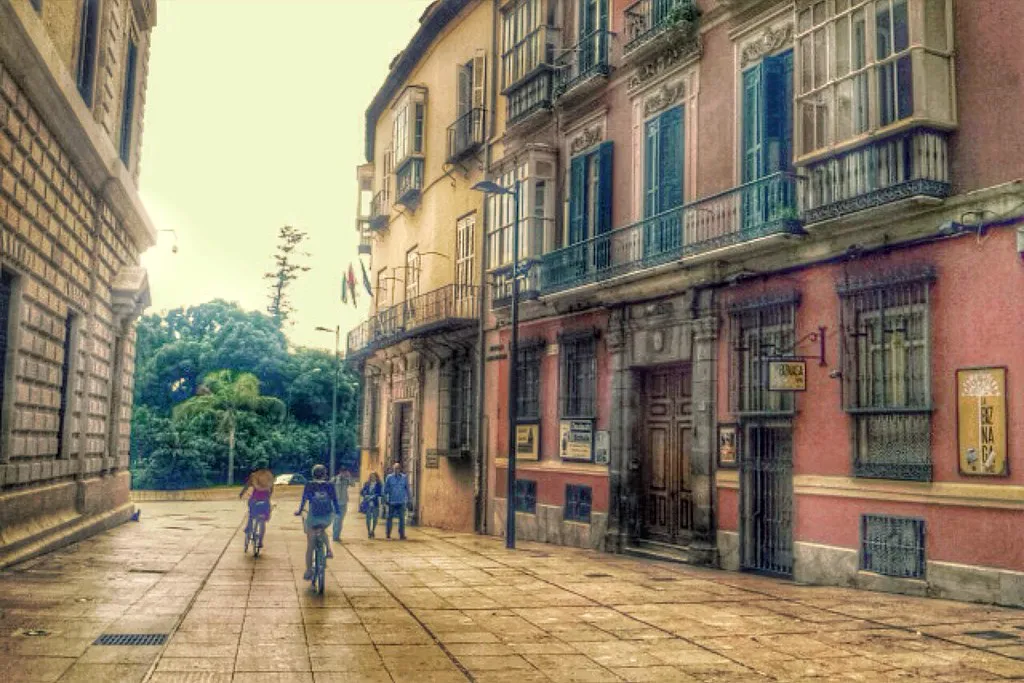
Málaga's historic centre is built on flat ground and has been heavily pedestrianised over the past decade. You can walk from the Alameda Principal to the Alcazaba in around ten minutes, and from the Picasso Museum to the Cathedral in two. Most of the streets in the old quarter are stone-paved and car-free, which makes navigating on foot genuinely pleasant even in summer.
The beachfront promenade stretches east from the port past La Malagueta beach all the way to the fishing villages of Pedregalejo and El Palo — a flat, shaded walk of about 4 km. In the other direction, the renovated port area around Muelle Uno offers a pleasant stroll with bars, restaurants, and sea views.
Wear comfortable shoes for the old quarter's cobblestones. The one area where walking gets harder is the hill up to Gibralfaro Castle — it is a steep 30-minute climb in the heat. If that is on your list, take a taxi or bus up and walk down. Consider exploring the area around Atarazanas Market as a starting point for any walking tour of the centre.
Málaga's Metro System: Quick & Efficient Travel
Málaga Metro has two lines. Line 1 runs from Andalucía Tech (near the university and technology park in the west) through to Atarazanas in the city centre — 11 stops in total, including the hospital and university campus. Line 2 runs from Palacio de los Deportes (the sports stadium) to Guadalmedina, close to El Corte Inglés. Both lines converge at El Perchel, which is a two-minute walk from the main María Zambrano train station.
A single journey costs €1.35 paid by contactless card at the turnstile. If you buy a tarjeta monedero (the rechargeable metro card, €1.80 for a PVC version), the cost per trip drops to €0.49 — and one card can be used by multiple people travelling together, making it excellent value for groups. Trains run every 6–10 minutes on weekdays and every 10 minutes at weekends.
Operating hours are Monday to Thursday 06:30–23:00, Friday 06:30–01:30, Saturday 07:00–01:30, and Sunday 07:00–23:00. The metro is fully accessible: all stations have lifts and ramps, and trains have designated wheelchair spaces. You can also bring a bike on board outside rush hour, free of charge.
The main limitation is coverage: the metro serves the west and centre of the city only. If you are staying east of the Alameda Principal — near La Malagueta beach or El Palo — the bus is more useful. But if you are based in the Teatinos, Huelin, or university district, the metro is the fastest way into the centre by some margin.
Málaga's Bus Network: Routes, Tickets & Tips
The EMT Málaga bus network covers every district in the city and is the most flexible public transport option for tourists. Most daytime routes run from around 06:45 to midnight, with frequency of 8–15 minutes on the busiest lines. Key routes for visitors include Line 11 (Teatinos to El Palo, crossing the entire city east to west), Line 34 (city centre to La Malagueta beach), and the Line A airport express (city centre to Málaga Airport every 20–25 minutes, 07:00–midnight).
A single ticket costs €1.40 paid to the driver (cash only; bring small bills, as drivers do not change notes larger than €5). The Bonobus card — sold at estancos (the shops with a yellow T sign), kiosks, and newspaper stands — costs €5 for 10 trips at €0.50 each. One Bonobus card can be used by multiple passengers on the same journey. Crucially, a second bus boarded within 60 minutes of the first is free on the Bonobus, which matters when your route requires a connection. You can also pay by contactless card or phone directly on the bus (tap the reader next to the driver), though contactless does not give you the multi-trip discount and the charge takes 2–3 days to appear on your bank statement.
Four night bus lines run after regular services end: N1 (Puerta Blanca to El Palo, every 30 minutes, 23:00–05:00), N2 (circular northern route, roughly every 70 minutes, 00:15–06:00), N3 (centre to Campanillas, Fri–Sat only), and N4 (Alameda Principal to Puerto de la Torre via Teatinos, every 45 minutes). Note that Line A (airport bus) does not accept the Bonobus — it is a flat €4 each way. Download the EMT Málaga app for real-time bus locations; it works in English without a Spanish phone plan.
Málaga's Train System: Local & Regional Connections
Málaga's main station is Estación María Zambrano, a combined transport hub and shopping centre in the west of the city. Renfe Cercanías operates two local commuter lines from here. The C1 line is the most useful for visitors: it connects the city centre with Málaga Airport (one stop, around 12 minutes, every 20 minutes) and continues along the Costa del Sol through Torremolinos, Benalmádena, and Fuengirola. The C2 line heads inland towards Álora, passing through the Guadalhorce valley — this is the access route for Caminito del Rey via El Chorro station.
Cercanías ticket prices are zone-based: a 1–2 zone single costs €1.80 (return €3.60); a 3-zone single is €2.05 (return €4.10). You have 2 hours after purchase to start your journey and return tickets must be used the same day. Children under 6 travel free; groups of up to 10 get 30% off singles or 40% off returns — useful for a group heading to Fuengirola or Torremolinos.
For those planning a day trip from Málaga, the train system is the most efficient choice for coast and countryside destinations. María Zambrano also serves high-speed AVE trains to Granada (around 50 minutes), Seville (90 minutes), Cordoba, and Madrid — all useful for multi-city Spain itineraries. Tickets for inter-city trains are best booked in advance on the Renfe website.
Cycling in Málaga: Bike Lanes & Rentals
Málaga has dedicated bike lanes along the seafront promenade connecting the centre to the beach villages of Pedregalejo and El Palo — a flat 4 km each way that passes La Malagueta beach. The coastal route is the most popular cycling option in the city.
For short trips, Málaga Bici is the city's public bike-share scheme. Pick up a bike at any docking station between 07:00–23:00 and return it any time. The first 30 minutes are free; after that it costs €0.017 per minute. Swap to a new bike before the 30-minute mark to reset the clock and keep riding for free. Registration is via the Málaga Bici app or website.
Private rental shops near the centre charge €10–€15 per day for a city bike, or €20–€25 for an electric bike. Electric bikes are worth the extra cost if you plan to climb to Gibralfaro Castle. Always confirm a helmet and lock are included. Stick to dedicated lanes in the centre and dismount in congested pedestrian areas. You can also explore the different neighborhoods by bike along the ring-road cycle lanes.
Getting Around Málaga by Car
Driving in the city centre is not recommended for most visitors. Traffic is heavy throughout the day, parking is expensive (€2–3 per hour in central car parks), and the old quarter's one-way system is genuinely confusing. If your hotel does not include parking, budget an extra €15–25 per day.
The more significant issue in 2026 is Málaga's Low Emissions Zone (ZBE — Zona de Bajas Emisiones), covering 437 hectares of the city centre. Fines of €200 or more have been in operation since 1 December 2025. Vehicles entering the ZBE must display a CERO, ECO, C, or B energy-efficiency certificate sticker on the windscreen. The sticker costs €5 and can be obtained at any post office using the vehicle's number plate. If you are hiring a car, check with the rental company that the vehicle has a valid certificate — most major companies at Málaga Airport now provide certified vehicles as standard, but it is worth confirming before you drive off.
Car hire in Málaga makes most sense when you are heading to Costa del Sol resorts or inland destinations like Ronda or Antequera that public transport does not serve efficiently. For city sightseeing, leave the car at the hotel and use public transport.
Taxis & Ride-Sharing in Málaga
Taxis in Málaga are white with a green roof light. When the light is on, the taxi is free. You can hail one on any main street, pick one up from a rank near the main attractions and transport hubs, or book via the Free Now app (formerly MyTaxi), which shows estimated fares before you commit. Calling a taxi by phone adds a small surcharge, so app booking or hailing directly is better value.
Fares are metered and regulated. The daytime rate (06:00–22:00) starts at €3.60 with a per-kilometre charge of €0.86. Nights and weekends start at €4.50 with a per-kilometre rate of €1.06. A typical city-centre journey costs €7–€12; the airport to the centre is usually €18–€25 depending on traffic. Surcharges apply for large luggage, bank holidays, and the Fair in August.
Uber does not operate in Málaga. For late-night transport when buses are infrequent, taxis and Free Now are your main options. They are reliable and consistently metered — always check the meter starts when you set off.
Hop-on, Hop-off Bus: Tourist-Friendly Option
The City Sightseeing Málaga hop-on, hop-off bus operates three routes from the main train station. The Red Route covers the central sights including the port and Gibralfaro Castle. The Green Route goes to the Botanical Gardens via the Málaga FC stadium. The Blue Route combines the Pompidou Centre and the port with the Russian Museum and Car Museum in the western part of the city. Tickets are valid for 24 or 48 hours and include an audio guide in multiple languages, plus entry to the Music Museum and Car Museum. Prices start at €25 for adults and €12.50 for children aged 3–12 (under 3 free).
The hop-on, hop-off is most worthwhile on your first day in the city. It gives you an efficient overview of where everything is and how the districts connect — useful orientation before you start exploring on foot or by public transport. After that first circuit, you will probably find the local bus or metro more practical and considerably cheaper.
One genuine advantage is the Green Route to the Botanical Gardens. The gardens are difficult to reach by standard bus and the hop-on, hop-off is one of the easiest ways to get there and back without a taxi or car.
Electric Scooters & Other Alternatives
Electric scooter rentals are available across Málaga through apps including Lime and Voi. Prices are typically a small unlock fee plus a per-minute charge. Scooters are well-suited to the seafront promenade and the flat streets around the centre, but should not be ridden on the pedestrianised old quarter streets. Always park in designated bays — the apps show these on the map — or face a fine. Helmets are strongly recommended and are required by law for riders under 16.
Horse-drawn carriages operate near the Cathedral and along the seafront, offering short tourist tours. They are a novelty rather than a practical transport option. For getting between the airport and hotels in the eastern beach areas, shared airport shuttle services are also available and can be cheaper than a taxi for solo travellers.
Payment Methods & Handy Apps for Getting Around
Most transport in Málaga now accepts contactless payment: debit and credit cards, Apple Pay, and Google Pay. Tap your card on the reader next to the driver for buses (€1.40, no multi-trip discount) or at the turnstile for the metro (€1.35). Contactless payments take 2–3 days to appear on your bank statement.
For better value, use the Bonobus card (bus) or tarjeta monedero (metro). The Bonobus is not personalised — one card covers multiple passengers — and a second bus within 60 minutes is free. The metro card costs €0.30 for paper or €1.80 for PVC and can be shared. VISA Maestro cards work at metro machines and bus readers but may not be accepted at all kiosks; a standard Visa or Mastercard is more reliable.
Useful apps for 2026: EMT Málaga for real-time bus tracking (download on wifi before heading out); Google Maps for integrated transport directions; Free Now for taxi booking with fare estimates; and Lime or Voi for electric scooter rentals.
Choosing the Best Way to Explore Málaga
| Transport | Best for | Cost (single) | Airport? |
|---|---|---|---|
| Walking | Historic centre, sights under 1 km | Free | No |
| Metro | West districts, university, centre | €0.49–€1.35 | No |
| EMT Bus | East beaches, city-wide coverage | €0.50–€1.40 | €4 (Line A) |
| Cercanías train | Airport, Costa del Sol, Caminito | €1.80–€2.05 | Yes (C1, ~12 min) |
| Taxi / Free Now | Night, luggage, door-to-door | €7–€25 | €18–€25 |
| Bike / e-scooter | Seafront promenade, flat centre | €10–€15/day | No |
For the historic centre and most tourist attractions, walking is the only sensible choice. The distances are short, the streets are pleasant, and getting in a bus or taxi for a 700-metre journey makes no sense. Comfortable shoes and a good map app are all you need.
For reaching the airport, the Cercanías C1 train is the fastest and cheapest option: 12 minutes from the centre, every 20 minutes, for under €2. If you are travelling with heavy luggage or arriving late at night when trains are infrequent, a taxi to the airport costs around €18–€25.
For beach days east of the centre (La Malagueta, El Palo, Pedregalejo), the coastal promenade walk is under 4 km and perfectly manageable. EMT bus Line 11 or Line 34 are good alternatives in the heat. For day trips to Costa del Sol resorts like Torremolinos or Fuengirola, the Cercanías C1 train is faster and cheaper than the bus.
If you plan to rent a car for part of your stay, use it for excursions outside the city — Ronda, Antequera, or the white villages inland — rather than for city-centre sightseeing. The ZBE low-emissions zone and parking costs make driving in the centre more trouble than it is worth. For everything else, a Bonobus card and the metro tarjeta monedero between them cover most journeys at under €0.50 each.
Frequently Asked Questions
How much does it cost to use public transport in Malaga?
A single bus ticket costs around €1.40, purchased from the driver. Metro tickets are about €1.35 for a single journey. Using a Bonobus card reduces the bus fare to roughly €0.80 per trip. You can also purchase a tourist card for unlimited travel over a set period.
Is Málaga a walkable city?
Yes, Málaga is an incredibly walkable city, especially its historic center. Many major attractions, like the Alcazaba and Picasso Museum, are within easy walking distance. Comfortable shoes are recommended for exploring the charming pedestrian streets.
Do buses run at night in Malaga?
Yes, Málaga has a night bus service, known as 'Búho' lines. These buses operate primarily on weekends and public holidays. They cover key routes after regular daytime services conclude. Always check the EMT Málaga website for specific schedules.
Can I pay by card on a Malaga bus or metro?
On Málaga's buses, you can typically pay with cash directly to the driver for a single ticket. The metro accepts card payments at its vending machines for tickets and top-ups. Contactless payment options are becoming more widespread on public transport. However, having some cash is always a good idea.
Where can I buy a bus or metro ticket in Malaga?
You can buy single bus tickets directly from the bus driver with cash. Bonobus cards for buses are available at kiosks, newsstands, and some tobacco shops. Metro tickets can be purchased from automated machines located in every metro station, accepting both cash and card.
Málaga offers a fantastic range of transport options to suit every traveler's needs and preferences. From efficient public transport to scenic cycling routes, navigating the city is straightforward. You can easily explore its rich history and vibrant culture.
By understanding the bus, metro, and train systems, you can maximize your time and budget. Don't forget the convenience of taxis and fun electric scooters for specific journeys. Plan your routes, embrace local apps, and enjoy your seamless Málaga adventure.
Whether you spend one day or several days in Málaga, choosing the right transport methods will enrich your experience. Embrace the local way of getting around and discover all the city has to offer.
You might also like


Continue reading
More guides you'll find useful


