

How to Get to Madrid: Your Complete Travel Guide
Plan your trip to Madrid with our comprehensive guide on flights, trains, buses, and cars. Get practical tips, price comparisons, and local insights for a smooth journey.
On this page
How to Get to Madrid: Your Complete Travel Guide
Madrid sits at the geographic heart of Spain and is one of Europe's best-connected capitals. Whether you're flying in from New York, catching a high-speed train from Barcelona, or driving down from Bilbao, there is a fast and affordable route waiting for you. This guide walks through every option so you can make the right call before you book.
I've arrived in Madrid by every method covered here — late-night Airport Express buses, AVE trains from Seville, and rental cars stuck in the M-30 tunnels. The differences between options matter more than most travel guides let on. Knowing them upfront saves money and avoids a frustrating first hour in the city.
Plan with trusted sources: cross-check opening hours and seasonal details with the official Madrid tourism site, and read more about the city on its Wikipedia entry before you go.
How to Get to Madrid by Plane
Most international travelers arrive at Adolfo Suárez Madrid-Barajas Airport (MAD), located about 13 km northeast of the city centre. It is Spain's largest airport and a major European hub, handling more than 60 million passengers a year. The airport has four terminals: T1, T2, T3, and T4. Long-haul and most intercontinental flights use T4; many European routes use T1, T2, and T3.

A free shuttle bus connects all terminals around the clock, which matters if your arrival and departure terminals are different. From the UK, direct flights from London, Bristol, and Edinburgh take around two and a half hours. From New York the flight runs roughly eight hours nonstop on several carriers including Iberia, American, and United.
Book flights well in advance if you're traveling in July, August, or over major Spanish holidays — prices surge and capacity fills fast. Consider arriving into T4 if you plan to use the Cercanías train into the city, since that line only stops at T4.
Getting from Madrid Airport to the City Center
You have four solid options for getting from Barajas into central Madrid. The right choice depends on what time you arrive, how much luggage you're carrying, and how many people are in your group.

Metro Line 8 is the fastest option during the day. The pink line runs from both airport stations (Aeropuerto T1-T2-T3 and Aeropuerto T4) to Nuevos Ministerios in around 15–20 minutes. A single ticket costs €4.50–€5.00 including the mandatory airport supplement. Metro runs 06:00–01:30 daily. One important tip: if you hold an Abono Turístico (Tourist Travel Pass), you do not pay the airport supplement at all — this saves each person in your group €2–3 compared to buying a single ticket.
Cercanías train (lines C-1 and C-10) is the cheapest option at €2.60 per person. Trains depart from T4 only — if you land at T1, T2, or T3, take the free inter-terminal shuttle to T4 first. The journey to Atocha station takes 25–30 minutes; to Chamartín it's 15–18 minutes. Trains run every 15–30 minutes but stop running at night — the last services leave the airport around 23:30.
Airport Express Bus (Line 203) runs 24 hours a day, making it the go-to option for late-night or early-morning arrivals. The bright yellow bus connects all terminals to Cibeles and Atocha in 30–40 minutes depending on traffic. Tickets cost €5 and can be paid by card directly on the bus. Between 23:30 and 06:00, the final stop is Cibeles rather than Atocha — a useful detail if your accommodation is in the south of the city.
Taxi from the airport carries a fixed flat fare of €33 to any destination inside the M-30 ring road, which covers virtually the entire city centre. The journey takes 20–30 minutes in normal traffic. If you're traveling in a group of three or four, splitting the €33 fare makes the taxi the best value of all the options. Madrid taxis are white with a red diagonal stripe and are easy to spot at the dedicated rank outside each terminal.
How to Get to Madrid by Train
If you're traveling from another Spanish city, the train is usually the smartest choice. Spain's high-speed rail network is one of the most extensive in Europe, and journey times from major cities are genuinely short. Madrid to Barcelona takes around 2.5–3 hours on the AVE; Madrid to Seville is 2.5 hours; Madrid to Valencia is 1.5–2 hours; Madrid to Málaga is 2.5 hours.
Several operators compete on key routes, which keeps prices in check. Renfe runs the flagship AVE and the budget Avlo service; Ouigo and Iryo also operate on high-demand corridors. With enough lead time you can find tickets from €15–€25 on the Madrid–Barcelona route. That said, prices increase sharply closer to the travel date, so book as early as possible on Renfe's website or via Trainline.
Madrid has two main train stations. Atocha, south of the city centre, handles most high-speed routes to southern and eastern Spain. Chamartín, in northern Madrid, serves routes to northern Spain and some international connections including Lisbon and Paris. Both stations connect directly to the Metro and Cercanías networks. Check the Renfe Cercanías official site for live schedules and fares.
How to Get to Madrid by Bus and Coach
Bus travel is the most budget-friendly way into Madrid, particularly from smaller Spanish towns and neighboring countries. The trade-off is time: a direct bus from Barcelona takes around seven hours versus 2.5 hours by AVE. But if you book an overnight service, you arrive in the morning without losing a day of sightseeing.
Madrid has several intercity bus terminals. Estación Sur (Méndez Álvaro, Metro Line 6) is the largest, primarily serving routes from southern Spain and Portugal. Avenida de América (Metro Lines 4, 6, 7, 9) handles routes from northeastern Spain and some international destinations. Smaller hubs at Plaza Elíptica, Príncipe Pío, and Moncloa serve additional regional routes — all have Metro connections.
ALSA is the dominant operator for long-distance routes, but competing services on busy corridors like Madrid–Valencia bring prices down. A Valencia–Madrid ticket typically runs €20–€40; Barcelona–Madrid is €25–€50 depending on the service and booking time. Check the EMT Madrid (Bus) official site for local bus routes and fares within the city.
How to Get to Madrid by Car
Madrid is the center of Spain's road network, with six main highways radiating outward: the A-1 north, A-2 northeast (Zaragoza and Barcelona), A-3 east (Valencia), A-4 south (Córdoba and Seville), A-5 southwest (Extremadura and Portugal), and A-6 northwest (Galicia and Castilla y León). Driving to Madrid is straightforward until you approach the city's ring road system.
The M-50 is the outermost ring, useful for bypassing the city entirely. The M-40 is the intermediate ring, practical for reaching different quarters. The M-30 hugs the city centre and combines surface roads with long tunnels. If your hotel is outside the centre, use the M-40 to find the closest access point. If you need to enter the core, follow the M-30 and exit at the branch closest to your destination.
Madrid operates a strict Low Emission Zone (ZBE) covering most of the municipality. Vehicles without an environmental badge (Distintivo Ambiental, category B or better) cannot enter a large part of the city. Vehicles with labels B, C, ECO, or ZERO can drive normally. Foreign-registered cars must register with the Madrid City Council before entering — failure to do so risks fines starting at €200. The practical alternative is to park near a peripheral Metro or Cercanías station and travel the last stretch by public transport. This avoids ZBE issues, parking costs (€20–€35 per day in central garages), and rush-hour gridlock.
Getting Around Madrid
Once you're in Madrid, the public transport network is comprehensive and easy to navigate. The Metro covers 15 lines across the entire city; most tourist areas sit within Zone A, the core central zone. Buses run an extensive city grid until around 23:30, with Búho (night buses) covering key routes after midnight. Cercanías suburban trains are essential for day trips to El Escorial, Aranjuez, Segovia, and Toledo.
For visitors spending several days, the Abono Turístico (Tourist Travel Pass) is the most efficient option. It gives unlimited travel on Metro, EMT city buses, light rail, and Cercanías for 1, 2, 3, 4, 5, or 7 consecutive days. Crucially, Zone T versions of the pass include the airport — meaning you travel to and from Barajas with no extra charge. Zone A day passes start at around €8.40 for one day; Zone T passes start at around €17.00. Buy them at any Metro station machine.
If you prefer pay-as-you-go, get a Tarjeta Multi (Multi Card), a reloadable contactless smartcard costing €2.50 at station machines. A single Metro ride in Zone A costs €1.50; a 10-trip Metrobus ticket costs €12.20, and the card can be shared between multiple people. Taxis are plentiful and reasonably priced — a typical city-centre journey costs €7–€15. Uber and Cabify also operate in Madrid with competitive pricing. For more detail on navigating the city day-to-day, see our full guide on getting around the city.
Madrid Transport Hubs: Atocha and Chamartín
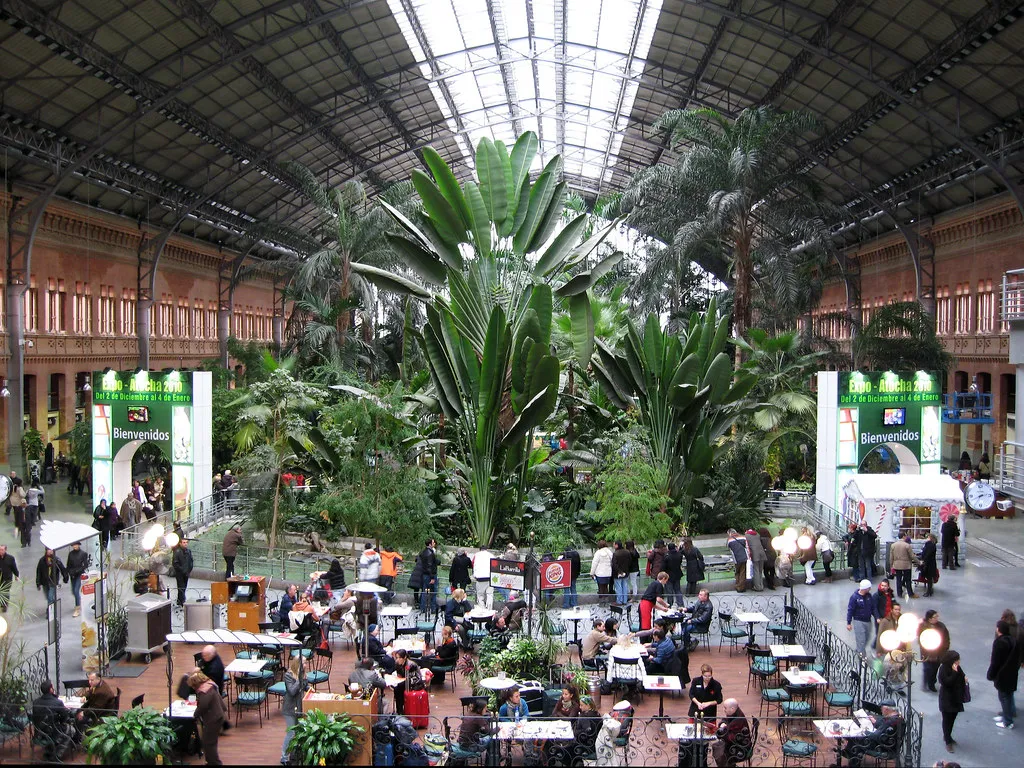
Atocha is Madrid's principal station for high-speed trains to southern and eastern Spain. It sits just south of the city centre and is well connected via Metro (Line 1, Atocha Renfe stop) and several Cercanías lines including the airport C-1 service. The main hall is famous for its tropical garden housed beneath the Victorian iron-and-glass roof — worth a look even if you're just changing trains. From Atocha, it takes three Metro transfers to reach the airport: Line 1 to Tribunal, Line 10 to Nuevos Ministerios, then Line 8 directly to the terminal.
Chamartín sits in northern Madrid and handles routes to northern Spain as well as international services toward Lisbon and Paris. It connects directly to Metro Line 10, making the airport transfer more direct: take Line 10 south to Nuevos Ministerios, then Line 8 out to the airport — just one transfer. If you're arriving from the north of Spain and need to reach the airport, Chamartín is a faster connection than Atocha.
Both stations have luggage storage (consignas with automated lockers), cash machines, and food options. When buying onward train tickets at either station, look for the self-service kiosks — queues at staffed windows can be long, particularly in summer.
How Many Days in Madrid?
Three to four days is the sweet spot for a first visit. That's enough time to cover the Prado Museum, the Royal Palace, Retiro Park, and Plaza Mayor without rushing, and still leave an evening or two for the city's famously late dining and nightlife. Madrid operates on a later schedule than most European cities — dinner before 21:00 means you'll largely be eating alone, and many bars don't fill up until midnight.
With five to seven days, you can go deeper into neighbourhoods like Malasaña, Chueca, and La Latina, plus take day trips. Toledo is one hour by high-speed train (as little as €13 one-way on Ouigo); Segovia is 30 minutes by AVE; El Escorial is under an hour by Cercanías C-8a from Chamartín. These are all easy half-day returns that don't require a car or a guide.
If you're arriving and departing via different transport modes — flying in, taking a train out, for example — plan your accommodation with the departure station in mind. The Salamanca neighbourhood sits between the airport Metro line and Atocha, which can cut your final morning's transit time significantly. For a full breakdown of how to structure your time, check our guide on how many days you need.
Time to Spare at Madrid Airport
If you have a layover or arrive well ahead of your flight, Barajas is a comfortable airport to spend a few extra hours in. Terminal 4 has the widest range of shops, restaurants, and services. The food court on the departures level covers everything from sit-down Spanish cuisine to fast food chains. There is a small art gallery on the T4 mezzanine — the terminal itself was designed by Richard Rogers and Antonio Lamela and is genuinely worth a look as architecture.
For travelers with a long layover of six hours or more, the Parque Juan Carlos I sits adjacent to the airport and is reachable on foot from T4. It's a large public park with a rose garden and lake, free to enter, and a good option if you want fresh air without venturing into the city. The trip to central Madrid takes only 15–20 minutes by Metro, so a shorter layover of three to four hours is enough time to reach Sol or Gran Vía, have a coffee, and return.
Luggage storage (consigna) is available in Terminal 4, typically open from early morning to late evening, at roughly €6–€10 per item. This is worth knowing if your hotel check-in is at 15:00 but your flight lands at 08:00 — store your bags and explore rather than waiting in the lobby.
Price Comparison: Getting to Madrid
Prices shift with season, booking lead time, and group size. The figures below are indicative for 2026; always check current fares on official sites before confirming.
| Option | Route / Mode | Approx. Cost | Journey Time | Notes |
|---|---|---|---|---|
| Metro Line 8 | Airport → Nuevos Ministerios | €4.50–€5.00 | 15–20 min | Free with Abono Turístico Zone T |
| Cercanías C-1/C-10 | T4 → Atocha / Chamartín | €2.60 | 25–30 min | T4 only; no night service |
| Airport Express Bus 203 | Airport → Cibeles / Atocha | €5 | 30–40 min | 24-hour; night stop = Cibeles only |
| Taxi | Airport → anywhere inside M-30 | €33 fixed | 20–30 min | Best value for groups of 3–4 |
| AVE from Barcelona | Barcelona Sants → Atocha | €15–€120 | 2.5–3 hr | Book 4–6 weeks ahead for best price |
| AVE from Seville | Seville Santa Justa → Atocha | €20–€80 | 2.5 hr | Renfe / Iryo / Ouigo compete |
| Bus from Valencia | Valencia → Estación Sur | €20–€50 | 4–5 hr | ALSA; overnight saves hotel night |
| Car from nearby city | Variable → M-30 / M-40 | €20–€140 fuel+tolls | Varies | Add €20–€35/day central parking; ZBE applies |
- Plane from major European city: €20–€500 (wide range depending on route and lead time); add €5 (Cercanías) to €33 (taxi) for the airport-to-city leg.
- High-speed train from Barcelona: €15–€120 (book 4–6 weeks out for best prices); journey 2.5–3 hours, arrives central Madrid.
- High-speed train from Seville: €20–€80; journey 2.5 hours.
- Bus from Valencia: €20–€50; journey 4–5 hours; arrives Estación Sur or Avenida de América.
- Car from nearby city: Fuel + tolls €20–€140 depending on distance; add central parking at €20–€35 per day if you drive in.
- Metro (airport to city): €4.50–€5.00 single (airport supplement included); free with Abono Turístico Zone T pass.
- Cercanías C-1/C-10 (airport to city): €2.60; 25–30 min to Atocha; T4 only.
- Airport Express Bus 203: €5; 30–40 min to Cibeles/Atocha; 24-hour service.
- Taxi (airport to city): €33 fixed fare to anywhere inside M-30; 20–30 min.
For groups of three or more, a taxi often works out cheaper than individual Metro tickets once you add the airport supplement. For solo travelers on a budget, Cercanías at €2.60 is the cheapest airport transfer available.
Left-Luggage Facilities in Madrid
For travelers with early arrivals, late departures, or short layovers, luggage storage is a practical necessity. Madrid offers several convenient options. Barajas Airport (T4) has staffed luggage storage open from early morning to late evening, charging roughly €6–€10 per item for the day. If your arrival and departure terminals differ, note that consigna at T1, T2, and T3 may have different operating hours.
Atocha and Chamartín both have automated lockers (consignas) available during station hours in various sizes. These are ideal for storing bags while you explore a few more hours in the city after check-out. Prices range from around €3–€6 for small lockers to €6–€10 for large ones per 24 hours.
Private luggage storage networks such as Bounce and Stasher operate at partner shops and hotels throughout central Madrid, including locations near Sol, Gran Vía, and La Latina. Booking online in advance locks in the rate and confirms availability — walk-ins are possible but not always guaranteed on busy weekend mornings.
Frequently Asked Questions
What is the fastest way to get to Madrid from the airport?
The Metro Line 8 is the fastest option from Madrid-Barajas Airport to the city center, taking about 15-20 minutes to Nuevos Ministerios. It costs €4.50–€5.00 including the airport supplement. Taxis are also fast, with a fixed fare of €33 to anywhere inside the M-30.
Are there direct trains to Madrid Airport?
Yes, the Cercanías C1 and C10 lines offer direct train service from Terminal 4 of Madrid-Barajas Airport to Atocha and Chamartín stations. The journey to Atocha takes about 25-30 minutes and costs €2.60 / ~$2.80. These trains operate from early morning until late evening.
Can I drive my car into Madrid city center?
Driving into Madrid city center is restricted due to the Low Emission Zone (ZBE). Most vehicles require an environmental badge, and foreign cars must register. It is often better to park outside the central area and use public transport to avoid fines.
How many days are enough for Madrid?
Three to four days are generally enough to experience Madrid's main attractions, museums, and vibrant nightlife. This allows time for popular sites like the Royal Palace and Prado Museum. If you plan day trips, consider extending your stay to five or more days.
Madrid rewards travelers who arrive prepared. Whether you pick the Metro for speed, the Cercanías for value, the Airport Express Bus for a late-night arrival, or the AVE from Barcelona for the journey itself, every option drops you into a city that is easy to navigate from the first moment. Plan your method based on your arrival time, group size, and budget — not habit.
Once you've sorted your arrival, the rest of the city opens up quickly. See our guides on top things to do in Madrid and where to stay in the city to complete your planning before you leave home.
You might also like


Continue reading
More guides you'll find useful


