Centre Pompidou Malaga: Your Essential Guide to El Cubo & Exhibitions
Discover Centre Pompidou Malaga's iconic El Cubo, current exhibitions, and essential visitor tips. Plan your visit with practical advice on tickets, hours, and getting there.
On this page
Centre Pompidou Malaga: A Comprehensive Visitor's Guide
Centre Pompidou Malaga is the Parisian institution's first international outpost, bringing one of the world's greatest modern art collections to Andalusia's port. It opened in March 2015 and has welcomed over 850,000 visitors since. The partnership between Málaga city and Centre Pompidou Paris was renewed in March 2025 for a full ten-year term running to 2034, signalling a long-term commitment rather than a temporary experiment.
The museum sits at Muelle Uno in the heart of Málaga's waterfront. Its glass entrance structure — El Cubo — is impossible to miss, and what lies beneath it surprises most first-time visitors. The gallery space of 6,000 square metres is largely underground, giving the interior an expansive, gallery-grade atmosphere that the modest exterior cube does not suggest.
Exploring more top things to do in Málaga is easy from here: the waterfront location puts you within a short walk of the Alcazaba, the Roman Theatre, and the Picasso Museum. This guide covers everything you need to plan a solid visit — exhibitions, tickets, hours, and transport.
Plan with trusted sources: cross-check opening hours and seasonal details with the official Andalusia tourism board, and read more about the city on its Wikipedia entry before you go.
El Cubo: Daniel Buren's Design and What Locals Actually See
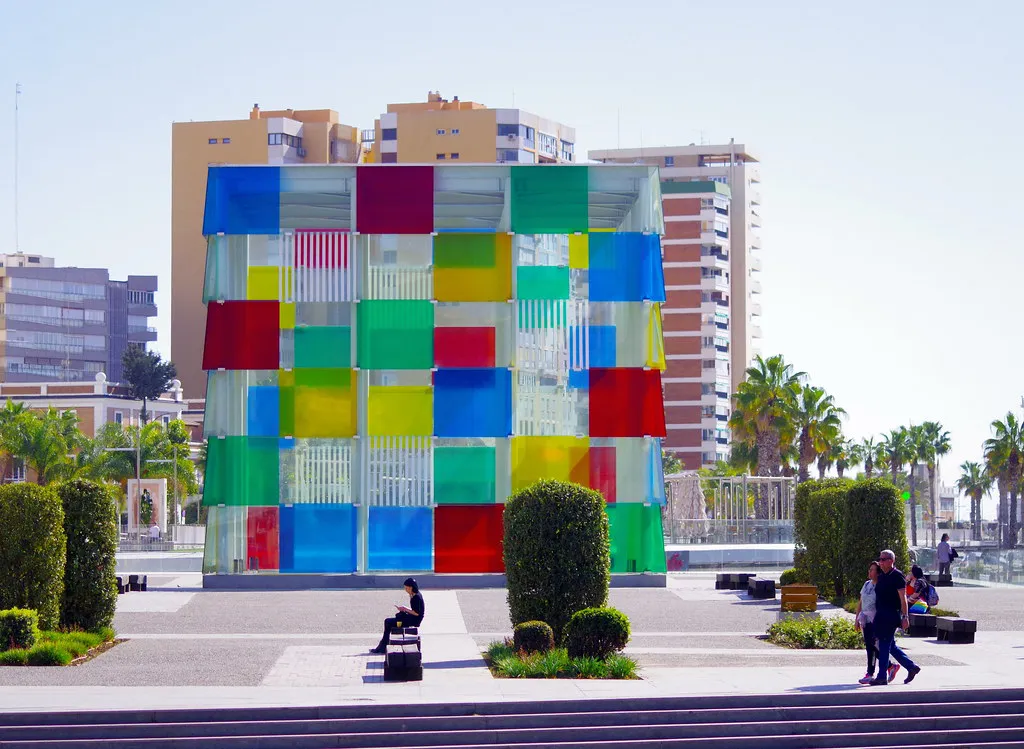
El Cubo is the street-level structure that marks the museum entrance — a transparent, multicoloured glass cube redesigned by French artist Daniel Buren in 2014. Buren is known for site-specific work that interacts with its surroundings rather than imposing on them. Here, the coloured glass panels pick up the Mediterranean light and the reflections of the port, changing the façade's appearance hour by hour. Walking past at sunrise or after dark gives you an entirely different building.
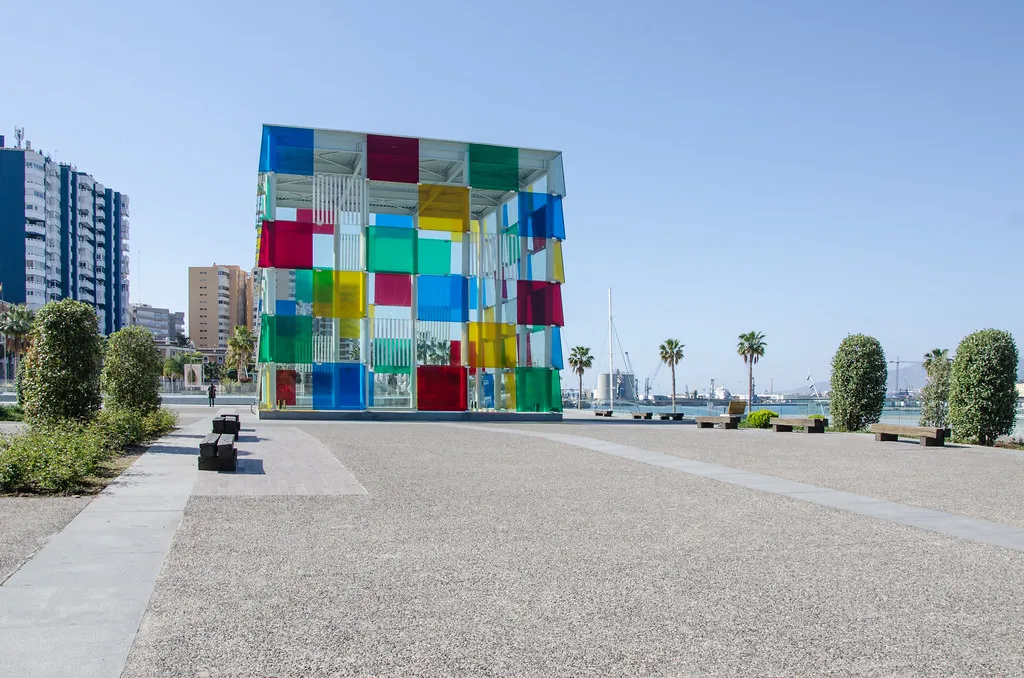
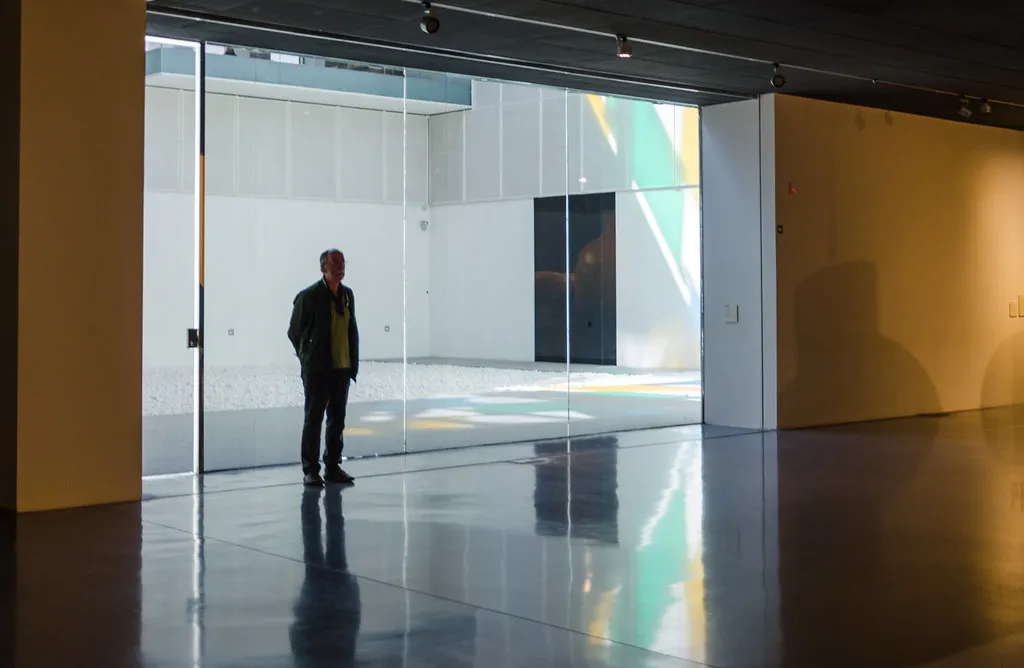
What surprises many visitors is that El Cubo is almost entirely entrance and circulation — the main exhibition rooms occupy 6,000 square metres of subterranean space below the port. The underground setting gives the galleries a quiet, gallery-grade calm. You descend into the museum rather than walking through a conventional building, which changes the whole rhythm of the visit.
The cube has become a genuine landmark in Málaga, featured on postcards and in the background of wedding photos shot along the Muelle Uno promenade. Locals call it simply "El Cubo." The contrast between the bold, colourful modernist structure and the surrounding port infrastructure is sharper than any marketing material conveys. Stand across the harbour for the best angle.
Buren has described his approach as "in situ" — he works within the specific physical and cultural context of a site. In Málaga, that means the design acknowledges the sea, the light, and the surrounding Spanish architecture simultaneously. The cube is classed as a work of art in its own right, not just a museum building. You can see the sky through the coloured glass from inside the main exhibition, a detail the guide to Málaga's competitor notes as one of the highlights of the visit.
What to See: Current Exhibition and Permanent Collection
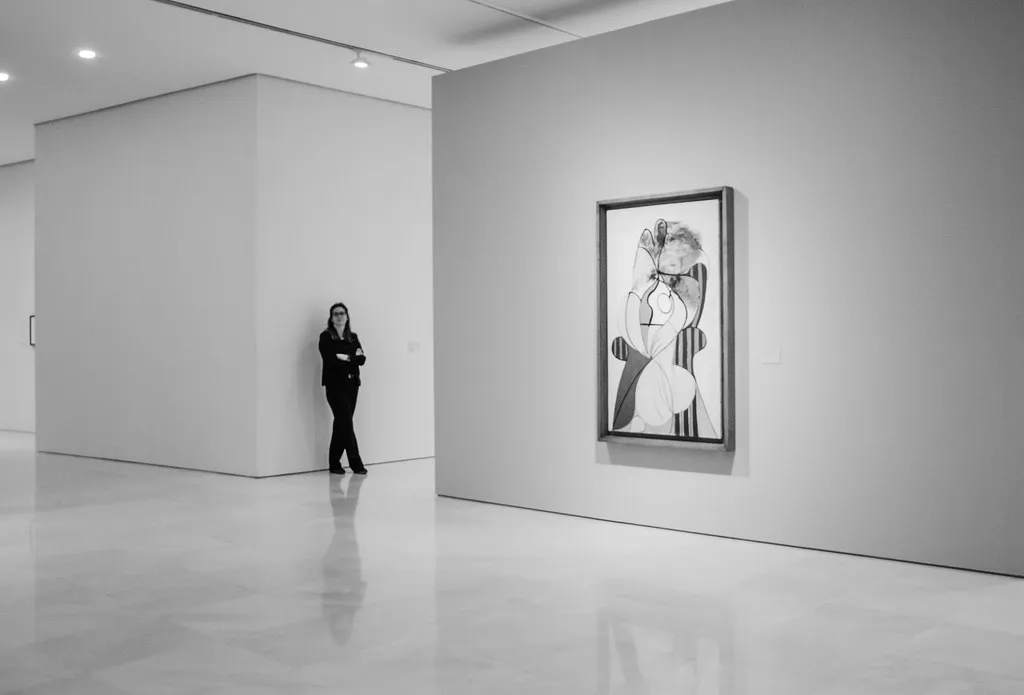
The current semi-permanent exhibition, To Open Eyes: Artists' Gaze, launched in July 2025 and runs until 31 January 2027. It explores how artists encourage viewers to look again at society and the world, divided into six thematic sections: Icons/Signs, Bodies/Colours, Gestures/Imprints, Spiritualities/Syncretisms, Fictions/Projections, and Spaces/Revelations. Works are drawn from the Centre Pompidou Paris collection and include pieces by Josef Albers, Marcel Duchamp, Marina Abramovic, Louise Bourgeois, and Donald Judd, among many others.
The collection is arranged thematically rather than chronologically, which is a deliberate curatorial choice from Paris. This approach highlights connections between movements and periods rather than telling a linear story. You might find a 1950s abstract canvas alongside a 2010 installation — the juxtaposition is intentional and often illuminating. Previous tours included "Modern Utopias," "From Miró to Barceló: A Century of Spanish Art," and "Place-ness: Habiter un lieu," giving some sense of how ambitiously the programming rotates.
Beyond the main exhibition, the museum typically hosts two or three themed or monographic temporary shows each year. These are built around different segments of the Paris collection — visual arts, drawing, photography, design, architecture, film, and new media. The current temporary show running until September 2026 is Le Geste et la Matière: Abstractions internationales (1945–…). Check the Centre Pompidou Málaga official website for the full current programme before your visit.
A central stairway in the main exhibition space usually showcases a single large-scale piece — this has become a recurring highlight that visitors photograph heavily. The final and largest room always features the biggest installations, including works at a scale that would not fit in a standard gallery. Allow time for this room; the pieces here reward slow viewing.
Tickets, Opening Hours, and Admission Costs
The museum is open Wednesday to Monday, 09:30 to 20:00. On Saturdays and Sundays, the closing time extends to 20:30. It is closed on Tuesdays, except on public holidays. Last entry is 30 minutes before closing. Check the official website for any seasonal changes.
- Main exhibition: €7
- Temporary exhibition: €4
- Combined ticket (main + temporary): €9
- Reduced admission (over-65s, students under 26, large families): €5.50
- Free admission: children under 18, unemployed visitors, and visitors with disabilities (plus one companion)
- Free admission on Sundays from 16:00 until closing — no booking required
| Ticket Type | Price | Covers |
|---|---|---|
| Main exhibition | €7 | Permanent collection (To Open Eyes, until Jan 2027) |
| Temporary exhibition | €4 | Le Geste et la Matière (until Sep 2026) |
| Combined ticket | €9 | Main + temporary exhibition (best value) |
| Reduced admission | €5.50 | Over-65s, students under 26, large families |
| Free entry | €0 | Under-18s, unemployed, visitors with disabilities + 1 companion |
| Sunday free slot | €0 | All visitors, 16:00 until closing |
Sunday afternoon free entry is one of the most under-used visitor advantages at the museum. Arriving at 16:00 on a Sunday gives you two to three hours in the galleries at no cost. The drawback is that this is the busiest free slot, so weekend afternoons attract more visitors. If crowds matter to you, a paid weekday morning is quieter.
For ticket purchases, buying online in advance through the official site avoids queues during peak season (July, August, and public holidays). Third-party platforms like Headout also offer skip-the-line options and occasionally bundle the Pompidou with other Málaga museum tickets. The combined ticket covering both the main exhibition and the current temporary show at €9 is almost always better value than buying separately. If you hold a student card or are over 65, ask for the reduced rate at the counter even if you bought general admission online — adjustments are made at the desk.
The museum is fully accessible for visitors with reduced mobility: elevators, ramps, and accessible restrooms are available throughout. Wheelchairs can be borrowed at the information desk at no charge.
Getting to Centre Pompidou Malaga: Transport Options
Centre Pompidou Malaga sits at Muelle Uno, the main port promenade. From Málaga city centre the most pleasant approach is on foot along the Paseo del Parque — from the Cathedral it is a 10 to 15-minute walk, passing the Malaga Park gardens. This route is flat, shaded in places, and lets you arrive oriented to the waterfront rather than stepping out of a car directly at the entrance.
Public buses serve the port area from the historic centre and from Málaga María Zambrano train station. Several lines stop near Muelle Uno; the journey from the station takes around 10 minutes. The bus is the budget option and works well if you are already oriented in the city. Check EMT Málaga route maps for current stop locations close to the port.
Taxis and ride-sharing apps pick up and drop off directly at Muelle Uno. From the Soho arts district or La Merced square expect to pay €5 to €8. From the airport the fare is roughly €15 to €20 depending on traffic. If you have heavy luggage, restricted mobility, or are arriving from outside the centre, this is the most practical option.
Car parking is available in an underground garage directly beneath Muelle Uno. The garage charges by the hour; budget around €2 to €3 per hour for a short museum visit. The entrance is signposted from the seafront road. This is the most convenient option for day-trippers arriving by car from outside Málaga, but city-centre visitors will find walking or public transport easier and cheaper.
From here it is straightforward to continue to other Málaga's hidden gems in the port area or along the coast.
Insider Tips: Getting the Most From Your Visit
Allow at least 90 minutes for the main exhibition alone, and two to three hours if you want to take in the temporary show as well. Art enthusiasts who watch the video and film installations should budget three to four hours. The underground galleries are cool and well air-conditioned — a relief during Málaga's hot summers — but there is no seating in the main exhibition rooms, so wear comfortable shoes.
Photography without flash is permitted in most areas of the museum. The bag and coat check at the entrance is free; using it makes moving through the galleries significantly easier, especially if you have a backpack. The museum shop near the exit is one of the better art-museum shops in Málaga, stocking art books, prints, and unusual gifts that are harder to find elsewhere in the city.
One practical note about food: the Centre Pompidou Málaga does not have an in-house café or restaurant. This catches visitors off guard. However, Muelle Uno immediately outside has a wide range of restaurants, bars, and terrace cafés — you can step out for a break mid-visit and return. Plan lunch or dinner after your visit rather than relying on anything inside.
Weekday mornings from opening at 09:30 until around 11:00 are the quietest time to visit. School groups arrive later in the morning and tourist foot traffic builds through the afternoon. If you are visiting with young children, the museum runs dedicated activities for children alongside current exhibitions — check the programme on the website, as these workshops fill up quickly. Guided tours are available in multiple languages and can add context to the thematic arrangement of the collection that is not always obvious from the wall labels alone.
Consider pairing your Pompidou visit with other Malaga restaurants and waterfront dining along Muelle Uno for a full half-day or full-day circuit of the port area.
The Partnership and the Constellation Programme 2025–2030
The original 2014 agreement between Málaga's city council and Centre Pompidou Paris was designed as a five-year pilot. It proved successful enough to be extended in 2020 for a further five years, then renewed again in March 2025 for a ten-year term — meaning the museum is committed to Málaga through to 2034. That ten-year extension signals this is now a permanent fixture rather than a cultural experiment. The opening ceremony in 2015 was attended by then-Prime Minister Mariano Rajoy and French Minister of Culture Fleur Pellerin, indicating the level of institutional weight behind the project from the start.
Running alongside the partnership renewal, the "Constellation programme 2025–2030" is the framework governing how the Paris institution shares its collection and curatorial expertise with Málaga. Under this programme, exhibition tours are planned further in advance, educational outreach is deepened, and the dialogue between local Spanish art scenes and the Paris collection is strengthened. Part of each programme cycle is deliberately focused on Spanish artists, not just Parisian names.
The museum has welcomed over 850,000 visitors since opening in 2015. That number, combined with the ten-year renewal, positions Centre Pompidou Málaga as one of the most significant international cultural partnerships in Spain. For the city, the museum sits within a broader strategy of cultural investment that includes the Picasso Museum, the Carmen Thyssen Museum, and the Museum of Málaga — all within walking distance.
What to Do Around Muelle Uno After Your Visit
The port area around Centre Pompidou Málaga is one of the most walkable and visitor-friendly parts of the city. Muelle Uno itself stretches along the waterfront with shops, boutiques, and around a dozen dining options ranging from tapas bars to sit-down seafood restaurants. This is the natural place for a post-museum lunch or early evening drink with harbour views.
From Muelle Uno, the Malaga Park (Parque de Málaga) is a five-minute walk north — a long, shaded botanical garden that runs parallel to the seafront. It is one of the most pleasant green spaces in the city centre and a good route toward the historic quarter. From the park, the Alcazaba of Málaga and the Roman Theatre at its base are another 10 to 15 minutes on foot. These are two of the city's most visited monuments and both are worth a combined visit if you have a full day.
The Picasso Museum Málaga, dedicated to Málaga's most famous native, is around 15 to 20 minutes on foot from Muelle Uno through the old town. If you are doing both museums in one day, do the Pompidou first — it is the shorter visit — and finish at the Picasso Museum. A combined day of modern and contemporary art makes excellent sense here given Picasso's direct connection to both institutions.
For accommodation, the neighbourhood around the port is well served. If you want to plan the wider visit, see our guide to Malaga 3-day itinerary for a structured route covering the port, the historic quarter, and beyond.
Frequently Asked Questions
How much time should you plan for Centre Pompidou Malaga?
Plan to spend at least 2 to 3 hours at Centre Pompidou Malaga. This allows enough time to comfortably view both the permanent collection and any temporary exhibitions. Art enthusiasts might extend their visit to 4 hours or more.
What are the current exhibitions at Centre Pompidou Malaga?
To find out about the current exhibitions at Centre Pompidou Malaga, always check the official website. The museum regularly updates its program with new temporary displays and installations. This ensures you have the most up-to-date information for your visit.
How do I buy tickets for Centre Pompidou Malaga?
You can buy tickets for Centre Pompidou Malaga directly at the museum's entrance or online. Purchasing tickets in advance through the official website is recommended to avoid queues. Third-party sites may also offer skip-the-line options or package deals.
Is Centre Pompidou Malaga accessible for disabled visitors?
Yes, Centre Pompidou Malaga is fully accessible for disabled visitors. The museum provides elevators, ramps, and accessible restrooms throughout the building. Wheelchairs are also available for loan at the entrance, ensuring a comfortable experience for all.
Is Centre Pompidou Malaga worth including on a short itinerary?
Yes, Centre Pompidou Malaga is definitely worth including, even on a short itinerary. Its compact size allows for a meaningful visit in a few hours. Its prime location at Muelle Uno also makes it easy to combine with other nearby attractions.
Centre Pompidou Malaga combines a world-class collection from Paris with a genuinely distinctive setting — an underground gallery entered through a glass cube on the Andalusian waterfront. With the partnership secured until 2034 and the current To Open Eyes exhibition running until January 2027, there is no better time to visit.
The practical details matter here: buy a combined ticket, arrive on a weekday morning for the quietest experience, or take advantage of free Sunday entry from 16:00. Skip planning for a café inside and instead choose one of the many options along Muelle Uno. The museum shop is genuinely worth a look on the way out.
Plan your Malaga 3-day itinerary to include this museum alongside the Alcazaba and Picasso Museum for a coherent day of art and history in one of Spain's most culturally rich port cities.
You might also like


Continue reading
More guides you'll find useful