

Tibidabo Barcelona Travel Guide: Getting There & What to See
Plan your visit to Tibidabo Barcelona with our guide. Discover transport, tickets, attractions, and practical tips for a perfect day out.
On this page
Your Essential Guide to Tibidabo Barcelona
Mount Tibidabo stands 512 metres above Barcelona at the highest point of the Collserola range. From up here you can see the Mediterranean, El Prat Airport, and the entire city grid laid out like a map. The mountain combines Spain's oldest functioning amusement park, a neo-Gothic basilica crowned by a bronze Christ, a Norman Foster communications tower, and miles of forested walking trails — all within 40 minutes of Plaça Catalunya.
Most first-time visitors arrive expecting a viewpoint and leave surprised by how much is packed into a single hilltop. This guide covers every attraction, the three-stage public transport route, current ticket prices for 2026, and a few historical details that make the whole place make sense.
Plan with trusted sources: cross-check opening hours and seasonal details with the official Barcelona tourism board, and read more about the city on its Wikipedia entry before you go.
Must-See Tibidabo Barcelona Attractions
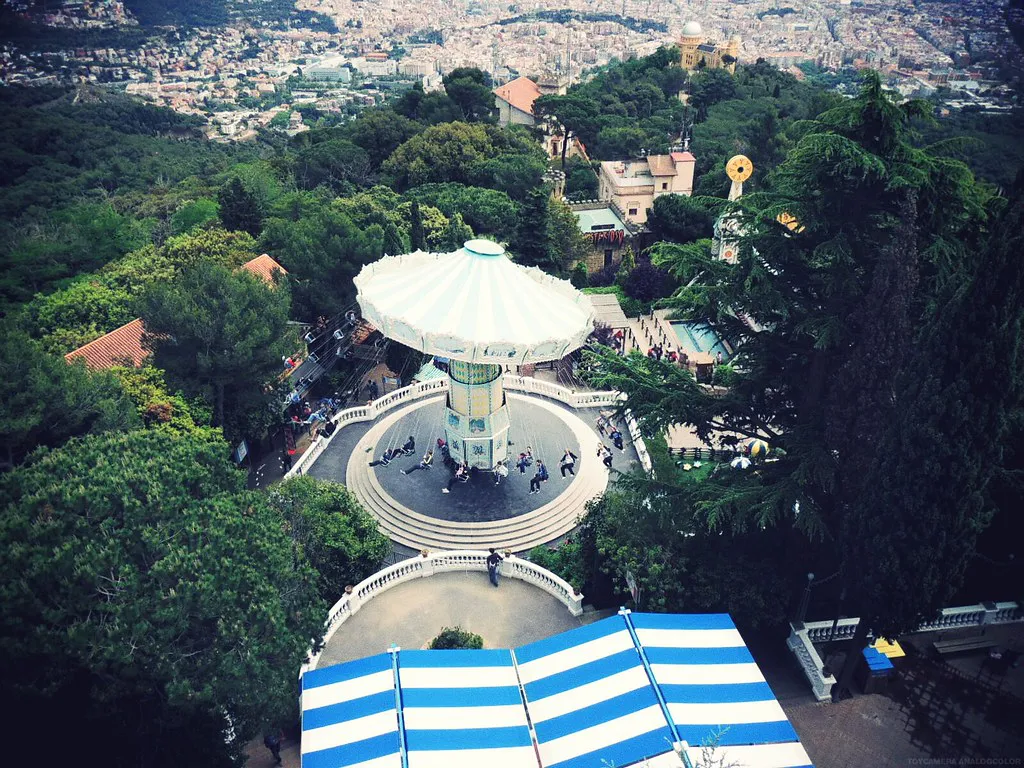
The Tibidabo Amusement Park (Parc d'Atraccions Tibidabo) is the headline draw. Inaugurated in 1899 and opened to the public in 1905, it is among the world's oldest amusement parks still in operation. The park runs across five terraced levels carved into the hillside, and most visitors start at the top and work their way down. Rides range from gentle classics to modern thrill attractions — the roller coaster and Diavolo are the big-adrenaline options, while Miramiralls (the historic hall of mirrors) and the Muntanya d'Autòmats appeal to visitors who want the nostalgic experience.
The Avió is the park's most iconic single ride: a vintage aircraft replica modelled on the Latécoère 26 used on the first commercial flight between Madrid and Barcelona in 1927. You board it, it swings out over the hillside, and the city fills the windows. It costs nothing extra beyond your park ticket and the queue rarely stretches more than 20 minutes on a weekday.
The Temple Expiatori del Sagrat Cor dominates the skyline even more than the rides. Built over several decades from 1902 onwards, it was granted basilica status in 1961. The lower Romanesque crypt is free to enter and arguably the more atmospheric space — dark, mosaic-lined, quiet even when the park outside is busy. An elevator inside the basilica takes you to the bronze Christ at the summit for an extra few euros; that platform gives you the highest viewpoint on the entire mountain. The Torre de Collserola, the communications tower designed by Norman Foster for the 1992 Barcelona Olympics, is nearby and has a public observation deck at 115 metres that offers a different, more northerly panorama over the Collserola hills.
The History That Makes Tibidabo Worth Understanding
Tibidabo's name comes from the Latin phrase in the Vulgate Bible — "tibi dabo" meaning "I will give to you" — allegedly spoken by Satan during the temptation of Christ while gesturing over a great city. Whether the mountain's founders intended that resonance is unclear, but the phrase stuck.
The original hermitage on the site dates to 1886, and you can still see it to the right of the Sagrat Cor today. The amusement park arrived before the church: fears that a Protestant church and hotel-casino complex would be built on the summit prompted a Catholic land purchase, and the basilica construction began in 1902. The park, meanwhile, was already a going concern. Walt Disney visited Tibidabo during a trip to Barcelona and reportedly offered a blank cheque to acquire the Muntanya d'Autòmats automata collection for his own planned park — the offer was refused. Between 2000 and the mid-2000s, the Chupa Chups confectionery company owned the park, an unlikely chapter that ended when the city's municipal authority took over management.
Knowing this backstory changes how the mountain reads. The crypt, the old hermitage, the funicular, and the automata exhibit are not random — they are layers of a story that started before Barcelona had a metro system.
Parks, Gardens, and Outdoor Spots on Mount Tibidabo
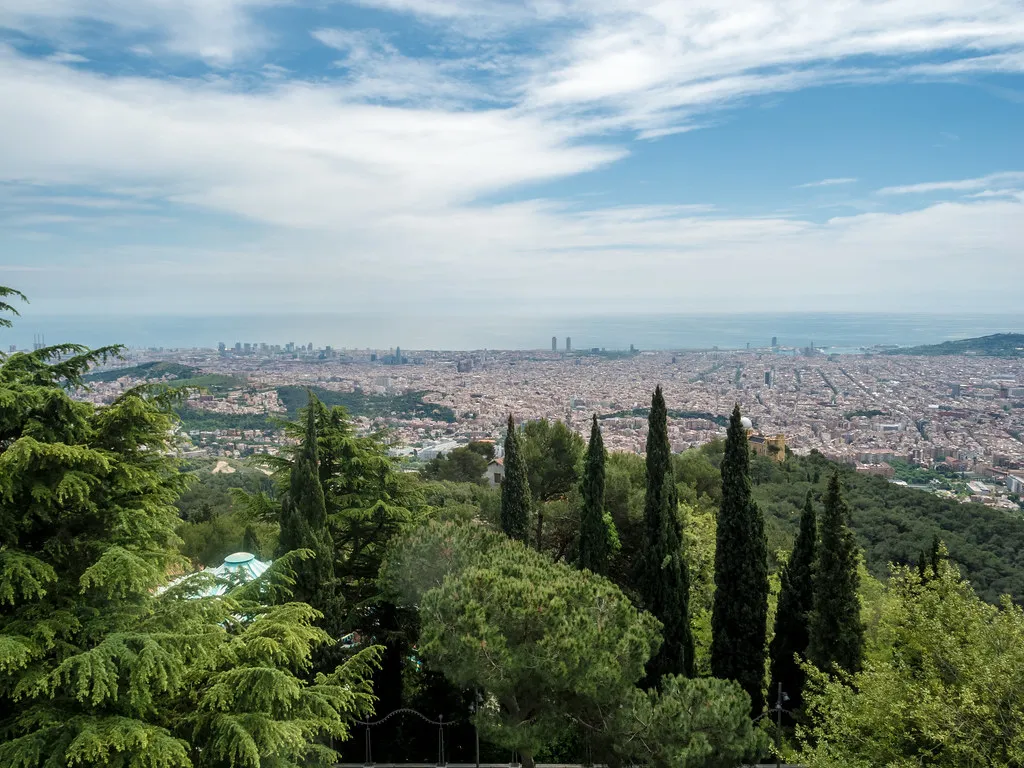
The Mirador del Tibidabo is a free viewpoint at roughly 500 metres above sea level, positioned in the heart of the mountain. On a clear day — and clarity here means low humidity, typically October through February — you can see the Pyrenees to the north and Mallorca's mountains on the horizon to the east. It is worth timing your visit to coincide with late afternoon: the light falls on the city from the west, and on evenings with a full moon the whole bay is visible without any haze.
The Collserola Natural Park surrounds the entire Tibidabo summit and covers 8,000 hectares of pine and holm oak forest. Several marked trails start directly from Plaça Tibidabo. The Font de la Budellera, about 40 minutes on foot, is a shaded spring surrounded by picnic tables and a small pond — genuinely tranquil on weekday mornings. Families who bring a picnic and skip the amusement park entirely can spend three or four hours up here without spending more than €5 on transport.
The Panoramic Area within the park perimeter — accessible with the lower-priced ticket — contains the Talaia giant swing and a handful of classic rides positioned at the highest terrace. These attractions sit right at the edge of the hill, so the backdrop on every photo is the entire city. This is where most of the best Tibidabo photographs are taken, and you do not need a full park ticket to reach it.
How to Get to Tibidabo
The standard public transport route runs in three stages from Plaça Catalunya. It is well-signed and takes around 45 minutes end to end. A T-Familiar 8-journey card (€11.20 for up to 5 people, 1 zone) covers all three stages for two people return — the most cost-efficient option if you are travelling as a pair or family.
Step 1: FGC S1 or S2 to Peu del Funicular
Board the FGC commuter rail at Plaça Catalunya — not the TMB metro. You want line S1 toward Terrassa Nacions Unides or S2 toward Sabadell Parc del Nord. Both stop at Peu del Funicular, roughly 15 minutes from Plaça Catalunya. Single fares cost around €2.40. Trains run every 5 to 10 minutes during the day.
Step 2: Vallvidrera Funicular to Vallvidrera Superior
At Peu del Funicular station, follow the funicular icon signs — the platform is a two-minute walk. The funicular runs every 6 minutes and the ride itself is three minutes. It is included in the standard integrated fare if you used a T-Familiar or T-Casual card. Alight at Vallvidrera Superior.
Step 3: Minibus 111 to Plaça Tibidabo
Exit the funicular station and cross the small plaza to the Bus 111 stop. The 111 is a compact red minibus — easy to spot. Scan your transport card as you board. Nine stops, roughly nine minutes, and you arrive at Plaça Tibidabo directly in front of the lower funicular station (La Cuca de Llum) and the park entrance. The 111 runs every 10 minutes and is also covered by integrated transport tickets.
An alternative: the Tibibus T2C runs directly from Plaça Catalunya to the base of La Cuca de Llum funicular when the park is open. It takes about 40 minutes, costs €3 one-way (not covered by integrated cards), and runs only during park operating hours. Check the Tibidabo Amusement Park website for its seasonal schedule before committing to this option. During school holidays it fills quickly.
Schedules, Prices, and Tickets for Tibidabo Park
The park's schedule shifts significantly by season and day of the week in 2026. It generally opens on weekends year-round, adds weekday openings through summer (mid-June to September), and closes entirely on some winter weekdays. Always confirm on the official Tibidabo website before you travel — the park has cancelled individual days for maintenance without much advance notice.
The full park ticket (access to all rides and shows) costs approximately €35 for adults and €12 for children under 120 cm. The Panoramic Area ticket, which covers La Cuca de Llum funicular and the classic upper-level rides but not the full park, is around €19. Both can be purchased online in advance or at the ticket booth on arrival. The Tibiclub membership is worth considering if you are Barcelona-based or plan multiple visits — it gives a per-visit discount and priority entry on busy days.
The exterior of the Sagrat Cor Temple, the Mirador del Tibidabo viewpoint, and the grounds around the park are free to access regardless of whether the park is open. The crypt inside the basilica is also free. Only the basilica elevator to the summit and the amusement park itself require payment.
| Ticket | Adult Price | Child Price | Includes |
|---|---|---|---|
| Full Park | ~€35 | ~€12 (under 120 cm) | All rides, shows, Panoramic Area |
| Panoramic Area | ~€19 | ~€19 | La Cuca de Llum funicular + upper classic rides |
| Basilica elevator | ~€4 | — | Summit platform above the bronze Christ |
| Crypt & grounds | Free | Free | Lower basilica, Mirador viewpoint, trails |
Family-Friendly and Budget-Friendly Tibidabo Options
Families with young children will find the Panoramic Area ticket gives the best value. The classic rides on the upper level — including the Avió plane and the Talaia swing — are manageable for smaller children and sit at the summit where the views are best. The full park adds the roller coaster, Hotel Krüeger (a horror-themed walkthrough), and the water rides on the lower levels, which are appropriate for children over about seven.
Budget visitors can do a meaningful half-day on Mount Tibidabo for under €10 per person. Take the FGC + Funicular + Bus 111 combination (€2.40 each way on a T-Casual single, or split a T-Familiar card), walk the free grounds, visit the crypt, and use the Mirador viewpoint. Pack your own lunch — there are good picnic areas at the Font de la Budellera and on the terrace below the Sagrat Cor. The paid amusement park is a separate decision on top of this. Consider using a Barcelona City Pass for integrated transport if you are visiting multiple attractions across the city.
Weekday mornings outside of July and August are the quietest times. The park tends to fill noticeably from noon on weekends and from mid-morning on Barcelona public holidays. Arriving at opening time on a Tuesday in May, for instance, gives you the first two hours with almost no queues at the main rides.
For accommodation, finding a base near the FGC Plaça Catalunya exit keeps the transport straightforward. You can compare options at hotels in Barcelona or browse where to stay in the city for neighbourhood-by-neighbourhood guidance.
Practical Tips for Your Tibidabo Visit
The mountain sits roughly 200 metres higher than the city, which means temperatures can be 3–5°C cooler and wind is a factor, particularly on the upper terrace near the Sagrat Cor. A light layer in your bag is useful even in June. In winter, afternoon fog sometimes rolls in from the sea and obscures the city view — if panoramas are your primary reason for going, visit in the morning and check the weather for haze, not just rain.
Cell coverage is good across the whole mountain, and the Citymapper app navigates all three transport stages accurately. Download an offline map anyway; the hillside streets between the funicular and the bus stop briefly have no signage in one direction. The last Bus 111 down to Vallvidrera Superior runs around 22:00, and the FGC last trains from Peu del Funicular toward Plaça Catalunya finish around 23:00 on weekdays and run slightly later on Fridays and Saturdays. If you are staying for sunset and dinner near the park, verify return times before you lose track of the hour.
For a full Barcelona day, Tibidabo pairs well with a morning at Barcelona's tapas bars in the Eixample or Gràcia before heading up in the afternoon. The FGC from Plaça Catalunya makes the transition quick. Check top things to do in Barcelona for other half-day options to combine with your mountain visit.
Frequently Asked Questions
How much time should you plan for Tibidabo Barcelona?
Plan for at least half a day, around 4-6 hours, to visit Tibidabo. This allows time for travel, exploring the panoramic area, and enjoying some rides. A full day is ideal if you want to experience the entire amusement park.
Which Tibidabo Barcelona options fit first-time visitors?
First-time visitors should prioritize the Sagrat Cor Temple and the Panoramic Area for the views. If time allows, the full amusement park is a great experience. Using the metro and funicular combination is a classic and reliable route.
Is Tibidabo Barcelona worth including on a short itinerary?
Yes, Tibidabo is worth it even on a short itinerary for its unparalleled views and unique atmosphere. Focus on the Panoramic Area and the Sagrat Cor Temple for a quicker, impactful visit. It offers a different perspective of the city.
What else can you find on the Tibidabo mountain?
Beyond the amusement park, you will find the magnificent Sagrat Cor Temple, offering breathtaking views. There are also several viewpoints, walking trails, and picnic areas. The mountain provides a peaceful escape with natural beauty.
Tibidabo delivers something genuinely unusual: an amusement park older than the basilica beside it, views that stretch to the Pyrenees on a clear day, and free walking trails that most city visitors never find. Whether you spend €35 on a full park day or €5 on transport and a picnic, the mountain earns the detour.
Check the park schedule before you go, confirm your transport card covers all three stages, and build in enough time to walk the upper terrace when the crowds thin in early afternoon. Tibidabo rewards visitors who slow down.
You might also like


Continue reading
More guides you'll find useful


