Alcazaba Of Malaga Travel Guide
Plan alcazaba of malaga with top picks, neighborhood context, timing tips, and practical booking advice for a smoother trip.
On this page
Alcazaba Of Malaga: Your Essential Travel Guide
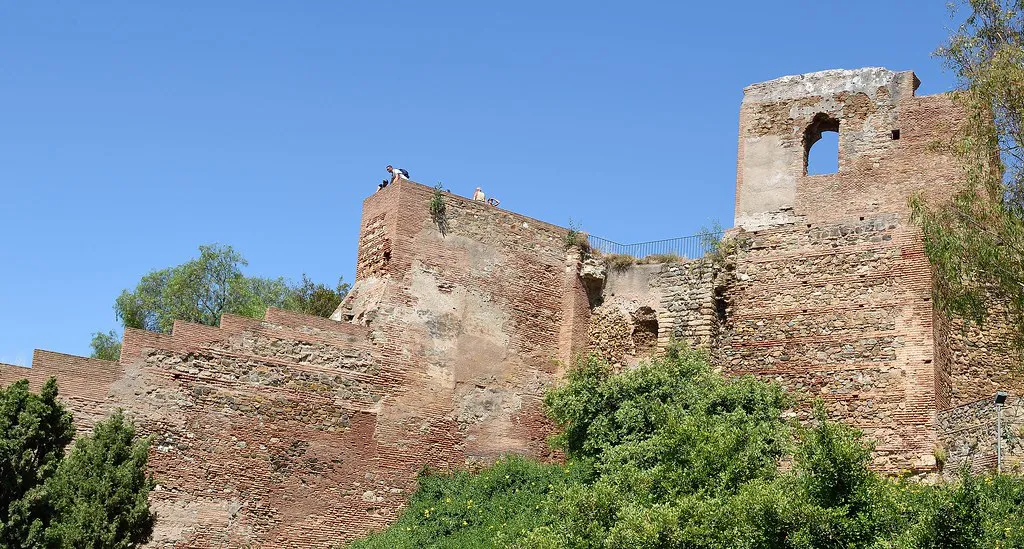
The Alcazaba of Malaga is a Moorish fortress palace perched on the slopes of Mount Gibralfaro, right at the edge of the old quarter. Built in the 11th century, it is one of the best-preserved examples of Moorish military and palatial architecture in Spain. The views of the port, the cathedral, and the Mediterranean from its upper terraces are some of the finest in the city.
This guide covers the practical details you need before you arrive: current opening hours, ticket prices, how to get there, accessibility options, and what to prioritise inside. It also covers the Alcazaba's relationship with Gibralfaro Castle and the free Roman Theatre directly at its entrance.
Plan with trusted sources: cross-check opening hours and seasonal details with the official Andalusia tourism board, and read more about the city on its Wikipedia entry before you go.
Visiting Hours and Ticket Prices
The Alcazaba operates on a two-season schedule. From 1 April to 31 October it opens daily 09:00–20:00, with last admission at 19:00. From 1 November to 31 March it opens daily 09:00–18:00, with last admission at 17:00. These times apply in 2026 — always confirm on the official site before you visit, as public holidays can cause closures.
Current ticket prices are as follows. General admission is €7.00. A combined ticket covering both the Alcazaba and Gibralfaro Castle costs €10.00, saving €4 on buying separately. Reduced admission is €3.00 for EU citizens over 65, students with valid ID, registered unemployed, people with disabilities of 33% or more, and large-family cardholders. Group rates (minimum 10 people) are €5.00 general and €8.00 combined. Children under 6 enter free at all times.
| Ticket Type | Price | Notes |
|---|---|---|
| General admission | €7.00 | Alcazaba only |
| Combined (Alcazaba + Gibralfaro) | €10.00 | Saves €4 vs buying separately |
| Reduced | €3.00 | EU 65+, students, disabled (≥33%), large families, unemployed |
| Group (min. 10 people) | €5.00 / €8.00 | General / Combined |
| Children under 6 | Free | All times |
| Sunday 14:00–close | Free | All visitors; busiest time of week |
Free admission applies every Sunday from 14:00 until closing. This is a genuine saving but comes with a trade-off: Sunday afternoons are the busiest time of the week. If you have flexibility, a weekday morning gives you the quietest experience. Tickets are available from machines at the entrance. In peak season (July–August) and on busy cruise-ship days, queues build quickly mid-morning — buying online in advance saves time.
Location and How to Get There
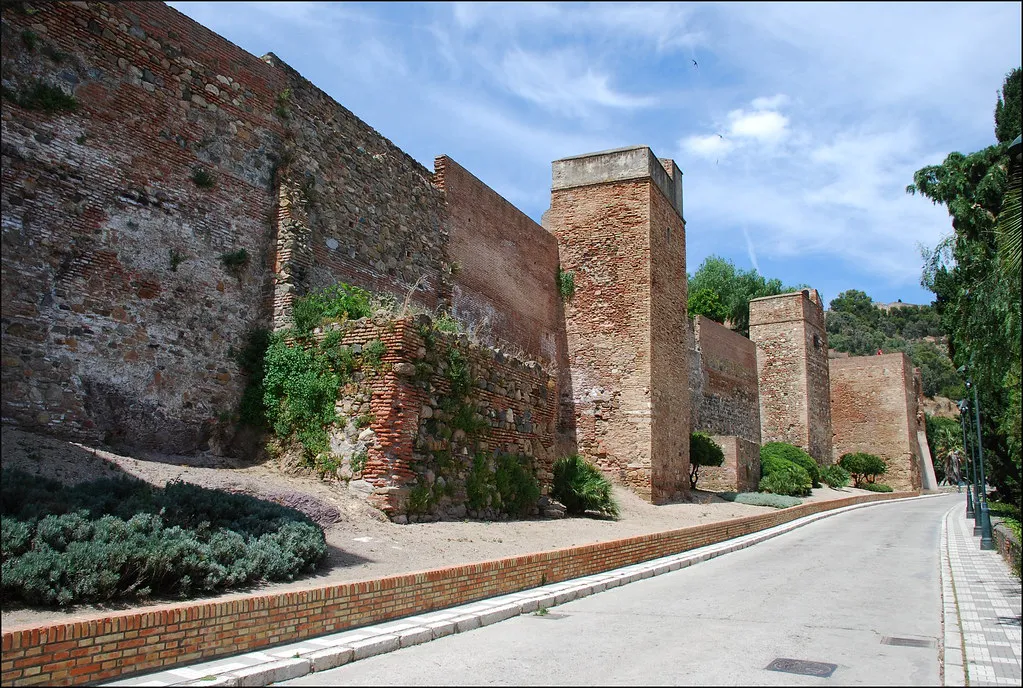
The Alcazaba entrance is on Calle Alcazabilla, in the heart of Málaga's historic centre. It sits a few minutes' walk from Calle Larios, the main shopping street, and about ten minutes from Málaga Port. If you are already in the old quarter, you will see the honey-coloured fortress walls from almost anywhere — just head uphill toward them.
On foot is the simplest option for most visitors. Several bus lines stop near the Alcazaba entrance if you are coming from further afield. If you are arriving by car, park in one of the public car parks in the centre and walk — driving directly to the entrance is not practical. The Renfe and Cercanías train station is about 20 minutes on foot from the Alcazaba via the port promenade.
What to See Inside the Alcazaba
Your visit begins at the entrance on Calle Alcazabilla and immediately passes through a succession of defensive archways. These gates were designed to slow attackers, forcing them to change direction at each threshold — you can still feel the strategic logic as you move through them. Pause on the lower walls for good views over the Palacio de la Aduana and its striking roof of 6,000 engraved aluminium tiles.
The terraced gardens on the way up are among the most pleasant parts of the visit. They are at their best in spring when orange blossom fills the air, but the bougainvillea climbs the walls almost year-round. The Patio de los Naranjos — the Orange Tree Courtyard — is a focal point: a symmetrical Moorish garden with citrus trees and water features that genuinely calm the pace after the climb.
The upper palace, the Cuartos de Granada, is the architectural highlight. The rooms and courtyards are smaller in scale than the Alhambra in Granada, but that works in your favour: the stucco carvings and tiled patios feel intimate rather than overwhelming, and you can explore freely without timed entry slots or large tour groups blocking the view. The palace also houses a collection of Moorish ceramics and pottery found during 1930s excavations on the site. Allow 90 minutes for a relaxed visit of the full complex.
Photography and Views
The Alcazaba offers some of the best photography in Málaga. The most distinctive shots come from framing the city through one of the characteristic horseshoe arches — the view west toward the port and cathedral through a Moorish arch is the image most associated with the fortress. The upper palace terrace gives a panorama that takes in the bay, the cathedral roofline, and (on clear days) the mountains to the east.
Timing matters. Early morning light gives warm tones on the honey-coloured walls and fewer people in the frame. Late afternoon is excellent in winter when the sun drops toward the west and the light turns golden. Avoid midday in summer: the hillside is exposed and the heat is significant, which also makes for harsh, flat light. The gardens and arched passageways provide shade and interesting light-and-shadow contrasts at almost any time of day.
The Roman Theatre: A Free Addition at the Entrance
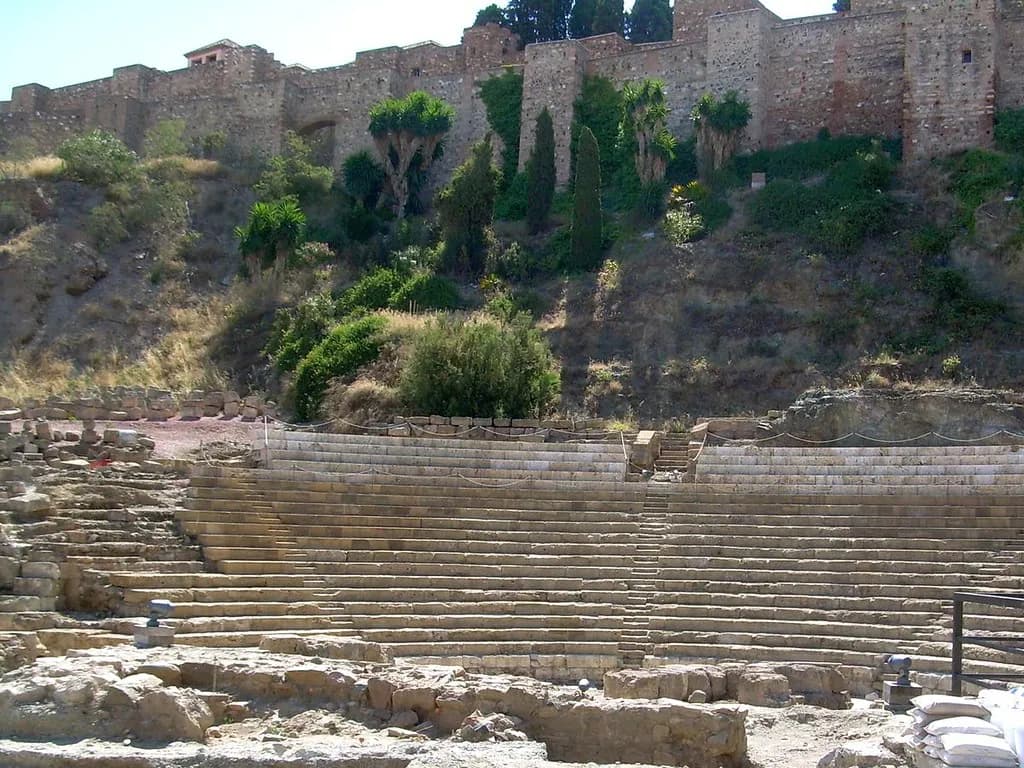
The Teatro Romano sits directly at the foot of the Alcazaba on Calle Alcazabilla — you walk past it on the way in. It is one of the best-preserved Roman theatres in Spain, built in the 1st century BC and rediscovered during construction work in 1951. Entry is free. A visit takes around 20 minutes and adds meaningful context: Málaga was a significant Roman port city long before the Moors arrived, and seeing the theatre makes that sequence of civilisations tangible in a way no guide can fully convey.
None of the major competitor guides give this its own section, but it is genuinely worth stopping for. The interpretation centre at the theatre is small but clear. Combine it with the Alcazaba on the same morning and you cover 2,000 years of Málaga's history without backtracking or extra cost.
Relationship between the Alcazaba and Gibralfaro Castle
The Alcazaba and Gibralfaro Castle were originally connected by a walled corridor called La Coracha. Today there is no direct passage between the two monuments — you must exit the Alcazaba and take a separate route up to the castle. The most scenic option is the footpath that climbs through pine woodland, with panoramic views opening as you ascend. Bus line 35 stops at the castle entrance if you prefer not to walk.
Visiting both gives a complete picture of Málaga's medieval defences. Gibralfaro sits higher on the mountain and offers an aerial perspective on the Alcazaba below — seeing the Alcazaba's layout from above helps you understand the scale of what you walked through. The combined ticket at €10 saves €4 versus buying separately. Allow a full half-day if you plan to do both. The Gibralfaro café, at the top, has particularly good views over the bay and city.
One practical note: there is no direct walkway between the two. Visitors sometimes assume the Coracha is still passable — it is not open to the public. Plan the route before you leave the Alcazaba so you know which option suits your group.
Accessibility and Services on the Premises
The Alcazaba has significant accessibility limitations. The route involves numerous steps, cobbled paths, and steep slopes. Pushchairs are not practical — if unavoidable, ask staff at the entrance where to leave one. Pets are not allowed inside. The Gibralfaro Castle has no wheelchair access at all.
For wheelchair users and those with limited mobility, a lift is available from Calle Guillén Sotillo, which runs alongside the monument. Buy your ticket at the machines at the tunnel entrance on that street, then call the lift. It operates during opening hours and stops working 45 minutes before the monument closes. The lift gives access to the upper area of the palace — the lower historic gardens with their narrow paths and steps remain inaccessible.
On-site services include a coffee shop inside the enclosure, water vending machines at the entrance and at the top of the palace, and two toilet areas — one next to the cafeteria and one at the upper level. Food and drinks from the café are priced at tourist rates. If you are on a budget, bring your own water and snacks to eat outside. Check out cheap eats around the city to plan meals before or after the visit.
Visits on Sunday Afternoons: Free Entry and Freetours
Every Sunday from 14:00, the Alcazaba opens free of charge to all visitors. For budget travellers this is an obvious draw. Some local guides run freetours on Sunday afternoons — tip-based guided visits where you pay what you feel the experience was worth. These can provide genuine historical context and local detail that noticeboards inside the fortress do not cover.
The honest trade-off: free entry Sundays are the busiest time of the week by a significant margin. If crowds affect your enjoyment, the saving of €7 may not compensate. Book any freetour in advance as places are limited. If you visit outside Sunday afternoons, a weekday morning — particularly early in the week or outside July and August — gives you long stretches of the fortress largely to yourself.
Rules of Behaviour in the Alcazaba
The Alcazaba is a protected heritage monument and has clear rules for visitors. Do not touch or climb on any historic structures — the stonework, stucco carvings, and ramparts are fragile and irreplaceable. Inscriptions or engravings on walls are strictly forbidden. Keep noise to a reasonable level; the site is a cultural and historical space, not a park.
Food and drinks from outside are generally not permitted inside the historic buildings, though you can eat in outdoor areas. Use the bins provided and take litter with you. Flash photography may be restricted in certain areas — watch for posted signs. Commercial photography requires a separate permit from the Department of Culture and Historical Heritage. Staying on marked paths protects both the structures and your own safety on the uneven terrain.
A Bit of History
Construction on the Alcazaba's defensive outer walls began in the 8th century, but the inner palace was not built until 1057, under the Hammudid and Zirid dynasties. The hilltop site was chosen deliberately: the views cover the ocean to the south, the inland plain to the north, and the mountains to the east. In the Al-Andalus era, Málaga never matched Granada or Seville in political importance, but it ranked among the most prominent port cities, and the Alcazaba reflected that status.
The Nasrid dynasty contributed the most refined architectural elements visible today — the horseshoe arches, the stucco inscriptions from the Quran, and the formal patio gardens with their symmetrical water features. When the Catholic Monarchs, Ferdinand and Isabella, took Málaga in 1487, the Alcazaba became a residence for Christian governors. Over the following centuries it fell gradually into disrepair. Major restoration work in the 1930s returned the fortress to the state visitors see today. The ceramics collection in the palace comes largely from that excavation period.
A Malaga City Pass can cover entry to the Alcazaba along with other key sites — worth checking if you plan to visit several monuments in a short trip.
Frequently Asked Questions
Is the Alcazaba of Malaga worth visiting?
Yes, the Alcazaba of Malaga is absolutely worth visiting. It is a stunning example of Moorish architecture and offers incredible historical insights. The fortress provides panoramic views of Málaga city and the Mediterranean Sea. Many consider it a highlight of their trip to Málaga.
How much time should you plan for Alcazaba of Malaga?
You should plan at least 1.5 to 2 hours to explore the Alcazaba thoroughly. If you combine it with a visit to Gibralfaro Castle, allow for 3 to 4 hours. This includes the walk between the two sites and time for photos.
What should travelers avoid when planning Alcazaba of Malaga?
Avoid visiting during the hottest part of the day, especially in summer. Also, try to avoid peak midday crowds for a more peaceful experience. Do not forget to wear comfortable shoes due to the many stairs and uneven paths. Check official hours to prevent unexpected closures.
Is Alcazaba of Malaga worth including on a short itinerary?
Yes, the Alcazaba is highly recommended even for a short itinerary. It offers a concentrated dose of history and beauty, making it a valuable stop. You can easily fit a visit into a Malaga 1-day itinerary. Prioritize it early in your day for the best experience.
The Alcazaba of Malaga rewards visitors who arrive prepared. Knowing the hours, having the right ticket, and understanding the route between the Alcazaba and Gibralfaro Castle turns a good visit into an excellent one. The fortress is one of the most compelling sites in Andalusia — at €7, or free on Sunday afternoons, it is hard to argue against.
Allow 90 minutes minimum for the Alcazaba alone, and a full half-day if you combine it with Gibralfaro. Pick up the Roman Theatre on the way in for free. Go early on a weekday for the best experience. Check out the cheapest flights to Malaga to start planning your visit today.
You might also like


Continue reading
More guides you'll find useful